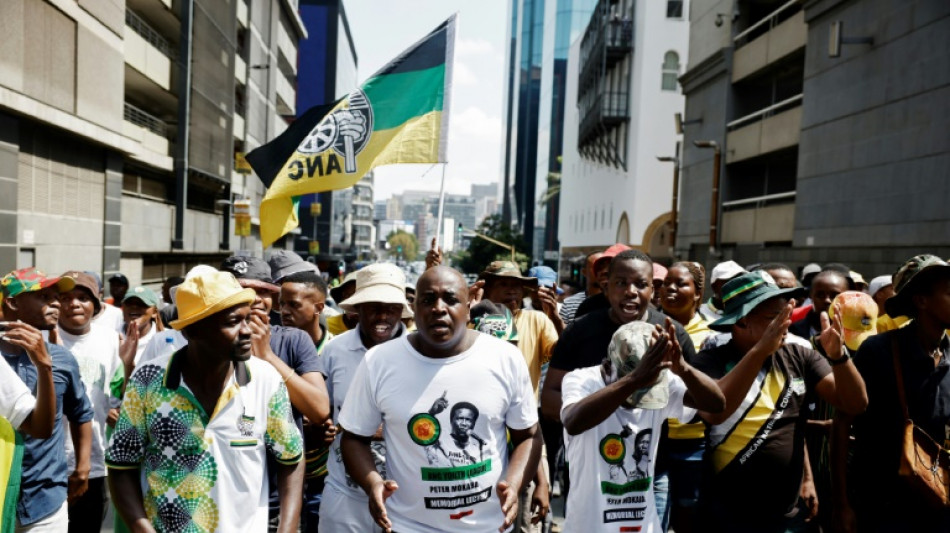
Hundreds protest S.Africa energy crisis / Photo: Marco LONGARI - AFP
 Teatro Mayor Unveils 152-Performance 2027 Season Highlighting Beethoven and García Márquez

 Rutgers Defeats NJIT 101-64 Behind Francis and Mark Scores

 THIEAUDIO Introduces Clairvoyance MKII: The Evolution of a Signature Sound
 Guardian Metal Resources PLC Announces Proposed Spin-Out of Non-Tungsten Projects

 Fulcrum Metals PLC Announces New Critical Mineral Recoveries Expand Potential

 Thukukile Zuma Resigns from ANC Johannesburg Leadership Amid Disciplinary Dispute

 CM Mohan Yadav Meets Bohra Spiritual Leader to Discuss Simhastha 2028 and Development

 Eli Crane Defeats Jonathan Nez in Tight Arizona Congressional Race

Hundreds of people took to the streets in Johannesburg on Wednesday to protest a prolonged energy crisis causing record power cuts in South Africa.
The demonstrators gathered in the centre of the financial capital of Africa's most industrialised nation to march on the headquarters of the ruling African National Congress (ANC) party.
Most were dressed in blue, the colour of the main opposition party, the Democratic Alliance (DA), which organised the rally.
Some held signs reading "enough is enough", "power to the people" and "load-shedding is killing jobs".
Scheduled blackouts, known as load-shedding, have burdened South Africa for years, with state-owned energy firm Eskom failing to keep pace with demand and maintain its ageing coal power infrastructure.
But the outages have reached new extremes over the past 12 months, with lights going off several times a day sometimes for almost 12 hours in total.
There was a strong police presence, with authorities saying they expected about 5,000 people to march in Johannesburg, which has a population of about 5.5 million.
A few hundred ANC supporters also gathered at the party's headquarters for a counter-demonstration.
Protests were also planned at other locations nationwide, including in Cape Town.
- 'Food is rotten' -
"We have to charge our phones at certain times. We have to cook at certain times. We shouldn't have to live this way in South Africa," Marino Hughes, a 22-year-old student, told AFP.
The outages have cost the country hundreds of millions of dollars in lost output, disrupting commerce and industry.
"I had to close four shops and 20 people lost their jobs, all this because I can't run my business because of load-shedding," said Lloyd Peltier, 40, a poultry entrepreneur.
An agricultural industry body said this week dairy farms were unable to keep milk refrigerated because of the blackouts.
"Food is rotten in our fridges... What is the ANC doing?" asked Mpana Hlasa, 35, who works at a school.
Many were angry at the recent approval of a steep energy tariff increase that debt-laden Eskom, which generates more than 90 percent of South Africa's energy, said would help its finances.
"I already pay over a thousand rand for electricity each month and I don't have any," said Betty Lekgadimane, 44, who is unemployed.
President Cyril Ramaphosa said this week it was "understandable" that people were "fed up" at the crisis, which was wreaking "havoc" on the country but warned it could not be fixed "overnight".
At an ANC meeting earlier this week, the president said the government was looking to import electricity from abroad and add production from renewable energy sources.
L.Davis--AMWN