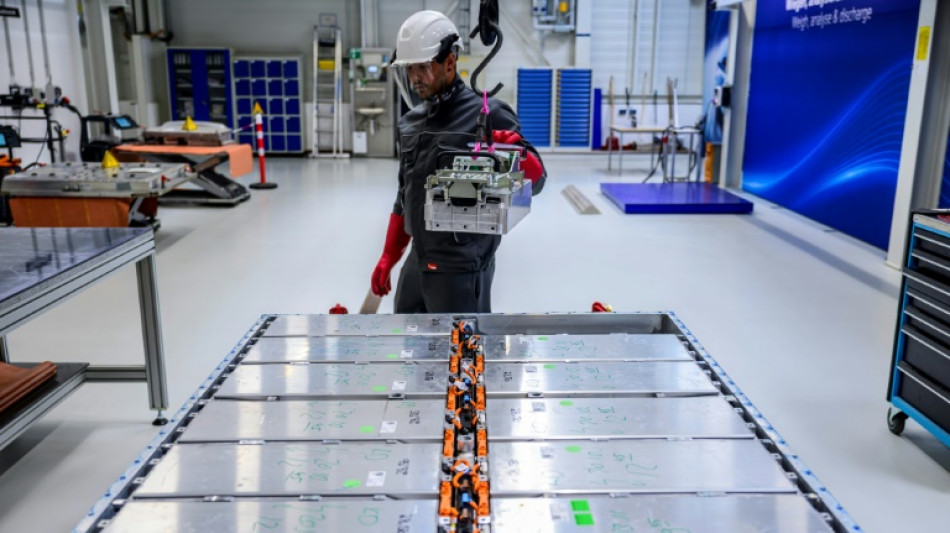
German economy to avoid recession in 2023, says Berlin / Photo: John MACDOUGALL - AFP
 Teatro Mayor Unveils 152-Performance 2027 Season Highlighting Beethoven and García Márquez

 Rutgers Defeats NJIT 101-64 Behind Francis and Mark Scores

 THIEAUDIO Introduces Clairvoyance MKII: The Evolution of a Signature Sound
 Guardian Metal Resources PLC Announces Proposed Spin-Out of Non-Tungsten Projects

 Fulcrum Metals PLC Announces New Critical Mineral Recoveries Expand Potential

 Thukukile Zuma Resigns from ANC Johannesburg Leadership Amid Disciplinary Dispute

 CM Mohan Yadav Meets Bohra Spiritual Leader to Discuss Simhastha 2028 and Development

 Eli Crane Defeats Jonathan Nez in Tight Arizona Congressional Race

Germany is set to narrowly escape a recession this year, the government said Wednesday, as Europe's biggest economy weathers the fallout from the Ukraine war better than expected.
Industrial powerhouse Germany is forecast to eke out growth of 0.2 percent in 2023, the economy ministry said in its latest projections.
Back in October, when fears were running high about soaring energy costs in the wake of Russia's war in Ukraine, Berlin was bracing for a contraction of 0.4 percent in 2023.
"The government has fended off the economic crisis," Chancellor Olaf Scholz told lawmakers in Berlin.
"We have shown what we are capable of."
Massive government intervention has helped keep the lid on energy costs for households and businesses after Russia cut deliveries of natural gas last year.
As well as criss-crossing the globe to find alternative suppliers, the German government has unveiled a 200-billion-euro ($212-billion) support package to cushion the energy crisis, including a cap on electricity and gas prices.
Mild winter weather and falling wholesale gas prices recently have further bolstered confidence that the expected downturn will not be as painful as initially thought.
"The German economy as a whole has proved resilient," the ministry said in its annual report.
"Consumers have also done their part by making major energy savings."
- Headwinds -
The German economy already defied predictions by dodging a contraction in the final quarter of 2022, official data showed last week.
Over the whole of 2022 output expanded by 1.9 percent, the data showed, better than analysts had predicted.
Lower energy prices have also helped bring down inflation from a peak of 10.4 percent in October, and the economy ministry expects the trend to continue.
For 2023, consumer price growth is now tipped to reach six percent, down from an earlier estimate of seven percent.
But Europe's top economy is not out of the woods yet, analysts said.
"Not falling off the cliff is one thing, staging a strong rebound, however, is a different matter," ING bank economist Carsten Brzeski said.
On the bright side, he said, Germany's export-oriented economy will likely benefit from China's relaxation of Covid curbs, while lower inflation could boost consumer spending at home.
But industrial production remains below pre-pandemic levels, and uncertainty lingers about energy security during the winter of 2023-2024.
Households and companies also have yet to feel the full impact of higher borrowing costs resulting from the European Central Bank's interest rate rises as it moves to cool inflation, Brzeski said.
In the years ahead, Germany will also have to find ways to confront a major shortage of skilled workers -- the country currently has two million vacancies and counting.
The ministry acknowledged in its report that many "uncertainties" hung over the German economy, including the ongoing fallout from the war in Ukraine.
F.Bennett--AMWN