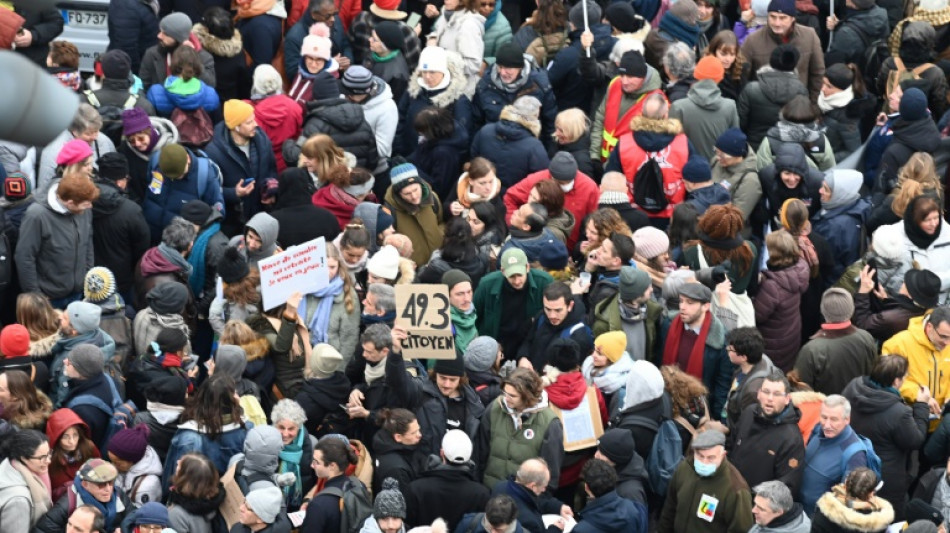
French PM says pension age hike 'non-negotiable' as strikes loom / Photo: Alain JOCARD - AFP
 Teatro Mayor Unveils 152-Performance 2027 Season Highlighting Beethoven and García Márquez

 Rutgers Defeats NJIT 101-64 Behind Francis and Mark Scores

 THIEAUDIO Introduces Clairvoyance MKII: The Evolution of a Signature Sound
 Guardian Metal Resources PLC Announces Proposed Spin-Out of Non-Tungsten Projects

 Fulcrum Metals PLC Announces New Critical Mineral Recoveries Expand Potential

 Thukukile Zuma Resigns from ANC Johannesburg Leadership Amid Disciplinary Dispute

 CM Mohan Yadav Meets Bohra Spiritual Leader to Discuss Simhastha 2028 and Development

 Eli Crane Defeats Jonathan Nez in Tight Arizona Congressional Race

France's prime minister on Sunday ruled out backtracking on a plan to raise the retirement age as unions prepared for another day of mass protests against the contested reform.
An increase in the minimum retirement age to 64 from the current 62 is part of a flagship reform package pushed by President Emmanuel Macron to ensure the future financing of France's pensions system.
After union protests against the change brought out over a million people into the streets on January 19, the government signalled there was wiggle room on some measures.
They included the number of contributing years needed to qualify for a full pension, special deals for people who started working very young, and provisions for mothers who interrupted their careers to look after their children.
But the headline age limit of 64 is not up for discussion, Prime Minister Elisabeth Borne said Sunday.
"This is now non-negotiable," she told the FranceInfo broadcaster.
While unions have welcomed the government's readiness for negotiation on parts of the plan, they say the proposed 64-year rule has to go.
Calling the reform "unfair", France's eight major unions, in a rare show of unity, said they hoped to "mobilise even more massively" on Tuesday -- their next scheduled protest day -- than at the showing earlier this month.
- 'Even more people' -
"It's looking like there will be even more people," said Celine Verzeletti, member of the hardleft union CGT's confederation leadership.
Pointing to opinion polls, Laurent Berger, head of the moderate CFDT union, said that "the people disagree strongly with the project, and that view is gaining ground".
It would be "a mistake" for the government to ignore the mobilisation, he warned.
Communist party leader Fabien Roussel called Borne's remark "a provocation", the prime minister "blinkered" and her government "inflexible".
Unions and the government both see Tuesday's protests as a major test.
Some 200 protests are being organised countrywide, with a big march planned for Paris, culminating in a demonstration outside the National Assembly where parliamentary commissions are to start examining the draft law on Monday.
The leftwing opposition has submitted more than 7,000 amendments to the draft in a bid to slow its path through parliament.
Macron's allies are short of an absolute majority in parliament and will need votes from conservatives to approve the pensions plan.
The government has the option of forcing the bill through without a vote under special constitutional powers, but at the risk of triggering a vote of no confidence, and possibly new parliamentary elections.
In addition to protest marches, unions have called for widespread strike action for Tuesday, with railway services and public transport expected to be heavily affected.
Stoppages are also expected in schools and administrations, with some local authorities having already announced closures of public spaces such as sports stadiums.
For people using public transport, Tuesday will be "difficult, or even very difficult", Transport Minister Clement Beaune said Sunday, calling on commuters to postpone trips and work from home when possible.
Some unions have called for further strike action in February, including at commercial ports, refineries and power stations.
Observers said the unions are playing for high stakes, and any slackening of support Tuesday could be fatal for their momentum.
"They have placed the bar high," said Dominique Andolfatto, a professor of political science. "They can't afford any missteps."
O.Johnson--AMWN

