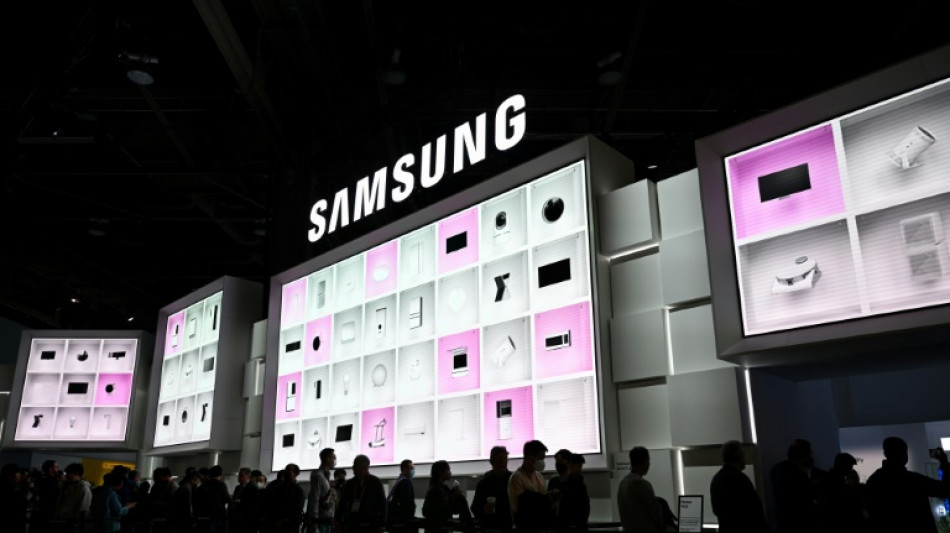
Samsung quarterly profits plunge to 8 year low on demand slump / Photo: Patrick T. Fallon - AFP
 Teatro Mayor Unveils 152-Performance 2027 Season Highlighting Beethoven and García Márquez

 Rutgers Defeats NJIT 101-64 Behind Francis and Mark Scores

 THIEAUDIO Introduces Clairvoyance MKII: The Evolution of a Signature Sound
 Guardian Metal Resources PLC Announces Proposed Spin-Out of Non-Tungsten Projects

 Fulcrum Metals PLC Announces New Critical Mineral Recoveries Expand Potential

 Thukukile Zuma Resigns from ANC Johannesburg Leadership Amid Disciplinary Dispute

 CM Mohan Yadav Meets Bohra Spiritual Leader to Discuss Simhastha 2028 and Development

 Eli Crane Defeats Jonathan Nez in Tight Arizona Congressional Race

Samsung Electronics said Tuesday that its fourth-quarter operating profits plunged nearly 70 percent, the biggest drop in more than eight years, as the global economic slowdown dealt a blow to electronics and chips sales.
The South Korean tech giant said operating profits for the October to December period slumped to 4.3 trillion won ($3.4 billion), a 69 percent drop from a year earlier.
The drop is in line with the estimate Samsung released earlier this month and marks the company's worst decline in quarterly profits since the third quarter of 2014.
"The business environment deteriorated significantly in the fourth quarter due to weak demand amid a global economic slowdown," Samsung said in a statement.
Sales fell eight percent to 70.46 trillion won from the same period the previous year.
Samsung singled out weak demand for memory chips, saying the sector had been hit hard "as prices fell and customers continued to adjust inventory amid deepening uncertainties in the external environment".
The firm is the flagship subsidiary of the giant Samsung Group, by far the biggest of the family-controlled conglomerates that dominate business in Asia's fourth-largest economy.
The fourth-quarter drop is the second consecutive margin squeeze for Samsung, which saw a 31 percent fall in operating profits in the third quarter year-on-year.
For the full year, Samsung reported 43.38 trillion won in operating profit and a record-high annual revenue of 302.23 trillion won.
- 'Heavy blow' -
Until the second quarter of 2022, Samsung, along with other tech companies, significantly benefited from strong demand for electronic devices -- as well as chips that power them -- during the pandemic.
But the global economy is now facing multiple challenges, including soaring inflation, rising interest rates and higher energy costs.
Global memory chip revenue dropped 10 percent last year, as electronic equipment manufacturers "started to deplete memory inventory they had been holding in anticipation of stronger demand," according to tech research firm Gartner.
"Consumers also began to reduce spending, with PC and smartphone demand suffering, and then enterprises starting to reduce spending in anticipation of a global recession, all of which impacted overall semiconductor growth," said Andrew Norwood, VP Analyst at Gartner.
The macroeconomic uncertainties are expected to persist in 2023, Samsung said, adding: "the Company anticipates demand to begin recovering in the second half."
"Samsung was dealt a heavy blow with deteriorating external factors, like weaker demand and rising costs," Samsung Electronics vice chairman Han Jong-hee said during CES 2023 in Las Vegas earlier this month, according to the Yonhap News Agency.
"I think this difficult business environment will continue this year as a prolonged economic slowdown and risks in supply chains increase uncertainties."
A.Mahlangu--AMWN

