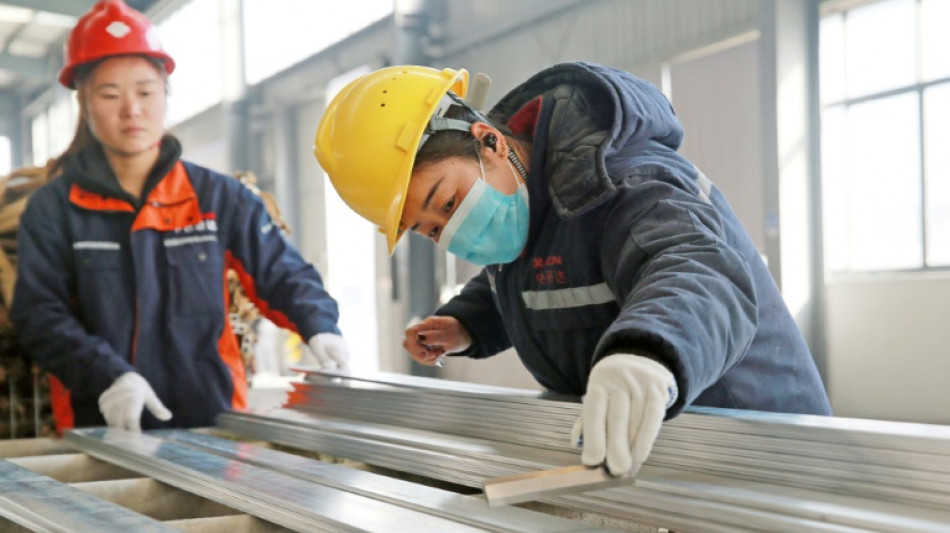
China manufacturing activity rebounds in January / Photo: STR - AFP
 Teatro Mayor Unveils 152-Performance 2027 Season Highlighting Beethoven and García Márquez

 Rutgers Defeats NJIT 101-64 Behind Francis and Mark Scores

 THIEAUDIO Introduces Clairvoyance MKII: The Evolution of a Signature Sound
 Guardian Metal Resources PLC Announces Proposed Spin-Out of Non-Tungsten Projects

 Fulcrum Metals PLC Announces New Critical Mineral Recoveries Expand Potential

 Thukukile Zuma Resigns from ANC Johannesburg Leadership Amid Disciplinary Dispute

 CM Mohan Yadav Meets Bohra Spiritual Leader to Discuss Simhastha 2028 and Development

 Eli Crane Defeats Jonathan Nez in Tight Arizona Congressional Race

China's factory activity expanded in January after four months of contraction, official data showed Tuesday, as its economy rebounded following the relaxation of strict Covid-19 curbs.
The world's second-largest economy is roaring back to life after Beijing's decision last month to abruptly drop its strict zero-Covid policy, which mandated strict lockdowns, sparking protests and hammering businesses.
The official manufacturing purchasing managers' index (PMI) -- a key gauge of Chinese factory output -- rose to 50.1 this month, from 47.0 in December, according to data from the National Bureau of Statistics (NBS).
Pandemic prevention measures have "entered a new stage" that is allowing "a gradual return" to normal life, NBS statistician Zhao Qinghe said in a statement.
The International Monetary Fund on Monday upgraded its forecast for China's 2023 gross domestic product (GDP) to 5.2 percent, citing Beijing's decision to fully reopen.
The non-manufacturing PMI, which includes the services and construction sector, stood at 54.4 in January, up from 41.6 in December.
That was well above the 52 points forecast by economists surveyed by Bloomberg.
Manufacturing activity typically slows during the Lunar New Year holiday -- which this year fell during the last week of January -- as workers go home to celebrate with their families.
But consumption of services has picked up as millions of people are now travelling freely for the first time in three years.
China's economy grew just three percent last year -- its slowest pace in four decades excluding pandemic-hit 2020 -- as Covid restrictions and a crisis in the property market hampered growth.
The IMF said Monday that pent-up demand accumulated during three years of strict pandemic controls would lead to a strong rebound in the country.
Passenger trips during the holiday travel rush reached 892 million from January 7 to 29, up 56 percent from 2022, a transport ministry official said Monday.
J.Oliveira--AMWN

