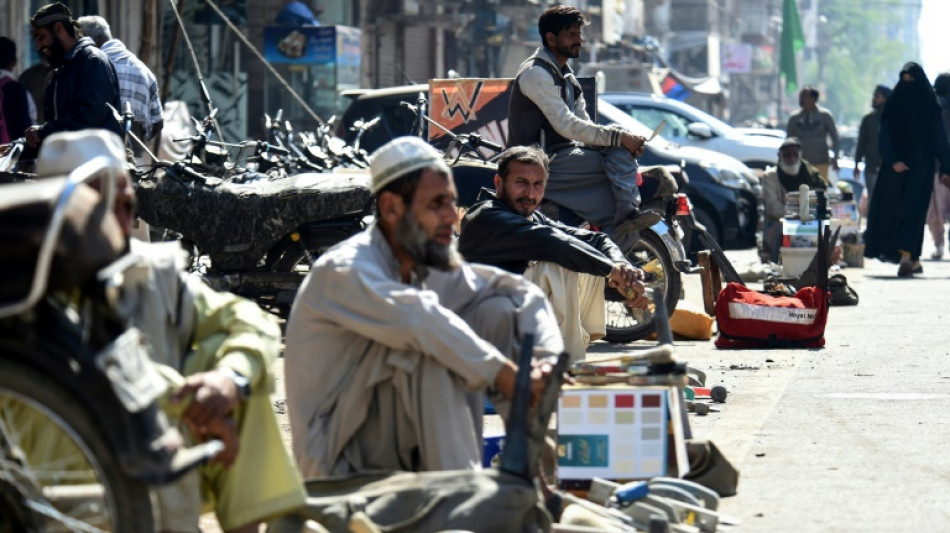
Pakistan inflation hits 48-year high as IMF visits / Photo: Asif HASSAN - AFP
 Teatro Mayor Unveils 152-Performance 2027 Season Highlighting Beethoven and García Márquez

 Rutgers Defeats NJIT 101-64 Behind Francis and Mark Scores

 THIEAUDIO Introduces Clairvoyance MKII: The Evolution of a Signature Sound
 Guardian Metal Resources PLC Announces Proposed Spin-Out of Non-Tungsten Projects

 Fulcrum Metals PLC Announces New Critical Mineral Recoveries Expand Potential

 Thukukile Zuma Resigns from ANC Johannesburg Leadership Amid Disciplinary Dispute

 CM Mohan Yadav Meets Bohra Spiritual Leader to Discuss Simhastha 2028 and Development

 Eli Crane Defeats Jonathan Nez in Tight Arizona Congressional Race

Inflation has risen to a 48-year high in crisis-hit Pakistan, according to government data released Wednesday, as IMF officials visit for urgent talks on a stalled bailout package.
Year-on-year inflation in January was recorded at 27.55 percent, its highest since May 1975.
Pakistan's economy is in dire straits, stricken by a balance of payments crisis as it attempts to service high levels of external debt, amid political chaos and a deteriorating security situation.
The world's fifth most populous country has less than $3.7 billion in its central bank -- enough to cover just three weeks of imports.
On Tuesday, a delegation from the International Monetary Fund arrived in Islamabad to revive negotiations over a stalled bailout package with the government, which had long held out from meeting the global lender's tough conditions.
Food prices rose by a staggering 43 percent in January year-on-year, which analyst Yousuf Nazar based in Britain described as a "killer".
"The overall rate actually masks or understates the misery of the people, and what is really going on behind these numbers," he told AFP.
"It also reflects badly on the management -- on the managers of the economy."
In the past week, with the prospect of national bankruptcy looming and no countries willing to offer less painful bailouts, Islamabad has started to bow to pressure to meet IMF demands.
The government loosened controls on the rupee to rein in a rampant black market in US dollars, a step that caused the currency to plunge to a record low. Artificially cheap petrol prices have also been hiked.
The state bank is no longer issuing letters of credit, except for essential food and medicines, causing a backlog of thousands of shipping containers at Karachi port stuffed with stock the country can no longer afford.
- 'One cannot earn enough' -
Industry has been hammered by the imports block and massive rupee devaluation. Public construction projects have halted, textiles factories have partially shut down and domestic investment has slowed.
The National Consumer Price Index for January rose by 2.88 percent from the previous month, the figures released by the country's statistics bureau on Wednesday showed.
In downtown Karachi on Monday, dozens of day labourers including carpenters and painters waited with their tools on display for work that never comes.
"The number of beggars has increased and the number of labourers has decreased," said 55-year-old mason Zafar Iqbal, who was eating biryani from a plastic bag donated by a passerby.
"Inflation is so high that one cannot earn enough."
Former prime minister Imran Khan, who was ousted last year in a no-confidence motion, negotiated a multi-billion-dollar loan package from the IMF in 2019.
But he reneged on promises to cut subsidies and market interventions that had cushioned the cost-of-living crisis, causing the programme to stall.
It is a common pattern in Pakistan, where most people live in rural poverty, with more than two dozen IMF deals brokered and then broken over the decades.
D.Sawyer--AMWN