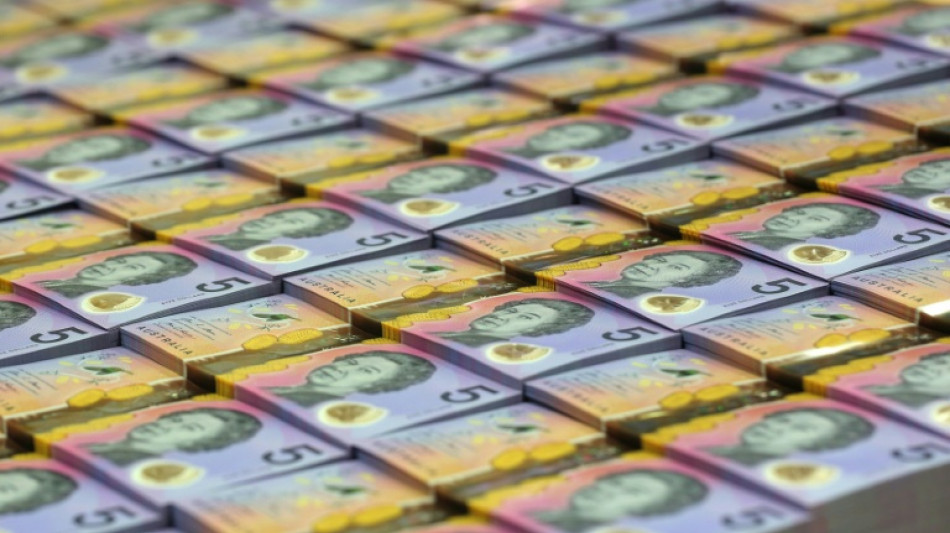
Australia to oust monarch from banknotes / Photo: STR - AFP/File
 Teatro Mayor Unveils 152-Performance 2027 Season Highlighting Beethoven and García Márquez

 Rutgers Defeats NJIT 101-64 Behind Francis and Mark Scores

 THIEAUDIO Introduces Clairvoyance MKII: The Evolution of a Signature Sound
 Guardian Metal Resources PLC Announces Proposed Spin-Out of Non-Tungsten Projects

 Fulcrum Metals PLC Announces New Critical Mineral Recoveries Expand Potential

 Thukukile Zuma Resigns from ANC Johannesburg Leadership Amid Disciplinary Dispute

 CM Mohan Yadav Meets Bohra Spiritual Leader to Discuss Simhastha 2028 and Development

 Eli Crane Defeats Jonathan Nez in Tight Arizona Congressional Race

Australia will erase the British-based monarch from its banknotes, replacing the late Queen Elizabeth II's image on its $5 note with a design honouring Indigenous culture, the central bank said Thursday.
The decision to leave her successor Charles III off the $5 note means no monarch would remain on Australia's paper currency.
The Reserve Bank of Australia said it would consult with Indigenous people on a new design that "honours the culture and history of the First Australians".
Queen Elizabeth's death on September 8 last year was marked by public mourning in Australia, but some Indigenous groups also protested the destructive impact of colonial Britain at the time, calling for the abolition of the monarchy.
Australia is a constitutional monarchy, a democracy with Charles III as its head of state. A referendum proposing a switch to a republic was narrowly defeated in 1999.
The central bank said its decision was supported by the centre-left Labor government of Prime Minister Anthony Albanese, who favours an eventual move to an Australian republic.
The new banknote would take "a number of years" to be designed and printed, it said, with the existing $5 note remaining legal tender even after the new design is in people's hands.
- 'No longer justifiable' -
The RBA's move was hailed by the nation's republican movement, which noted that Indigenous people predated British settlement by 65,000 years.
"Australia believes in meritocracy so the idea that someone should be on our currency by birthright is irreconcilable as is the notion that they should be our head of state by birthright," said Australian Republic Movement chair Craig Foster.
"To think that an unelected king should be on our currency in place of First Nations leaders and elders and eminent Australians is no longer justifiable at a time of truth telling, reconciliation and ultimately formal, cultural and intellectual independence."
Foster said such symbols were important to Australians.
"This decision by the RBA is a natural consequence of recognising the important place of First Nations Australians in our national story," he said.
"Australians deserve to see themselves, and only themselves reflected in our Constitution, our system of government and all National symbols including our currency."
A British-based monarch has featured on Australian banknotes since 1923, and was on all paper bills until 1953, the year of Elizabeth II's coronation.
The queen's face adorned the 1-pound banknote, and then the new $1 note from 1966.
That first $1 banknote also included imagery of Aboriginal rock paintings and carvings and designs based on a bark painting by Indigenous artist David Malangi Daymirringu.
The queen's features have beamed up at Australians on the polymer $5 note since 1992.
But the central bank's governor Philip Lowe announced three months ago that it had begun talking with the government about whether to forego replacing the queen's image with a portrait of King Charles III.
P.Costa--AMWN