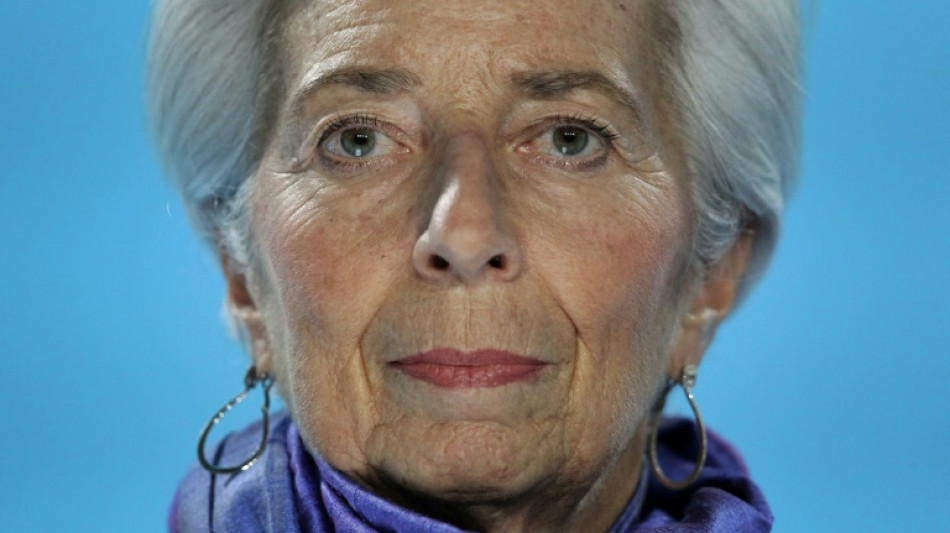
Despite improving outlook, ECB to hike rates again / Photo: Daniel ROLAND - AFP/File
 Teatro Mayor Unveils 152-Performance 2027 Season Highlighting Beethoven and García Márquez

 Rutgers Defeats NJIT 101-64 Behind Francis and Mark Scores

 THIEAUDIO Introduces Clairvoyance MKII: The Evolution of a Signature Sound
 Guardian Metal Resources PLC Announces Proposed Spin-Out of Non-Tungsten Projects

 Fulcrum Metals PLC Announces New Critical Mineral Recoveries Expand Potential

 Thukukile Zuma Resigns from ANC Johannesburg Leadership Amid Disciplinary Dispute

 CM Mohan Yadav Meets Bohra Spiritual Leader to Discuss Simhastha 2028 and Development

 Eli Crane Defeats Jonathan Nez in Tight Arizona Congressional Race

The European Central Bank is set to hike interest rates again Thursday as it pursues its inflation fight, despite tentative signs the eurozone has weathered shocks from the Ukraine war better than feared.
The ECB launched an unprecedented campaign of monetary policy tightening after Moscow's invasion of Ukraine, and subsequent cuts to gas supplies, sent eurozone energy and food costs spiralling.
Since July, it has lifted interest rates by 2.5 percentage points to tame consumer price growth -- which peaked in October at over five times the bank's two-percent target.
The bank's governing council is expected to deliver a half percentage point hike on Thursday, the same as at their last meeting in December.
But, with inflation starting to slow, this is down from two jumbo 0.75 percentage point lifts before that.
The Frankfurt-based institution's president Christine Lagarde "should reiterate that inflation... remains too high and reaffirm the absolute necessity for the ECB to continue to act over time to bring it down," said Franck Dixmier at Allianz.
The Federal Reserve also lifted rates again Wednesday, but downshifted to a smaller 0.25 percentage point increase as inflation cools in the United States.
Meanwhile, the Bank of England is also expected to increase borrowing costs again on Thursday.
In the eurozone, recent data have raised hopes the worst of the economic shock may have passed.
Eurozone inflation fell by more than expected to 8.5 percent in January, while the 20-nation currency club eked out growth at the end of 2022, defying fears of a contraction.
The less gloomy figures have given cause for hope that Russia's efforts to strangle crucial gas supplies to Europe may not trigger the economic shock once feared.
As Moscow slashed deliveries following its invasion of Ukraine, European governments rolled out relief measures to cushion consumers and businesses from surging prices, and rushed to fill up storage facilities.
- 'More positive' signs -
Wholesale gas prices have been easing while relatively mild winter weather has meant supplies have not been used up as quickly as expected.
Analysts hope that other factors, such as easing supply chain problems and the reopening of China's Covid-hit economy, are now offsetting the fallout from Ukraine.
After months of doom and gloom, officials are striking a more positive note about the outlook.
Speaking at the World Economic Forum in Davos last month, Lagarde said the eurozone economy will fare "a lot better" than initially feared, with the news "much more positive in the last few weeks".
Signs of weakness are still causing concerns, however.
GDP in Germany, Europe's top economy, unexpectedly contracted at the end of 2022, signalling it may be about to tip into recession.
But it is expected to be a shallow contraction, and the government has forecast the economy will expand slightly over 2023 as a whole.
While the ECB has stressed it will "stay the course" to bring inflation back to target, policymakers are walking a fine line -- seeking to tighten enough but not so much that it dramatically deepens economic pain across Europe.
Most analysts also expect a further 0.50 percentage point hike in March but, with inflation starting to ease, there are already signs of a debate among policymakers about when to slow the pace.
ECB board member Fabio Panetta, known for his dovish stance, said the bank should not commit to any particular hike beyond the forthcoming meeting.
Others, such as Joachim Nagel, the head of Germany's Bundesbank central bank, have backed further hikes going forward.
All eyes will be on Lagarde's comments after the rate decision is announced for hints of a future direction.
D.Kaufman--AMWN