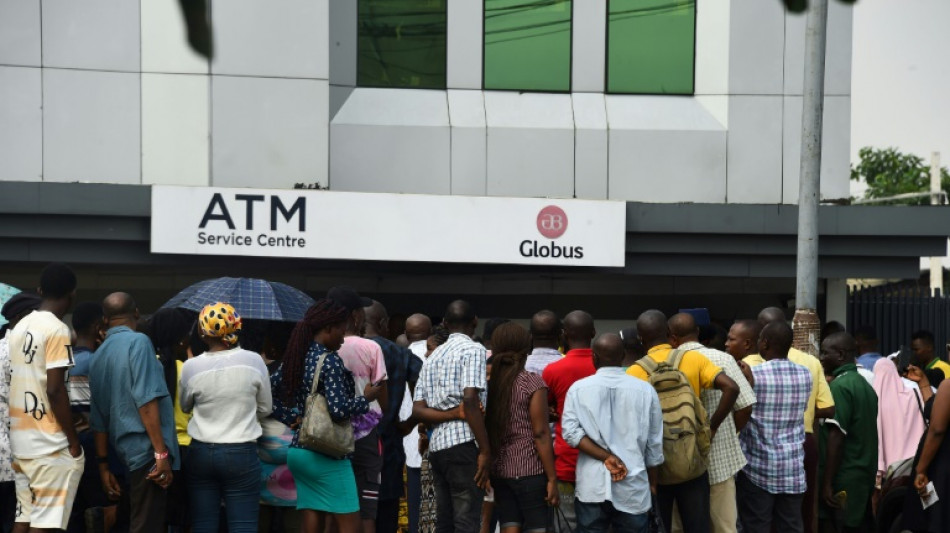
Nigeria eases currency swap to try and curb queues / Photo: PIUS UTOMI EKPEI - AFP
 Teatro Mayor Unveils 152-Performance 2027 Season Highlighting Beethoven and García Márquez

 Rutgers Defeats NJIT 101-64 Behind Francis and Mark Scores

 THIEAUDIO Introduces Clairvoyance MKII: The Evolution of a Signature Sound
 Guardian Metal Resources PLC Announces Proposed Spin-Out of Non-Tungsten Projects

 Fulcrum Metals PLC Announces New Critical Mineral Recoveries Expand Potential

 Thukukile Zuma Resigns from ANC Johannesburg Leadership Amid Disciplinary Dispute

 CM Mohan Yadav Meets Bohra Spiritual Leader to Discuss Simhastha 2028 and Development

 Eli Crane Defeats Jonathan Nez in Tight Arizona Congressional Race

Nigeria's central bank on Thursday ordered financial institutions to distribute newly designed bills over the counter in a bid to reduce massive queues at cash dispensers.
Weeks ahead of a presidential election in Africa's most populous country, frustrations are growing among Nigerians who are struggling to get hold of cash after a redesign of the local naira currency.
The central bank governor Godwin Emefiele "has directed deposit money banks to commence the payment of the redesigned Naira notes over the counter, subject to a maximum daily payout limit of N20,000 (about 43 dollars)," spokesman Osita Nwanisobi said.
Across the country including in megacity Lagos and the capital Abuja, Nigerians have been queueing for hours outside ATMs to try and get cash.
Often, the banks run out, leaving people stranded in a country where most depend on daily wages in cash.
The newly-designed notes were introduced in December as part of a measure by the Central Bank of Nigeria (CBN) to crackdown on currency counterfeiting, ransom payments to kidnappers, as well reduce the volume of money outside the banking system.
The deadline to swap old notes was initially the end of January, but faced with increased pressure the CBN postponed it to February 10.
It also said there would be a grace period of seven days after the deadline during which Nigerians could deposit old notes at the central bank.
"The CBN is working assiduously to address the challenge of queues," said Nwanisobi, urging people "to exercise patience."
One of the reasons behind the unavailability of new notes is because of "people stocking and aggregating the newly introduced banknotes," said Nwanisobi.
"Also worrisome are the reported cases of unregistered persons and non-bank officials swapping banknotes for members of the public, purportedly on behalf of the CBN," he said, a practice that is unlawful.
L.Mason--AMWN