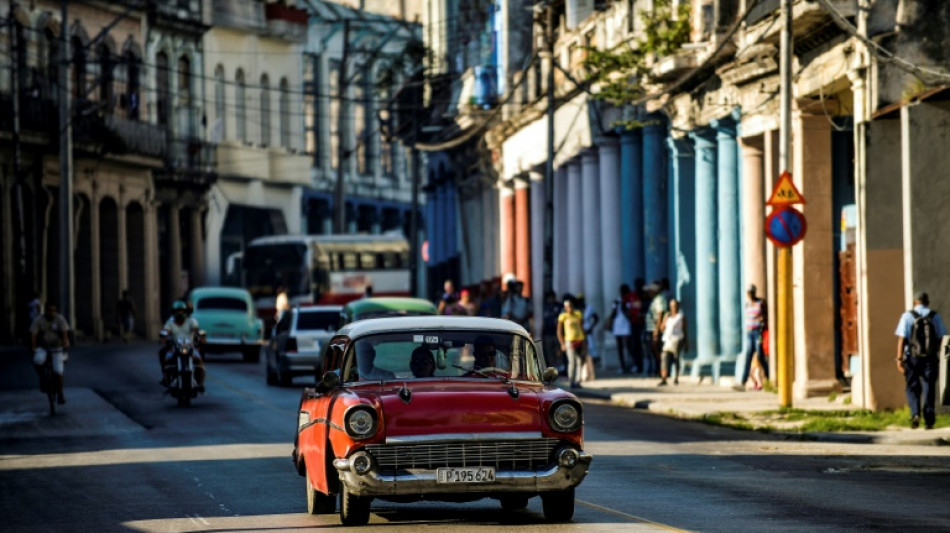
Cuba puts state-owned car owners on commuter aid duty / Photo: Yamil LAGE - AFP
 Teatro Mayor Unveils 152-Performance 2027 Season Highlighting Beethoven and García Márquez

 Rutgers Defeats NJIT 101-64 Behind Francis and Mark Scores

 THIEAUDIO Introduces Clairvoyance MKII: The Evolution of a Signature Sound
 Guardian Metal Resources PLC Announces Proposed Spin-Out of Non-Tungsten Projects

 Fulcrum Metals PLC Announces New Critical Mineral Recoveries Expand Potential

 Thukukile Zuma Resigns from ANC Johannesburg Leadership Amid Disciplinary Dispute

 CM Mohan Yadav Meets Bohra Spiritual Leader to Discuss Simhastha 2028 and Development

 Eli Crane Defeats Jonathan Nez in Tight Arizona Congressional Race

Cuba has warned drivers of state-owned cars to pick up people at bus stops or face prosecution, as Havana faces painful shortages of diesel fuel, authorities said this week.
Diesel has been in very short supply since being diverted in March to run oil-fueled power plants.
As Cubans sweat out the island's worst economic crisis in three decades, public transport has become an ordeal; nearly 50 percent of buses are out of operation "for lack of tires and batteries," a ministry official told AFP last year.
So the Americas' only one-party Communist government announced it has begun implementing the old but previously unenforced rule on picking up riders.
People in Havana routinely wait hours for a bus to get to their schools or jobs.
Betty Pairol, a Cuban military officer, recently got a big surprise while trying to get to work.
"I was at a traffic light asking for a ride and a car stopped... and made a sign for us to get in.
"To our surprise it was Foreign Minister Bruno Rodriguez Parrilla," she said in a Facebook post that included a picture of her and a friend in Rodriguez's back seat.
Most public transport vehicles in Cuba use diesel fuel, unlike most smaller vehicles.
"Amid the complex situation that our country is experiencing, the use of state transport in support of commuters is essential," Prime Minister Manuel Marrero Cruz tweeted on Thursday.
He asked the Transport Ministry to ensure full enforcement.
In case state cars don't stop as directed, "the violation will be considered a serious offense," he warned.
Marcela Martinez, a 40-year-old tourism worker, believes that this measure "should have been carried out a long time ago."
"For this to work there has to be an inspector" to enforce the rule, because otherwise state workers will not stop, she told AFP at a bus stop in central Havana.
"Public transport is pretty bad -- not bad, lousy," she said.
Official figures show the island of 11.2 million inhabitants has some 600,000 cars, many of them state-owned.
S.F.Warren--AMWN