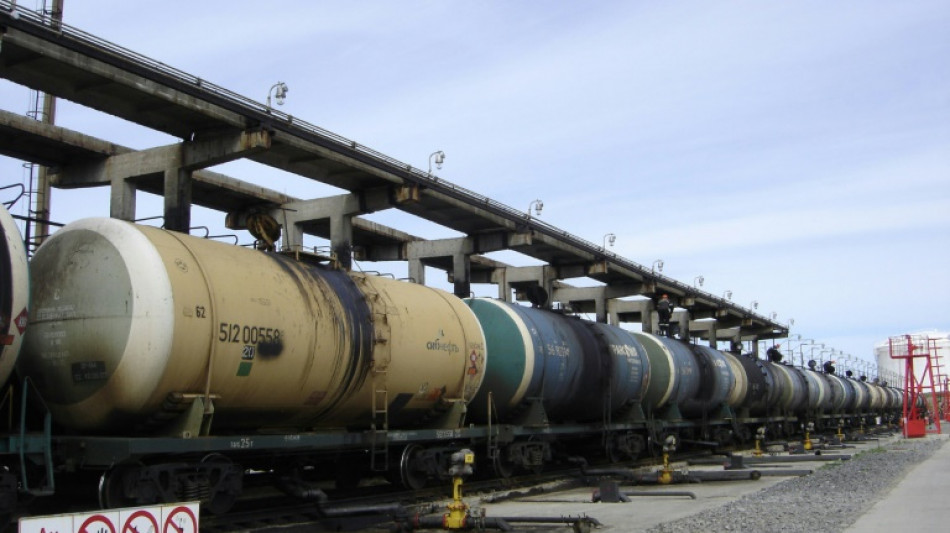
West's new oil sanctions aim to tighten screws on Russia / Photo: © AFP/File
 Teatro Mayor Unveils 152-Performance 2027 Season Highlighting Beethoven and García Márquez

 Rutgers Defeats NJIT 101-64 Behind Francis and Mark Scores

 THIEAUDIO Introduces Clairvoyance MKII: The Evolution of a Signature Sound
 Guardian Metal Resources PLC Announces Proposed Spin-Out of Non-Tungsten Projects

 Fulcrum Metals PLC Announces New Critical Mineral Recoveries Expand Potential

 Thukukile Zuma Resigns from ANC Johannesburg Leadership Amid Disciplinary Dispute

 CM Mohan Yadav Meets Bohra Spiritual Leader to Discuss Simhastha 2028 and Development

 Eli Crane Defeats Jonathan Nez in Tight Arizona Congressional Race

The West's latest wave of sanctions on Russian energy exports seeks to hit Moscow harder than its previous moves over the Ukraine war.
An EU-wide ban on Russia oil products -- like diesel, gasoline and jet fuel -- came into effect Sunday alongside a Group of Seven (G7) price cap on the same items.
That expanded on an EU embargo on seaborne oil deliveries introduced two months ago -- when it also established with G7 partners a $60-dollar-per-barrel cap for exports around the world.
There are two price cap levels, $100 per barrel for more expensive fuel like diesel and $45 on lower-quality products such as fuel oil.
Key energy producer Russia launched its invasion of Ukraine almost one year ago, on February 24, 2022, sparking international condemnation and economic retaliation.
- More profound impact -
"The caps and ban on Russian petroleum products are likely to have a more profound impact than the similar measures that targeted crude oil in December," said PVM Energy analyst Stephen Brennock.
"Unlike with its crude exports, there are no readily available markets to accommodate its surplus fuel supplies."
Prior to the conflict, the 27-nation European Union was the main buyer of Russian diesel, consuming almost 700,000 barrels per day (bpd) or half of its imports of that product.
Despite a sharp drop over the last year, more than one quarter of EU diesel imports still originated in Russia in first few weeks the year, according to S&P Global data.
That amounted to an average of 450,000 bpd.
Moscow will be forced to find new markets for its oil products to preserve revenues that help finance its ongoing war in Ukraine.
The most obvious candidates are Asian superpowers China and India.
"China and India ... have become the biggest buyers of Russian crude in recent months. Yet the same ravenous appetite for crude will not apply to its refined oil products," Brennock said.
"Both countries are net exporters of products and have plenty of excess refining capacity -- so there is scant need for them to be importing more."
Moscow's only other option might be to refine less fuel -- but this would likely lead to a drop in oil production.
- G7 pressure -
The G7 industrialised countries and Australia reached agreement Friday on price caps for Russian petroleum products.
The policy aimed "to prevent Russia from profiting from its war of aggression against Ukraine" and support stability in energy markets, the G7 said a statement.
Commerzbank analyst Carsten Fritsch added that Russian diesel was already selling below the price cap, with Baltic Sea shipments costing only $90 per barrel last week.
Moscow last week banned the sale of Russian crude to nations using the G7 cap and warned that the measures would destabilise world markets.
But oil prices were broadly unmoved on Monday.
European Commission president Ursula von der Leyen estimates that the oil price cap costs Moscow 160 million euros ($170 million) per day.
However, since the start of the war, Russia has earned 194 billion euros from exports of oil and petroleum products, according to the Centre for Research on Energy and Clean Air (CREA) think-tank.
That includes almost 85 billion euros from EU nations, according to the CREA.
Y.Aukaiv--AMWN