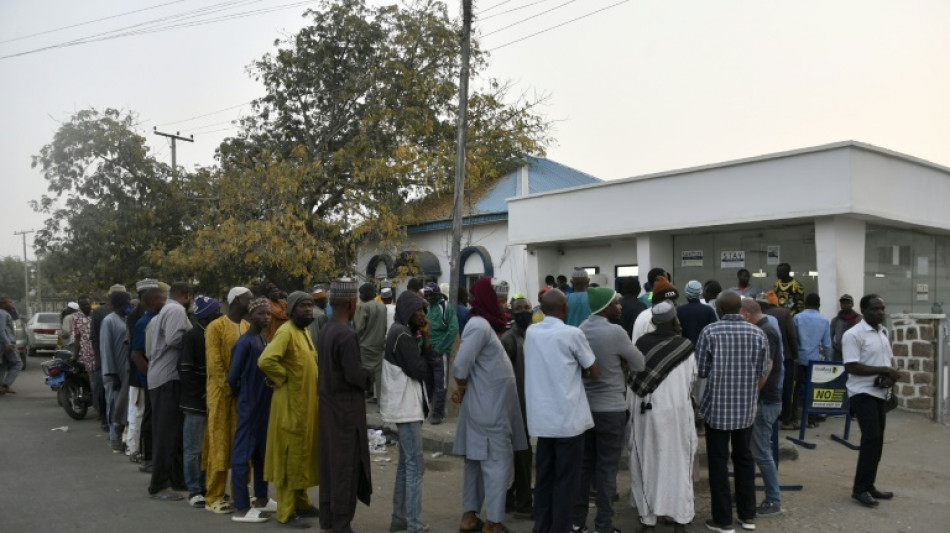
Uncertainty in Nigeria as cash, fuel shortages bite ahead of vote / Photo: PIUS UTOMI EKPEI - AFP
 Search Underway for 'Dooars Rani' Tigress After Second Escape from Buxa Tiger Reserve

 The Dilemma of Recording Live Music: Preserving Memories vs. Being Present

 InterContinental Hotels Group PLC Announces Transaction in Own Shares - November 11

 Fulcrum Metals PLC Announces New Critical Mineral Recoveries Expand Potential
 Fulcrum Metals PLC Announces Publication of Updated Investor Presentation

 Christmas Day Shifts More than Double as Americans Return to In-Person Holiday Celebrations

 Thukukile Zuma Resigns from ANC Johannesburg Leadership Amid Disciplinary Dispute

 CM Mohan Yadav Meets Bohra Spiritual Leader to Discuss Simhastha 2028 and Development

 Eli Crane Defeats Jonathan Nez in Tight Arizona Congressional Race

With under three weeks to go until Nigeria's presidential elections, major shortages of cash and fuel have plunged Africa's most populous country into crisis.
As well as provoking outrage among ordinary people, the shortages threaten to upend the February 25 presidential poll while throwing its organisation into doubt.
In response to the situation, President Muhammadu Buhari is holding a state council meeting with governors, former heads of state and the chairman of the National Electoral Commission (INEC), Mahmood Yakubu.
- Why is there a shortage of banknotes? -
It began when authorities replaced the old naira notes with new ones, of different colours, a move aimed at reducing the volume of money outside the banking system.
But it also sought to reduce vote-buying, a common practice in Nigeria, says Idayat Hassan, director of the Center for Democracy and Development.
"This measure was not carefully planned and led to a cash drop. People are returning their old notes to banks" for which there are not enough new notes to replace them, she said.
"The supply cannot meet the demand."
In a society where the informal economy is vital, and heavily based on cash, the shortage has led to riots, notably in the northern city of Kano.
Many blame the authorities.
"I doubt the Central Bank of Nigeria printed enough notes," said Tunde Ajileye, an analyst with the Nigerian consultancy SBM Intelligence.
Panic has added further pressure on the system.
"People, out of fear, withdrew a lot more than ordinarily, putting pressure on the system," Ajileye said.
Some, in possession of new notes, are already fuelling a thriving black market, worsening the shortage.
With the polls fast approaching, supporters of ruling party candidate Bola Ahmed Tinubu are crying foul, even accusing the presidency of trying to prevent the election of their candidate, dubbed "Godfather".
- Why is there a shortage of petrol? -
Petrol shortages are common in Nigeria, Africa's largest crude oil producer, but does not refine it and has to import for domestic needs.
"The country just doesn't have the money to pay" for petrol, explained Tunde Ajileye.
Supplies are hamstrung by fuel subsidies, a highly sensitive subject.
The Nigerian government pays part of the cost of petrol at filling stations, allowing people to buy at artificially low prices.
The system costs billions of dollars of public funds every year.
With prices soaring as a result of the Russian war in Ukraine, the government has been overwhelmed by the cost of its subsidy system and can no longer pay traders.
"Marketeers feel penalised, the government is forcing them to sell at normal market price," Ajileye said.
For political reasons, the government does not want to increase the fuel price two weeks before the elections", he said.
The two sides are at odds: on the one hand, traders do not want to sell at a loss.
On the other hand, the presidency accuses them of stockpiling oil and fuelling the black market.
- What does this mean for the presidential election? -
Voters could punish the ruling party at polls.
Nigerians are struggling to "disassociate" the ruling APC from double-digit inflation and the failure to end violence by jihadist, separatist and criminal groups, Ajileye said.
And "unless something practical is done before the election, there will have serious implications on the logistics of this election", added Hassan.
If the shortages continue, participation in the polls will be affected, she said.
"It will reduce the turnout since people have to come back to their local communities to vote.
More than 93 million people will be eligible to vote, a major logistical challenge for the electoral commission.
Will the commission have access to cash to pay its agents and transport electoral material throughout the territory? Can the observers be deployed?
INEC insisted Wednesday that the presidential election would go ahead on February 25, saying it had received guarantees from the central bank.
Ch.Havering--AMWN