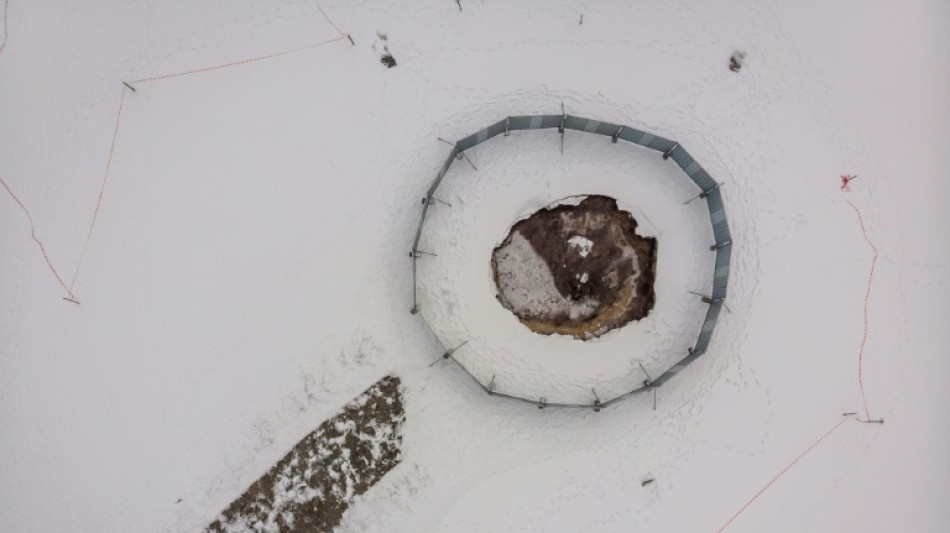
Sinkholes sow fear in former Polish mining town / Photo: Wojtek RADWANSKI - AFP
 Search Underway for 'Dooars Rani' Tigress After Second Escape from Buxa Tiger Reserve

 The Dilemma of Recording Live Music: Preserving Memories vs. Being Present

 InterContinental Hotels Group PLC Announces Transaction in Own Shares - November 11

 Fulcrum Metals PLC Announces New Critical Mineral Recoveries Expand Potential
 Fulcrum Metals PLC Announces Publication of Updated Investor Presentation

 Christmas Day Shifts More than Double as Americans Return to In-Person Holiday Celebrations

 Thukukile Zuma Resigns from ANC Johannesburg Leadership Amid Disciplinary Dispute

 CM Mohan Yadav Meets Bohra Spiritual Leader to Discuss Simhastha 2028 and Development

 Eli Crane Defeats Jonathan Nez in Tight Arizona Congressional Race

Two decades after the local coal mine closed, residents in a southern Polish town live in fear that the ground will collapse under their feet after 20 sinkholes appeared in the past two years.
Five craters have emerged this year alone in pockmarked Trzebinia. Five months ago, a huge hole swallowed up tombs at the cemetery.
"No one knows where the next one will strike. We're sitting on a ticking time bomb. People are scared," said Mateusz Krol, a local community leader from the Siersza neighbourhood that has been hit hardest.
"People are worried that a sinkhole will appear not just next to their house, but right beneath it. They avoid certain streets, worried they might fall in," the IT specialist told AFP.
Security barriers have been installed around a 10-metre (33-foot) wide, five-metre deep hole that appeared this month in the town's snow-covered football pitch.
Local community gardens have been declared off limits over concerns about the stability of the ground.
"No one has died or been injured to date. Homes have not been damaged," said local firefighter Piotr Bebenek, but warned that cave-ins have gotten "markedly worse" since last year.
- Flooded tunnels -
The local mine, which closed in 2001, was turned into a museum.
Its rusty headframe remains -- along with a network of underground wells and tunnels at the root of the sinkholes.
Groundwater has flooded the tunnels, eating away at their walls as it keeps rising and causing the ground to cave in.
"The biggest mistake was to close down the mine after it had been operating just fine for 138 years," said Jozef Dziedzic, a retired miner.
Poland has long been dependent on coal for its energy consumption.
While efforts have been made to diversify with around 50 mines closed since 1990, the country remains heavily reliant on the so-called "black gold".
Poland has been importing coal from around the world since Europe imposed an embargo on supplies from Russia following Moscow's invasion of Ukraine.
- 'People were traumatised' -
Experts have urged residents to evacuate Trzebinia, but authorities have appealed for calm.
"There is of course a risk, and we are all aware of it, but for now, there is no reason to leave," said Mariusz Tomalik, spokesman for the SRK, the state institution that manages shuttered mines.
The sinkhole at the cemetery left a 20-metre-wide, 10-metre-deep crater that swallowed up dozens of stone graves and their 60-some remains.
"People were traumatised," Dziedzic said.
After experts ruled out the possibility of exhuming the remains, the hole was simply filled in.
Two new holes appeared in December just a couple of metres from someone's home.
Workers have since been drilling to check whether there are other pockets of air and water that could threaten the structure of the house.
Whenever one is found, a mix of sand and cement is injected inside to stabilise the ground.
The SRK is due to release a report soon on the sinkhole, which has affected nearly 300 hectares of land.
Despite the risk, residents are staying put.
"We've spent our whole lives here, we have our homes and our families. It's not easy to leave, to start over," Dziedzic said.
"You don't just transplant old trees."
A.Malone--AMWN