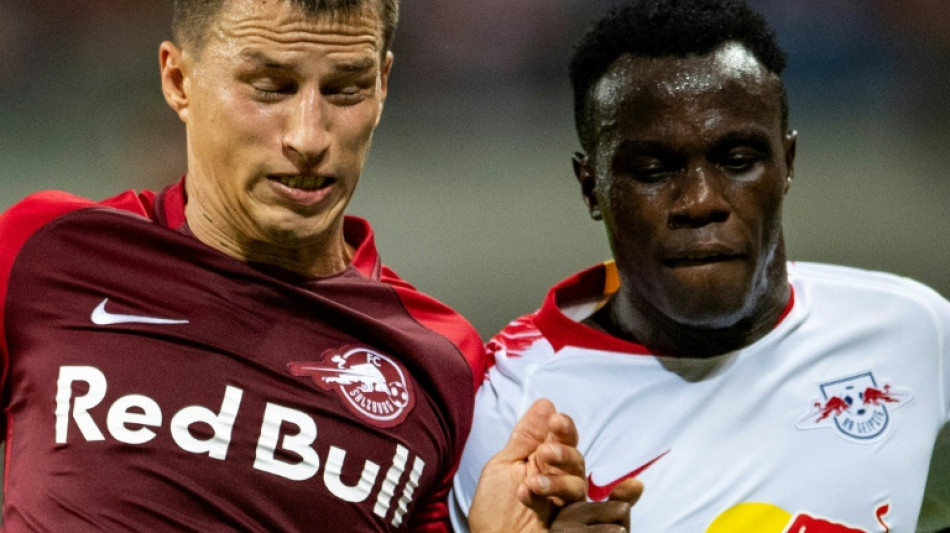
One investor, two clubs: is Europe big enough for both? / Photo: ROBERT MICHAEL - AFP
 Search Underway for 'Dooars Rani' Tigress After Second Escape from Buxa Tiger Reserve

 The Dilemma of Recording Live Music: Preserving Memories vs. Being Present

 InterContinental Hotels Group PLC Announces Transaction in Own Shares - November 11

 Fulcrum Metals PLC Announces New Critical Mineral Recoveries Expand Potential
 Fulcrum Metals PLC Announces Publication of Updated Investor Presentation

 Christmas Day Shifts More than Double as Americans Return to In-Person Holiday Celebrations

 Thukukile Zuma Resigns from ANC Johannesburg Leadership Amid Disciplinary Dispute

 CM Mohan Yadav Meets Bohra Spiritual Leader to Discuss Simhastha 2028 and Development

 Eli Crane Defeats Jonathan Nez in Tight Arizona Congressional Race

With Qatari suitors reportedly seeking to add Manchester United to a portfolio that includes Paris Saint-Germain, precedent suggests both clubs would be allowed to pursue the Champions League grail at the same time.
The experience of Austrian outfit Salzburg and German side Leipzig, two clubs linked with energy-drink company Red Bull, suggests they could.
On the face of it, UEFA's rule on "Integrity of competition/multi-club ownership" creates a serious obstacle.
"No individual or legal entity may have control or influence over more than one club participating in a UEFA club competition," says Article 5 of the regulations.
But the question of what counts as control has proved slippery for UEFA.
In the case of United, the reported bidder is by Qatar's emir, Sheikh Tamim bin Hamad Al-Thani. PSG are owned by Qatar Sports Investments (QSI), a subsidiary of the state's sovereign wealth fund.
A source with knowledge of the bid insisted to AFP that the bidders are not connected to the owners of PSG.
"The most important thing is that the potential bidder is neither QSI nor QIA (the Qatar Investment Authority sovereign wealth fund), it is a completely different fund," the source said.
In the regulations, UEFA lays out different ways control over a club might be exerted, concluding with the catch-all: "being able to exercise by any means a decisive influence in the decision-making of the club."
In 2017, RB Leipzig from the German Bundesliga and Red Bull Salzburg of the Austrian Bundesliga, both owned by the energy-drink company, were both allowed to enter the Champions League.
UEFA's Club Financial Control Commission had investigated the Red Bull connection and recommended that only Salzburg, as Austrian champions, should be allowed into the Champions League.
Salzburg rapidly restructured, removing board members "allegedly linked" to the drinks company, ending a loan arrangement and relegating Red Bull from owner to sponsor.
That satisfied UEFA.
Salzburg were eliminated in the last qualifying round as Leipzig finished third in their group. Both clubs ended up in the Europa League. They were drawn to meet in the semi-finals but while Salzburg beat Lazio in the last eight, Leipzig fell to Marseille.
The following season they did clash. Both qualified for the Europa League and were drawn the same group. Salzburg won 3-2 in Leipzig and 1-0 at home as they won all six games and topped the group.
Leipzig finished third, two points behind Celtic, and were eliminated.
M.Fischer--AMWN