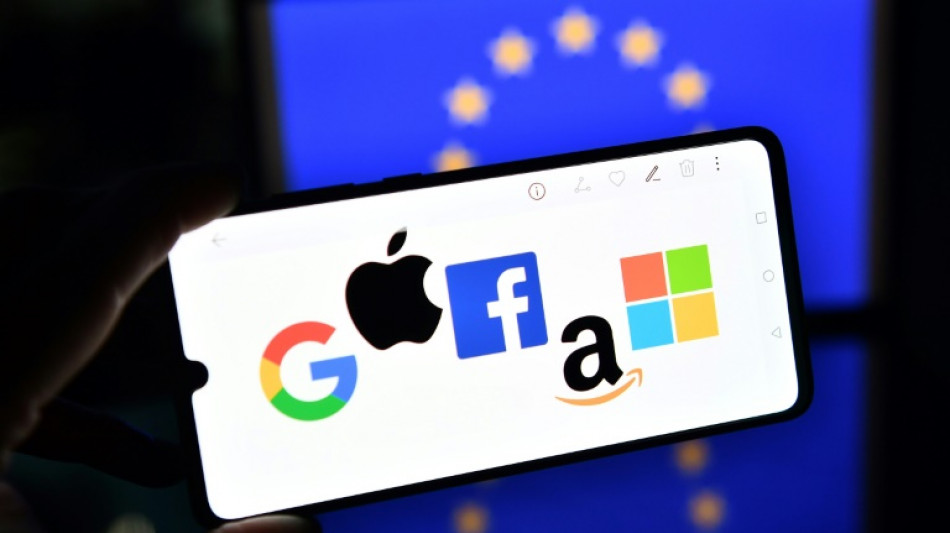
TikTok, Twitter user numbers bring them under strict EU rules / Photo: JUSTIN TALLIS - AFP/File
 Search Underway for 'Dooars Rani' Tigress After Second Escape from Buxa Tiger Reserve

 The Dilemma of Recording Live Music: Preserving Memories vs. Being Present

 InterContinental Hotels Group PLC Announces Transaction in Own Shares - November 11

 Fulcrum Metals PLC Announces New Critical Mineral Recoveries Expand Potential
 Fulcrum Metals PLC Announces Publication of Updated Investor Presentation

 Christmas Day Shifts More than Double as Americans Return to In-Person Holiday Celebrations

 Thukukile Zuma Resigns from ANC Johannesburg Leadership Amid Disciplinary Dispute

 CM Mohan Yadav Meets Bohra Spiritual Leader to Discuss Simhastha 2028 and Development

 Eli Crane Defeats Jonathan Nez in Tight Arizona Congressional Race

TikTok, Twitter, Apple Store, Amazon and several other online platforms have announced user figures in Europe that bring them under stricter EU regulations for policing internet content.
The companies published their numbers ahead of a deadline Friday made compulsory under the new EU Digital Services Act (DSA) that puts internet behemoths operating in Europe under monitoring by the European Commission.
Those platforms -- also joined by Alphabet's Google Search and Google Maps units and its YouTube subsidiary, and Meta's Facebook and Instagram units -- all said they had more than 45 million monthly active "recipients" of their services.
That is the threshold above which they are categorised as a "Very Large Online Platform" (VLOP) or a "Very Large Online Search Engine" (VLOSE) under the DSA.
Many, but not all, of those falling into the VLOP/VLOSE listings are US internet giants.
One major non-American one was Chinese-owned TikTok, which on Friday said it had 125 million active monthly users in the EU.
Several platforms had chafed at the introduction of the new EU rules -- and some said only that they did or did not qualify as a very big platform under the DSA.
For instance, Amazon and Apple Store's iOS App Store said only that the number of people using their services monthly exceeded 45 million, without saying how many.
Swedish music-streaming site Spotify, British-based site OnlyFans, which streams content from sex workers and other content creators, and US dating app Tinder all said only that their active monthly users came in below the 45-million mark.
"We note with some concern that some platforms only published an estimation that they are below the threshold. This is not sufficient," warned a commission spokesman, Johannes Bahrke.
"The rules are clear. A number is a number. We call on those platforms that haven't done so yet to publish the numbers without delay," he said.
- Potentially huge fines -
The DSA came into force in November last year, introducing tougher rules for internet companies to better protect European consumers.
It aims to crack down on illegal online content, counter the online sale of unsafe goods, better protect minors, boost transparency around internet services and data use, and give users more choice and information when they use the internet in the European Union.
Friday's deadline for platforms to report "average monthly active recipients" determines which big platforms get enhanced EU scrutiny.
They are the ones that each month have more than 45 million active users in the EU -- or a reach of around 10 percent of the bloc's population.
The figure goes beyond just registered users to encompass those exposed to information or services online, or those who request online information without necessarily having an account with the platform.
The biggest platforms need to issue annual audits and say what measures they are implementing to stop illegal content.
The commission can also order them to divulge and explain their algorithms and databases -- something that they like to jealously guard.
Smaller platforms have lighter-touch obligations under the DSA.
Potential EU fines for VLOPs and VLOSEs found in breach can go up to six percent of their global annual revenues -- a huge incentive for them to comply.
The commission said on Friday it has launched a one-month public consultation period for how it goes about its DSA enforcement.
F.Bennett--AMWN