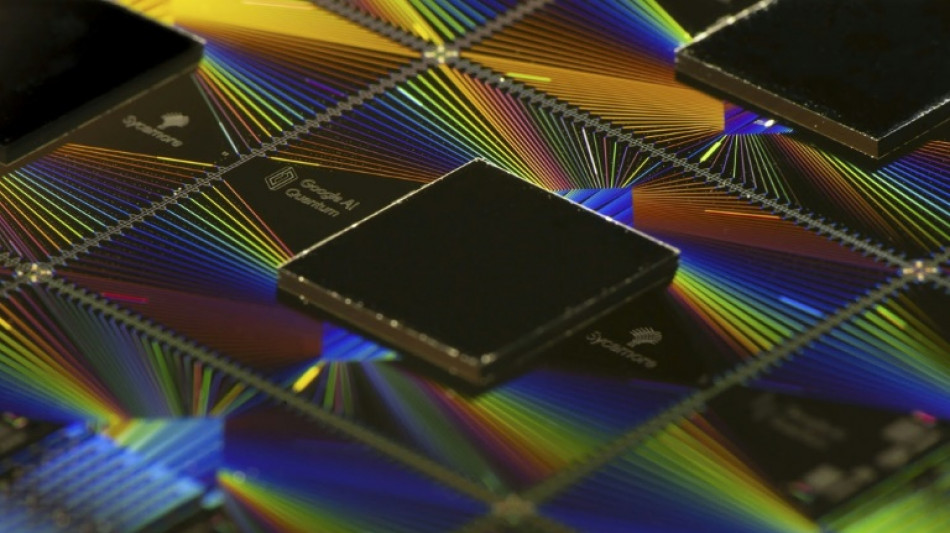
Google hails 'key milestone' in quantum computing / Photo: HO - GOOGLE/AFP/File
 Search Underway for 'Dooars Rani' Tigress After Second Escape from Buxa Tiger Reserve

 The Dilemma of Recording Live Music: Preserving Memories vs. Being Present

 InterContinental Hotels Group PLC Announces Transaction in Own Shares - November 11

 Fulcrum Metals PLC Announces New Critical Mineral Recoveries Expand Potential
 Fulcrum Metals PLC Announces Publication of Updated Investor Presentation

 Christmas Day Shifts More than Double as Americans Return to In-Person Holiday Celebrations

 Thukukile Zuma Resigns from ANC Johannesburg Leadership Amid Disciplinary Dispute

 CM Mohan Yadav Meets Bohra Spiritual Leader to Discuss Simhastha 2028 and Development

 Eli Crane Defeats Jonathan Nez in Tight Arizona Congressional Race

Google scientists said Wednesday they have passed a major milestone in their quest to develop effective quantum computing, with a new study showing they reduced the rate of errors -- long an obstacle for the much-hyped technology.
Quantum computing has been touted as a revolutionary advance that uses our growing scientific understanding of the subatomic world to create a machine with powers far beyond those of today's conventional computers.
However the technology remains largely theoretical, with many thorny problems still standing in the way -- including stubbornly high error rates.
In new research published in the journal Nature, the Google Quantum AI lab described a system that can significantly decrease the error rate.
That could give the US tech giant a step up on its rivals such as IBM, which is also working on superconducting quantum processors.
While traditional computers process information in bits that can be represented by 0 or 1, quantum computers use qubits, which can be a combination of both at the same time.
This property, known as superposition, means that a quantum computer can crunch an enormous number of potential outcomes simultaneously.
The computers harness some of the most mind-boggling aspects of quantum mechanics, including a phenomenon known as "entanglement" -- in which two members of a pair of bits can exist in a single state, even if far apart.
- 'Magic' -
But a problem called decoherence can cause the qubits to lose their information when they leave their quantum state and come into contact with the outside world.
This fragility causes high error rates, which also increase with the number of qubits, frustrating scientists wanting to ramp up their experiments.
However Google's team said it had demonstrated for the first time in practice that a system using error-correcting code can detect and fix errors without affecting the information.
The system was first theorised in the 1990s, however previous attempts had just thrown up more errors, not less, said Google's Hartmut Neven, a co-author of the study.
"But if all components of your system have sufficiently low error rates, then the magic of quantum error correction kicks in," Neven told a press conference.
Julian Kelly, another study co-author, hailed the development as "a key scientific milestone", saying that "quantum error correction is the single most important technology for the future of quantum computing".
Neven said the result was still "not good enough, we need to get to an absolute low error rate".
He added that "there are more steps to come" to achieve the dream of a useable quantum computer.
Google claimed in 2019 it had passed a milestone known as "quantum supremacy", when the tech giant said its Sycamore machine executed a calculation in 200 seconds that would have taken a conventional supercomputer 10,000 years to complete.
However the achievement has since been disputed, with Chinese researchers saying last year that a supercomputer could have beaten Sycamore's time.
M.Thompson--AMWN