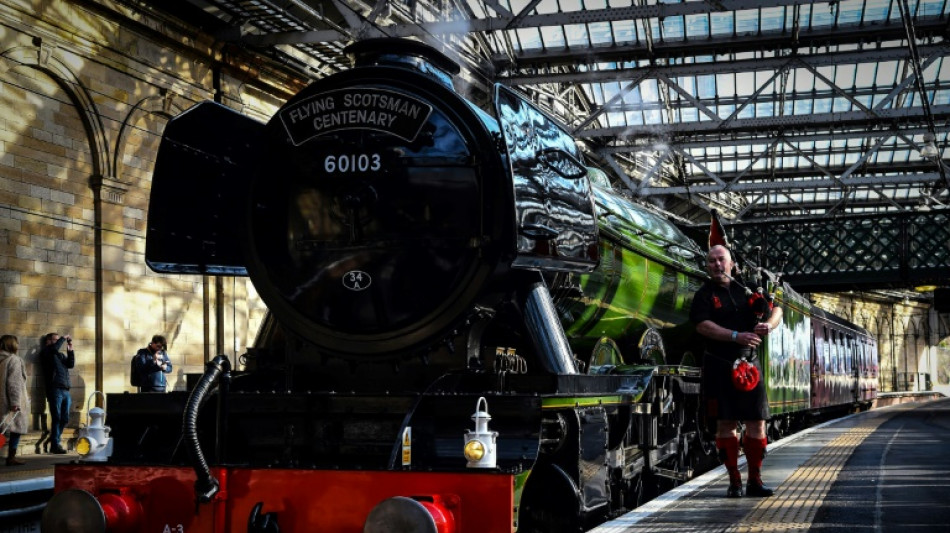
Flying Scotsman whistles into Edinburgh for 100th birthday / Photo: Andy Buchanan - AFP
 Search Underway for 'Dooars Rani' Tigress After Second Escape from Buxa Tiger Reserve

 The Dilemma of Recording Live Music: Preserving Memories vs. Being Present

 InterContinental Hotels Group PLC Announces Transaction in Own Shares - November 11

 Fulcrum Metals PLC Announces New Critical Mineral Recoveries Expand Potential
 Fulcrum Metals PLC Announces Publication of Updated Investor Presentation

 Christmas Day Shifts More than Double as Americans Return to In-Person Holiday Celebrations

 Thukukile Zuma Resigns from ANC Johannesburg Leadership Amid Disciplinary Dispute

 CM Mohan Yadav Meets Bohra Spiritual Leader to Discuss Simhastha 2028 and Development

 Eli Crane Defeats Jonathan Nez in Tight Arizona Congressional Race

The Flying Scotsman, the first steam train to reach over 100 miles an hour, turned 100 on Friday, whistling its way into Edinburgh's Waverley station to mark the day.
Judith McNicol, director of the National Railway Museum, said the train is an icon and is recognised worldwide.
"It's been to America. It's been to Australia. It's well travelled, so it's well recognised as well," she told AFP.
The 97-tonne train was designed by Edinburgh-born Sir Nigel Gresley and was built in Doncaster at a cost 7,944 pounds at the time.
It left Doncaster Works on February 24, 1923 and was named Flying Scotsman a year later at the British Empire Exhibition in Wembley after taking the 10:00 am route from London King's Cross to Edinburgh Waverley.
It was the first train to complete the journey non-stop and in 1934 became the first steam train to travel at over 100 miles per hour.
The Flying Scotsman also holds the world record for the longest non-stop run for a steam locomotive, set in 1989 with a 422-mile (679-kilometre) trip.
- 'Mechanics and magic' -
One of the reasons the train could make the non-stop trip was an access corridor that allowed drivers to switch places easily when they needed a rest, McNicol said.
It retired from regular service in 1963 after covering over two million miles.
Poet Laureate Simon Armitage, who read out a poem at the celebration for the train's 100th anniversary, said the Flying Scotsman represents the "coming together of mechanics and magic".
"There's something very dreamlike about the whole thing," he told AFP.
"It's a big, filthy, noisy, messy beast as well as being very beautiful and very powerful".
The train, owned by the National Railway Museum in York, will spend the rest of the year travelling across the Britain to give people the chance to see the engine in action.
O.Johnson--AMWN