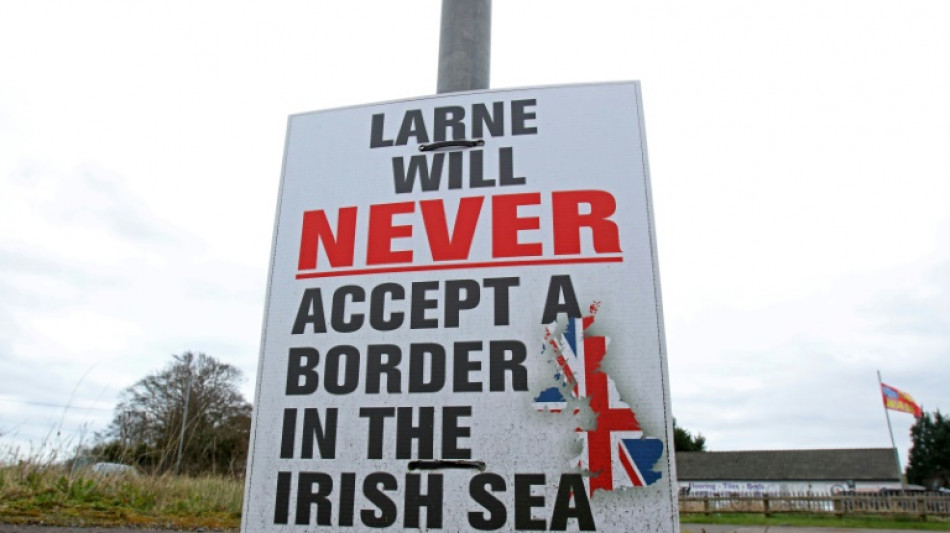
UK-EU Brexit fix: What's at stake? / Photo: Paul Faith - AFP
 Search Underway for 'Dooars Rani' Tigress After Second Escape from Buxa Tiger Reserve

 The Dilemma of Recording Live Music: Preserving Memories vs. Being Present

 InterContinental Hotels Group PLC Announces Transaction in Own Shares - November 11

 Fulcrum Metals PLC Announces New Critical Mineral Recoveries Expand Potential
 Fulcrum Metals PLC Announces Publication of Updated Investor Presentation

 Christmas Day Shifts More than Double as Americans Return to In-Person Holiday Celebrations

 Thukukile Zuma Resigns from ANC Johannesburg Leadership Amid Disciplinary Dispute

 CM Mohan Yadav Meets Bohra Spiritual Leader to Discuss Simhastha 2028 and Development

 Eli Crane Defeats Jonathan Nez in Tight Arizona Congressional Race

An agreement between Britain and the European Union over post-Brexit trade rules in Northern Ireland appears imminent.
Here are three areas at stake in the compromise:
- Northern Ireland -
Fixing the so-called Northern Ireland protocol is seen as crucial by political leaders in Belfast and London, as well as Brussels and even Washington.
Brexit has stoked tensions within the UK province, which shares the only land border with the EU and has a troubled history.
The protocol aimed to prevent any customs procedures occurring on that border with Ireland, a flashpoint during three decades of conflict in Northern Ireland over British rule.
It keeps the province in the EU's single market and customs union, requiring oversight from European courts and mandating checks on goods arriving from mainland Britain.
But pro-British unionists argue that weakens Northern Ireland's place within the UK, and as part of their vehement opposition to it, have collapsed devolved power-sharing.
The Democratic Unionist Party (DUP) has vowed not to return until the protocol is scrapped or radically overhauled, leaving Northern Ireland without a devolved government for the past year.
The political instability follows more than a week of rioting over the pact in 2021, largely in unionist areas, which injured 88 police officers.
There have also been several violent incidents in recent months blamed on dissident republicans seeking reunification with Ireland.
In the latest last week, a senior off-duty officer was gunned down in what police said was a "terrorist-related" attack by splinter group, the New IRA.
The situation is unnerving locals and those further afield, with the United States -- which played a key role in securing a 1998 peace deal -- in particular urging a compromise over post-Brexit trade.
However, it is unclear if the DUP will accept the expected deal and agree to resume power-sharing.
Pro-Irish Sinn Fein, which became the biggest party in the assembly after winning elections last May, cannot form an executive without DUP participation.
- EU-UK relations -
Arguments over the protocol have dogged relations between Britain and the EU since Brexit and are seen as hindering broader cooperation between the two sides.
The UK government has introduced legislation which, if passed, would allow it to unilaterally override parts of the pact.
That has angered the EU and is seen as risking a wider trade war, which could prove damaging on either side of the Channel but particularly in recession-threatened Britain.
Progress on issues such as London accessing billions of pounds of funding from the bloc's Horizon Europe research programme has remained stalled while the protocol talks were ongoing.
The UK hopes a deal could now unlock that much-needed money.
With the war in Ukraine renewing focus on defence and security cooperation within Europe, both sides are seen as keen to put the recent Brexit acrimony aside and collaborate more closely in these areas.
The rising threat posed by China and shared challenges of climate change are also seen as ripe for closer ties if the protocol squabble can be resolved.
- UK politics, economy -
Britain has been wracked by political and economic instability since the 2016 EU referendum, with the country sharply divided for several years between "Leave" and "Remain" camps.
Former prime minister Boris Johnson used fatigue at domestic political gridlock over Brexit to help win an 80-seat majority in December 2019, vowing to "get Brexit done".
But rather than conclude matters around the UK's divorce, the deal he agreed -- in particular the protocol -- has left plenty of unfinished business for his eventual successor, Rishi Sunak.
With the UK economy predicted to enter recession this year and faring worse than the rest of the G7, Brexit is seen by a majority of Britons as not going well and a mistake, according to polls.
Trade with Europe is down significantly and exports to countries outside the bloc have not been able to make up for the shortfall.
The UK's departure from the bloc and ensuing political uncertainty have also dented inward investment.
This has left Sunak with the political and economic challenge of making Brexit work better and be seen as more of a success.
The deal to overhaul the protocol could be portrayed as a key step, as he prepares to fight a general election expected next year against a resurgent Labour opposition.
But he faces the immediate challenge of selling any deal to his fractious Conservative party, with the threat of a damaging rebellion by eurosceptics and those eager to undermine his rule.
P.Santos--AMWN