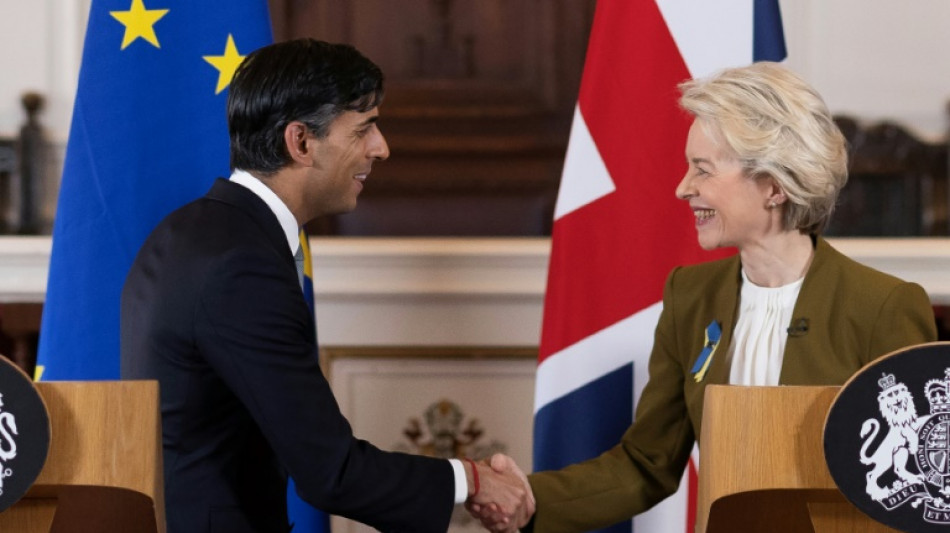
Britain's marathon battle over Brexit
/ Photo: Dan Kitwood - POOL/AFP
 Search Underway for 'Dooars Rani' Tigress After Second Escape from Buxa Tiger Reserve

 The Dilemma of Recording Live Music: Preserving Memories vs. Being Present

 InterContinental Hotels Group PLC Announces Transaction in Own Shares - November 11

 Fulcrum Metals PLC Announces New Critical Mineral Recoveries Expand Potential
 Fulcrum Metals PLC Announces Publication of Updated Investor Presentation

 Christmas Day Shifts More than Double as Americans Return to In-Person Holiday Celebrations

 Thukukile Zuma Resigns from ANC Johannesburg Leadership Amid Disciplinary Dispute

 CM Mohan Yadav Meets Bohra Spiritual Leader to Discuss Simhastha 2028 and Development

 Eli Crane Defeats Jonathan Nez in Tight Arizona Congressional Race

Here are milestones in the rocky Brexit process, from the UK's shock 2016 vote to leave the European Union to a new deal on trade rules for Northern Ireland called the Windsor Framework.
- Leave wins -
In a referendum on June 23, 2016, that followed decades of arguments over Europe, Britons vote by 52 percent to 48 percent to become the first nation to leave the EU.
Conservative prime minister David Cameron, who led the campaign to remain in the EU, resigns.
He is replaced by interior minister Theresa May, who also backed remaining in the EU.
On March 29, 2017, May formally triggers the exit process, which gives the United Kingdom until March 29, 2019, to leave the EU.
- Draft agreed -
Ending more than a year of acrimonious talks, UK and EU negotiators agree a draft divorce deal on November 13, 2018.
But May faces an angry backlash from her own Conservative party over its terms and MPs vote against the deal three times in 2019.
Twice the EU agrees to delay Brexit -- firstly until May 22 2019 and then until October 31.
- Johnson elected -
Parliament's rejection of May's Brexit deal forces her to step down.
On July 23, 2019, Conservative party members choose Brexit figurehead Boris Johnson to succeed her.
He favours the UK leaving the EU on October 31, whether or not the two sides reach agreement on their future trading relations by that deadline.
On October 22, British MPs approve in principle a new Brexit divorce deal Johnson has struck with the EU.
A week later, EU members agree to postpone Brexit yet again, until January 31, 2020.
- Brexit -
Johnson's resounding win in a snap general election on December 12, 2019, smooths his Brexit bill's passage through parliament on January 9, 2020.
On January 31, the UK formally leaves the EU.
It enters a transition period up until December 31, 2020, during which much in the relationship does not change.
- Post-Brexit negotiations -
In March 2020, the EU and UK began difficult negotiations on their future trade relationship.
Talks are broken off due to the coronavirus pandemic, and arguments over fair competition and fishing rights.
When they resume there is no notable progress on key sticking points.
Johnson warns that if there is no compromise by October 15 he will walk away with no deal to govern future relations between the UK and EU, despite the potential economic chaos.
To the EU's dismay, on September 9 the UK government says it plans to overwrite parts of the Brexit divorce deal concerning trade though Northern Ireland, which has a land border with EU member Ireland.
-UK leaves single market -
The October deadline comes and goes with no sign of a deal. But just before Christmas, Johnson and the EU announce they have reached an agreement on future trading relations.
It comes into effect at 2300 GMT on December 31, 2020, at the moment when EU rules cease to apply and the UK leaves the single market and customs union.
- Northern Ireland Protocol -
The eleventh-hour EU-UK deal includes the "Northern Ireland Protocol".
This keeps the province in the European single market for physical goods, unlike the rest of the UK.
That avoids the creation of a hard border between Ireland and Northern Ireland -- which is an essential part of a peace agreement that ended three decades of armed conflict in the province.
But it creates a customs border down the Irish Sea between Northern Ireland and the rest of the UK, angering pro-UK unionists in the province and eurosceptics in London.
It is blamed for supply problems in Northern Ireland in 2021, sparks violence there and leads to the collapse of the province's government.
- 'New chapter' -
After another turbulent year in 2022 -- in which both Johnson and his short-lived successor Liz Truss both resign -- new prime minister Rishi Sunak reaches an agreement with the EU on February 27, 2023, to overhaul the controversial trading rules for Northern Ireland.
The new "Windsor Framework" creates a check-free lane for goods coming from the rest of the UK that are intended to stay in Northern Ireland, without heading into Ireland and the EU's single market.
It remains to be seen whether Sunak can sell the new accord to hardline eurosceptics in his own party -- and persuade Northern Ireland's largest pro-UK party, the Democratic Unionists, to accept them and end the political paralysis in the province.
burs-gil/pvh
Y.Nakamura--AMWN