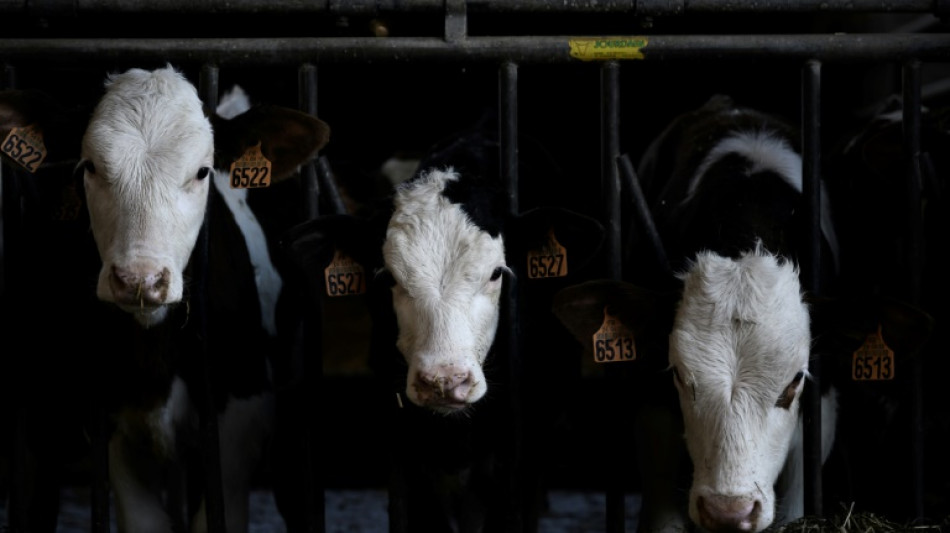
Cow manure fuels French tractors / Photo: Philippe LOPEZ - AFP
 Search Underway for 'Dooars Rani' Tigress After Second Escape from Buxa Tiger Reserve

 The Dilemma of Recording Live Music: Preserving Memories vs. Being Present

 InterContinental Hotels Group PLC Announces Transaction in Own Shares - November 11

 Fulcrum Metals PLC Announces New Critical Mineral Recoveries Expand Potential
 Fulcrum Metals PLC Announces Publication of Updated Investor Presentation

 Christmas Day Shifts More than Double as Americans Return to In-Person Holiday Celebrations

 Thukukile Zuma Resigns from ANC Johannesburg Leadership Amid Disciplinary Dispute

 CM Mohan Yadav Meets Bohra Spiritual Leader to Discuss Simhastha 2028 and Development

 Eli Crane Defeats Jonathan Nez in Tight Arizona Congressional Race

A French farmer steps away from his barn and fills up a tractor with fuel made from the manure of his cows, an attempt to put their climate-damaging methane to good use.
Anchored by a stone farmhouse, much has changed on the Guerin family farm in the southern Dordogne region since its founding in 1926.
The cow barn is largely automated, and features two huge, partially buried tanks covered with rounded domes that capture the methane emitted from the cow dung.
A dark green filling station with a pump and bank card payment terminal is connected to the facilities -- but it isn't diesel that comes out of the nozzle.
Instead it is bioNGV -- renewable natural gas for vehicles -- produced on the farm, a substance that is essentially methane.
Cleaner than diesel, it is also cheaper and now powers all the farm's cars and a new tractor -- the first to run on bioNGV that its manufacturer, the Italian-American firm New Holland, began selling last year.
The farm's owner, Bertrand Guerin, hopes the truck he uses to collect milk will also soon be filling up at his site.
The 59-year-old is also seeking to attract the visitors to the region from Britain and the Netherlands, where cars that run on natural gas are more common.
The filling station is part of a new chain, Biogaz de France, created by an association of farmers producing methane in which Guerin serves as vice president.
- Mix and ferment -
His concern is that market giants such as Engie and TotalEnergies, which are themselves looking to diversify away from fossil fuels, decide to move into and dominate the market for methane derived from agriculture.
"Let the farmers develop this sector," Guerin said.
In the vast barn a Montbeliarde cow ambles over to the milking machine.
After giving up several litres of milk -- all without any human intervention -- she enjoys a spot of massage from a rotating brush.
She calmly steps over the automatic scraper that removes the manure of the farm's hundred cows from the barn without giving it a thought.
The manure, urine and any hay on the floor is pumped into the domes before any methane is released.
Methane has a much greater climate-warming power than carbon dioxide, and accounts for a huge share of the climate impact from livestock farming.
Methane, whether it comes from cow burps or their manure, accounts for almost half of French agriculture's emissions.
"On all livestock farms we have methane which escapes," Guerin said.
- 'Just the beginning' -
To reduce the carbon impact, that source of destructive pollution is transformed into a cleaner fuel that allows him to reduce his expenses.
Every day 40 tonnes of organic material -- two-thirds manure and one-third food waste -- are stuffed into the methane dome where it is fermented at 38 degrees Celsius (100 degrees Fahrenheit).
"We mix it, ferment it. Bacteria break stuff down and CO2 and methane are released," Guerin said.
Most of the gas produced at the farm is burned to generate electricity that is put onto the power grid and is sufficient for the equivalent of a thousand homes.
Only a fraction is kept to be purified into methane and then compressed for use in vehicles.
What's left after being digested by the methane dome is used as fertiliser on the farm, allowing for a reduction of synthetic fertilisers made from fossil fuels.
The farm, which includes five associated families and three employees, aims to replace its diesel-burning tractors as soon as possible.
"This is just the beginning of the story," Guerin said.
Y.Aukaiv--AMWN