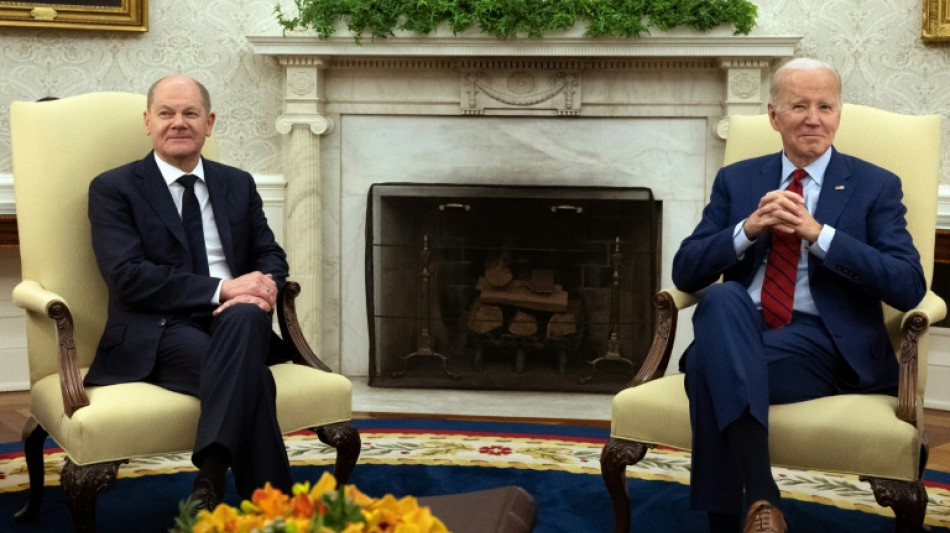
Biden, Scholz pledge Ukraine support at White House talks / Photo: Andrew Caballero-Reynolds - AFP
 Search Underway for 'Dooars Rani' Tigress After Second Escape from Buxa Tiger Reserve

 The Dilemma of Recording Live Music: Preserving Memories vs. Being Present

 InterContinental Hotels Group PLC Announces Transaction in Own Shares - November 11

 Fulcrum Metals PLC Announces New Critical Mineral Recoveries Expand Potential
 Fulcrum Metals PLC Announces Publication of Updated Investor Presentation

 Christmas Day Shifts More than Double as Americans Return to In-Person Holiday Celebrations

 Thukukile Zuma Resigns from ANC Johannesburg Leadership Amid Disciplinary Dispute

 CM Mohan Yadav Meets Bohra Spiritual Leader to Discuss Simhastha 2028 and Development

 Eli Crane Defeats Jonathan Nez in Tight Arizona Congressional Race

US President Joe Biden and German Chancellor Olaf Scholz held talks at the White House on Friday in a display of unity over the Ukraine war after warnings from Russia over arms supplies.
In Scholz's first trip to Washington since February 2022, the two leaders underlined their resolve to back Kyiv following recent friction over tank deliveries.
When they last met "Russia was amassing its troops" on the border, Biden said in brief remarks to the press, adding the West had vowed to respond and "together we made good on that promise."
In reply, Scholz said it was important to send a message to Ukraine that "we will continue to (support it) as long as it takes and as long as it necessary."
Shortly before the meeting, Russia warned Western countries against providing more weapons to Ukraine, singling out Germany.
"It is obvious that this will prolong the conflict and have sad consequences for the Ukrainian people," Kremlin spokesman Dmitry Peskov said.
But the United States announced a new $400 million security aid package for Ukraine on Friday that featured a range of ammunition for Kyiv's forces.
- 'Alliance unity' -
The German chancellor's visit came after a period of rocky ties, namely over the delivery of modern battle tanks long sought by officials in Kyiv, which was agreed to at the end of January.
In an admission of the friction between two of the biggest armaments suppliers to Ukraine, US national security advisor Jake Sullivan recently said that Germany had said no Leopard tanks would be sent "until the president also agreed to send Abrams."
Biden relented "in the interests of (NATO) alliance unity and to ensure that Ukraine got what it wanted," Sullivan said.
The German government has insisted that the two sides needed time to develop a "common approach" to weapons deliveries.
The saga showed that "the divisions between the US and Germany can be bridged, but that doing so is possible only at the highest levels in certain cases," said former US diplomat Jeffrey Rathke.
- 'Especially sensitive' -
Since Biden's arrival in the Oval Office, the United States' relationship with Germany has seen its ups and downs.
The successor to Donald Trump put pressure on Berlin to drop the controversial Nord Stream 2 gas pipeline from Russia to Germany -- a move it finally made in the days just before Russia invaded Ukraine.
The absence of a joint press conference raised questions about remaining difficulties, with the two leaders trying to dispel that impression and Scholz saying the bilateral relationship was "in a very good shape."
On Friday, the two leaders had been forecast to also tackle issues surrounding relations with China. Germany's economic ties with the Asian superpower put it in a delicate position.
Tensions have flared between Beijing and Washington over an alleged Chinese surveillance balloon and economic competition in key technologies such as semiconductors.
The meeting was to be a chance to send a "clear and persuasive signal to China" over its relationship with Russia, Rathke said, with both sides warning Beijing against sending arms to Moscow.
Berlin would be "especially sensitive to the potential fall-out of more overt Chinese aid to Russia's war effort," said Joern Fleck of the Atlantic Council.
At the same time, Scholz also brought his concerns over what Berlin and the EU view as unfair green subsidies under the US "Inflation Reduction Act."
The debate over the program is "a test for the trans-Atlantic relationship," said the influential BDI German industrial lobby.
Scholz needed to push for "improvements" to the program to avoid EU companies being disadvantaged, and to ward off a trade war between the two, it added.
G.Stevens--AMWN