S.African economy sinks below pre-pandemic levels / Photo: - - AFP/File
 Search Underway for 'Dooars Rani' Tigress After Second Escape from Buxa Tiger Reserve

 The Dilemma of Recording Live Music: Preserving Memories vs. Being Present

 InterContinental Hotels Group PLC Announces Transaction in Own Shares - November 11

 Fulcrum Metals PLC Announces New Critical Mineral Recoveries Expand Potential
 Fulcrum Metals PLC Announces Publication of Updated Investor Presentation

 Christmas Day Shifts More than Double as Americans Return to In-Person Holiday Celebrations

 Thukukile Zuma Resigns from ANC Johannesburg Leadership Amid Disciplinary Dispute

 CM Mohan Yadav Meets Bohra Spiritual Leader to Discuss Simhastha 2028 and Development

 Eli Crane Defeats Jonathan Nez in Tight Arizona Congressional Race

South Africa's economy tumbled below pre-pandemic levels in the last three months of 2022 as record power shortages hit activity, official data showed Tuesday.
The gross domestic product of Africa's most industrialised country contracted by 1.3 percent in the fourth quarter, worse than expected by analysts.
"After rallying in the third quarter of 2022 ... GDP fell below pre-pandemic levels," said the national statistics agency StatsSA.
The economy had expanded by 1.6 percent in the July-to-September period.
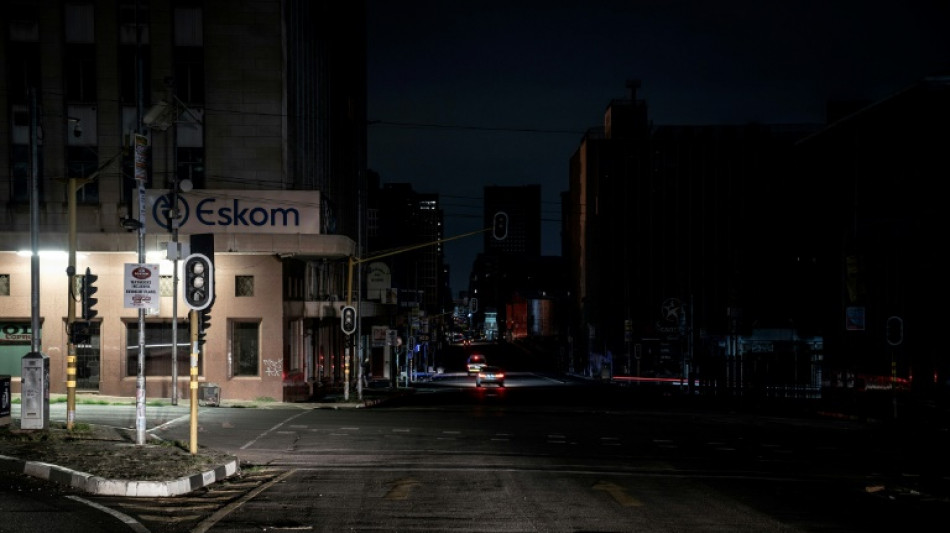
Growth in Africa's most industrialised country was weighed down in the final quarter by unprecedented levels of power outages.
Only two days were spared by the staggered blackouts during the last three months of last year.
Outages cost more that $50-million in lost output each day, according to estimates by the energy minister.
The blackouts are blamed on the 100-year-old state energy firm Eskom which produces about 90 percent of the country's energy needs.
Eskom is saddled with constantly breaking down generating plants and is failing to meet demand.
The trade and finance sectors were the biggest drags to the economy's growth between October and December, with exports decreasing by 4.8 percent. Mining agriculture and manufacturing also slumped.
- New electricity minister -
South Africa's economy was badly hit by the Covid-19 pandemic, which amplified joblessness and poverty in one of the world's most unequal countries. Economic growth had slowed for about two years.
After the economy returned to its pre-pandemic size in the first quarter of 2022, growth was hampered by floods and the energy crisis.
Economic growth is now forecast to be as low as 0.3 percent in 2023 due to the electricity supply crisis, according to the central bank, down from 2.5 percent in 2022.
The energy crisis has forced President Cyril Ramaphosa to declare a national state of disaster and appoint a special Minister of Electricity.
Ramaphosa on Monday night named Kgosientsho Ramokgopa, a 48-year-old civil engineer and former mayor of Pretoria to the new electricity portfolio.
The power cuts have reached new extremes, with the country experiencing a record 207 days of power outages last year alone, compared to 75 days in 2021.
While the four-quarter contraction "is no surprise because of power cuts", economist Carmen Nel with the Cape Town-based Matrix Fund Managers, said "the number itself is a shocker obviously".
F.Bennett--AMWN