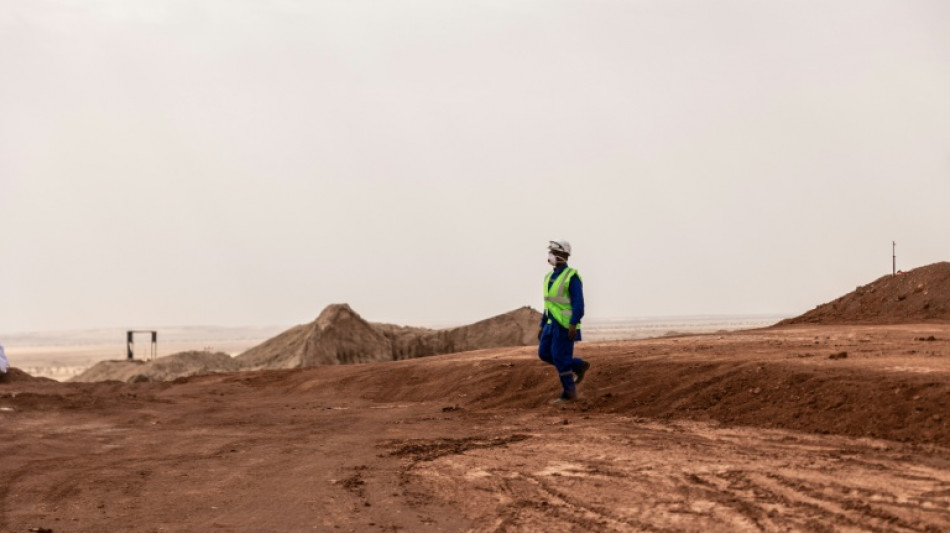
Worry, mistrust meet plans to secure waste from Niger uranium mine / Photo: OLYMPIA DE MAISMONT - AFP
 Search Underway for 'Dooars Rani' Tigress After Second Escape from Buxa Tiger Reserve

 The Dilemma of Recording Live Music: Preserving Memories vs. Being Present

 AmeriLife Welcomes Finance Veteran Richard Dziadzio as Chief Financial Officer; Names Jim Quinn President & Chief Transformation Officer

 Fulcrum Metals PLC Announces New Critical Mineral Recoveries Expand Potential

 Guardian Metal Resources PLC Announces Proposed Spin-Out of Non-Tungsten Projects
 THIEAUDIO Introduces Clairvoyance MKII: The Evolution of a Signature Sound

 BlackBerry to Participate in Upcoming Investor Conferences
Irving Resources Reports on Drilling in Yamagano Mining Right at the Yamagano Joint Venture, Kyushu, Japan

 XCF Global Hosts USDA at New Rise Renewables Reno as Facility Surpasses 4.4 Million Gallons Since Restart

 Patriot Software Adds Performance Reviews to Patriot HR

 Healixa's FrostPulse(TM) Technology Solves a Major Roadblock to Data Center Growth: Cooling Without the Water Burden
NuRAN Wireless Board Approves Growth Strategy to Scale Recurring Revenue from 5,000+ Contracted Towers
PPX Mining Reports Callanquitas Operating Results for the First Nine Months of 2026
 Valion Bio Reinforces Commitment to American Troops; Discusses Entolimod with Attendees at RW Baird's National Security Conference

 Thukukile Zuma Resigns from ANC Johannesburg Leadership Amid Disciplinary Dispute

 CM Mohan Yadav Meets Bohra Spiritual Leader to Discuss Simhastha 2028 and Development

 Eli Crane Defeats Jonathan Nez in Tight Arizona Congressional Race
Towering mounds dot the desert landscape in northern Niger's Arlit region, but there is little natural about them -- they are heaps of partially radioactive waste left from four decades of operations at one of the world's biggest uranium mines.
An ambitious 10-year scheme costing $160 million is underway to secure the waste and avoid risks to health and the environment, but many local people are worried or sceptical.
From 1978, France's nuclear giant Areva, now called Orano, worked the area under a subsidiary, the Akouta Mining Company (Cominak).
It closed the site in 2021 after extracting 75,000 tonnes of uranium, much of which went to fuelling the scores of nuclear reactors that provide the backbone of France's electricity supply.
Cominak's director general Mahaman Sani Abdoulaye showcased the rehabilitation project to the first French journalists to visit the site since 2010, when seven Areva employees were kidnapped by jihadists.
The company intends to hand back a "site (that is) safe, healthy and non-polluting, in line with national standards and international recommendations", Abdoulaye said at his offices in Niamey.
The toughest task is to deal with the estimated 20 million tonnes of tailings that have been in contact with uranium.
The waste is spread over 120 hectares (nearly 300 acres) in mounds as high as 35 metres (114 feet), but its radioactivity levels are very low, said Helene Sciorella Djibo, in charge of the operation.
"We have natural doses below what can be found in regions of France and the world," she said.
Orano's plan is to level out the waste and seal it under a two-metre-deep cap of waterproofed clay and sandstone, backed by a programme to monitor air and water for at least five years.
- Worry -
But in the town of Arlit, which with the surrounding area has a population of 200,000, there is concern.
Bassirou Babale, the departmental director of mines at Arlit, pointed to worry about whether cracks could develop in the cover on top of the waste.
The concern is that leaks could enable radon -- a cancer-causing radioactive gas derived from the natural breakdown of uranium -- to escape and "flood the town", he said.
"Tests (of the cover) are underway," he said.
Rhamar Ilatoufegh of a local NGO called Aghir In'man (Human Shield) is angry.
"Radioactive waste is being stored in the open," he said. "This is the biggest negative legacy left from uranium mining."
A French watchdog, the Independent Research and Information Commission on Radioactivity (CRIIRAD), has described the waste as a "sword of Damocles" hanging over the area's water supply.
Orano's Gilles Recoche, a director in charge of responsibility, engagement and communication, said air and water were being "amply" monitored across the whole town.
"The levels are below the norms for Nigerien and international law," he said. "There has not been a single confirmed case of sickness linked to radioactivity."
- Uranium wealth
Niger's regulations stipulate a safety threshold for miners of 20 millisieverts (mSv) of radiation a year. Orano reported that maximum exposure at the site of mine in 2022 was 8.6 mSv per year.
But former Cominak employee Hassan Souley was suspicious.
"People live seven kilometres (four miles) from the mines -- everyone is very worried, people are sick," he said.
"Orano is behind all these problems and does not even want to listen."
Arlit's mayor, Abdourahmane Maouli, pointed to steps being taken to try to ease concerns.
"There is mistrust, doubt and fear about the radioactivity in our town, it's normal," he said. "But measures have been taken to tackle it."
An agency set up in 2012, the Agadez Regional Health Observatory (OSRA), is monitoring the wellbeing of people who retired or left Cominak and Somair, another mine in the area still being operated by Orano.
"Out of 2,000 consultations, we detected a dozen cases of illness that could be attributable to radiation -- blood and lung cancers and silicosis," an OSRA doctor, Ayouba Dogonyaro, told AFP.
"Six of them were recognised (as such) by the OSRA medical committee, comprising three doctors representing the mines, civil society and the state," he said.
- Mining future -
Niger is one of the world's poorest countries, but it is also one of the planet's biggest sources of uranium.
Its mining industry is eyeing a long-term future as the nuclear industry touts its potential for easing reliance on carbon-spewing fossil fuels.
One of the world's biggest uranium deposits lies at Imouraren, around 80 kilometres (50 miles) south of Arlit.
Matthieu Davrinche, director of the Imouraren company, which works with Orano and the Niger government on exploring the site's potential, told AFP that tests would start next year at the site, which is estimated to have reserves of 200,000 tonnes of uranium.
A decision on whether to mine the deposits will be made in 2028, he said.
The scheme was put on hold in 2015 after the price of uranium collapsed following the 2011 Fukushima disaster in Japan.
P.M.Smith--AMWN