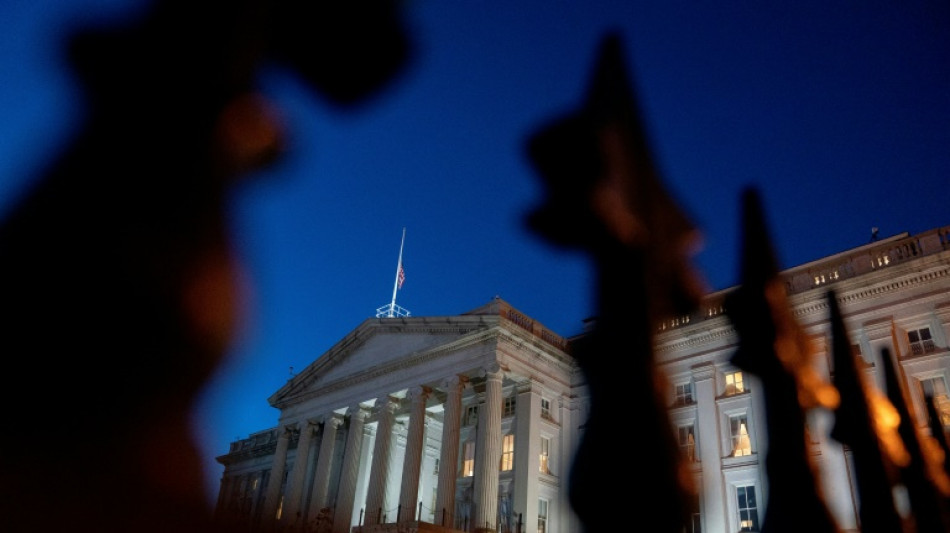
US government seeks to avoid 'bailout' label amid banking turmoil / Photo: Stefani Reynolds - AFP/File
 Search Underway for 'Dooars Rani' Tigress After Second Escape from Buxa Tiger Reserve

 The Dilemma of Recording Live Music: Preserving Memories vs. Being Present

 AmeriLife Welcomes Finance Veteran Richard Dziadzio as Chief Financial Officer; Names Jim Quinn President & Chief Transformation Officer

 Fulcrum Metals PLC Announces New Critical Mineral Recoveries Expand Potential

 Guardian Metal Resources PLC Announces Proposed Spin-Out of Non-Tungsten Projects
 THIEAUDIO Introduces Clairvoyance MKII: The Evolution of a Signature Sound

 BlackBerry to Participate in Upcoming Investor Conferences
Irving Resources Reports on Drilling in Yamagano Mining Right at the Yamagano Joint Venture, Kyushu, Japan

 XCF Global Hosts USDA at New Rise Renewables Reno as Facility Surpasses 4.4 Million Gallons Since Restart

 Patriot Software Adds Performance Reviews to Patriot HR

 Healixa's FrostPulse(TM) Technology Solves a Major Roadblock to Data Center Growth: Cooling Without the Water Burden
NuRAN Wireless Board Approves Growth Strategy to Scale Recurring Revenue from 5,000+ Contracted Towers
PPX Mining Reports Callanquitas Operating Results for the First Nine Months of 2026
 Valion Bio Reinforces Commitment to American Troops; Discusses Entolimod with Attendees at RW Baird's National Security Conference

 Thukukile Zuma Resigns from ANC Johannesburg Leadership Amid Disciplinary Dispute

 CM Mohan Yadav Meets Bohra Spiritual Leader to Discuss Simhastha 2028 and Development

 Eli Crane Defeats Jonathan Nez in Tight Arizona Congressional Race
US authorities may have taken extraordinary steps in recent weeks to assure depositors of failed lenders Silicon Valley Bank and Signature Bank, but they are avoiding parallels with bailouts of the 2008 crisis -- which have been criticized.
Days after SVB's collapse this month, the Treasury Department, Federal Reserve and Federal Deposit Insurance Corporation (FDIC) announced that its depositors -- along with those of Signature Bank -- would have access to their money.
But officials were quick to add: "No losses will be borne by the taxpayer."
In the 2008 financial crisis, authorities spared shareholders and bondholders while propping up institutions, said David Smith, professor of commerce at the University of Virginia.
The way the 2008 crisis was managed had provoked criticism, given rise to the Occupy Wall Street movement, and fuelled resentment towards banks.
But "there's no bailout" this time in the sense that officials are protecting depositors rather than shareholders and bondholders, Smith said.
Between the fall of 2008 and late 2009, the US Treasury injected more than $200 billion to recapitalize US banks, without any compensation. It has since recovered more than it invested.
In contrast, the intervention in SVB and Signature Bank this time wiped out the entire market value of the two institutions, led to the dismissal of their executives and is expected to result in significant losses for holders of debt issued by the two banks.
The Justice Department has opened an investigation into SVB's collapse, according to media reports, while President Joe Biden told Congress that it should "act to impose tougher penalties for senior bank executives whose mismanagement contributed to their institutions failing."
- Who will foot the bill? -
While some believe it is wrong to call the government's moves a bailout, Aaron Klein of the Brookings Institution believes that it is one.
"Uninsured depositors like (entrepreneur) Peter Thiel and cryptocurrencies were made whole by the government," when they would otherwise have lost parts of their deposits, Klein said.
Authorities have said the FDIC will use resources from the Deposit Insurance Fund to ensure that depositors are made whole, and this is funded in part by fees assessed on financial institutions.
At the end of 2022, the fund had a balance of $128 billion, or 1.27 per cent of the $10 trillion in insured deposits.
"Depending on how much the FDIC has to drain their deposit insurance reserve to cover depositors now," they might have to charge banks higher fees to replenish that reserve, said David Smith.
"Clearly consumers ultimately will bear the cost, because that has to get passed on somehow," he said.
In an opinion piece for the Daily Mail, former vice president Mike Pence called it "disingenuous" to say that costs will not be borne by taxpayers.
"Every American with a bank account will pay higher fees to replenish the billions spent by the FDIC to backstop failing banks," he wrote.
Republican White House contender Nikki Haley added: "Now depositors at healthy banks are forced to subsidize Silicon Valley Bank's mismanagement."
In the short-term, the government's efforts helped prevent "contagion," said Mark Williams, lecturer at Boston University.
But a longer-term cost is that "moral hazard has been increased," he added.
"How will that impact... bank behavior going forward?" he asked.
Ch.Havering--AMWN