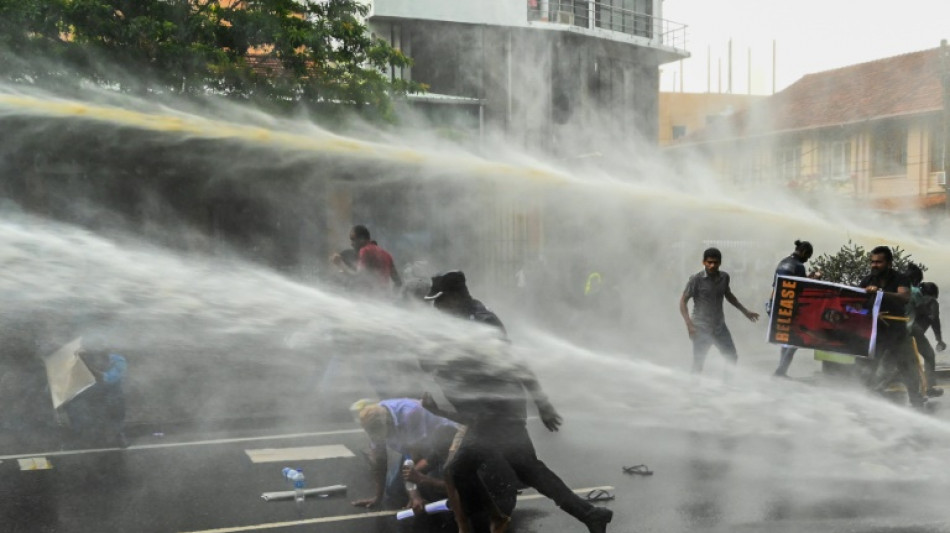
Sri Lanka: timeline of a crisis / Photo: ISHARA S. KODIKARA - AFP
 Search Underway for 'Dooars Rani' Tigress After Second Escape from Buxa Tiger Reserve

 The Dilemma of Recording Live Music: Preserving Memories vs. Being Present

 AmeriLife Welcomes Finance Veteran Richard Dziadzio as Chief Financial Officer; Names Jim Quinn President & Chief Transformation Officer

 Fulcrum Metals PLC Announces New Critical Mineral Recoveries Expand Potential

 Guardian Metal Resources PLC Announces Proposed Spin-Out of Non-Tungsten Projects
 THIEAUDIO Introduces Clairvoyance MKII: The Evolution of a Signature Sound

 BlackBerry to Participate in Upcoming Investor Conferences
Irving Resources Reports on Drilling in Yamagano Mining Right at the Yamagano Joint Venture, Kyushu, Japan

 XCF Global Hosts USDA at New Rise Renewables Reno as Facility Surpasses 4.4 Million Gallons Since Restart

 Patriot Software Adds Performance Reviews to Patriot HR

 Healixa's FrostPulse(TM) Technology Solves a Major Roadblock to Data Center Growth: Cooling Without the Water Burden
NuRAN Wireless Board Approves Growth Strategy to Scale Recurring Revenue from 5,000+ Contracted Towers
PPX Mining Reports Callanquitas Operating Results for the First Nine Months of 2026
 Valion Bio Reinforces Commitment to American Troops; Discusses Entolimod with Attendees at RW Baird's National Security Conference

 Thukukile Zuma Resigns from ANC Johannesburg Leadership Amid Disciplinary Dispute

 CM Mohan Yadav Meets Bohra Spiritual Leader to Discuss Simhastha 2028 and Development

 Eli Crane Defeats Jonathan Nez in Tight Arizona Congressional Race
The International Monetary Fund approved a $2.9 billion bailout deal for Sri Lanka on Monday, raising hopes for an easing of the island nation's dire economic crisis.
The South Asian country of 22 million people has suffered months of blackouts as well as acute food, fuel and medicine shortages.
Tens of thousands of people have protested against the government's handling of the crisis, aggravated by the loss of tourist revenue during the Covid-19 pandemic.
At the peak of the demonstrations, an angry crowd stormed former leader Gotabaya Rajapaksa's house and forced the then-president to flee the country.
His successor Ranil Wickremesinghe has cracked down hard on demonstrations and introduced sweeping economic reforms in an effort to repair the nation's shattered finances.
AFP looks at how the crisis unfolded:
- April 1: State of emergency -
President Gotabaya Rajapaksa declares a state of emergency after clashes between police and hundreds of demonstrators demanding his resignation outside his residence in the capital Colombo.
- April 3: Cabinet resigns -
Most of the cabinet resigns at a late-night meeting two days later, leaving Rajapaksa and his brother Mahinda -- the prime minister -- isolated.
The central bank governor quits a day later.
- April 5: President loses majority -
Finance minister Ali Sabry resigns just a day after being appointed.
The president then loses his parliamentary majority as former allies urge him to quit. He lifts the state of emergency.
- April 12: Foreign debt default -
The government announces it is defaulting on its foreign debt of $51 billion.
- April 19: First casualty -
Police kill a protester, the first casualty after several weeks of anti-government protests.
The next day, the IMF says it has asked Sri Lanka to restructure its colossal external debt before a rescue package can be agreed.
- May 9: Day of violence -
A mob of government loyalists bussed in from the countryside attacks peaceful protesters camped outside the president's office.
Nine people are killed and hundreds more injured in reprisal attacks.
Mahinda Rajapaksa resigns as prime minister and has to be rescued by troops after thousands of protesters storm his official residence in Colombo.
He is replaced by Ranil Wickremesinghe, a political veteran also deeply unpopular among the protesters.
- June 10: Humanitarian crisis -
The United Nations warns that Sri Lanka is facing a dire humanitarian crisis, with millions already in need of aid.
More than three-quarters of the population had reduced their food intake due to severe food shortages, it says.
- July 9: President's home stormed -
Rajapaksa flees his official residence with the assistance of troops, shortly before demonstrators storm the compound.
Wickremesinghe's home is torched by protesters.
- July 13: President flees country -
Rajapaksa flies to the Maldives on a military aircraft, accompanied by his wife and two bodyguards.
Six-time premier Wickremesinghe is appointed as acting president.
The government declares a state of emergency.
- July 14: Rajapaksa resigns -
Rajapaksa leaves the Maldives for Singapore.
On arrival, he emails his resignation as president to the parliamentary speaker.
- July 20: Wickremesinghe elected president -
Wickremesinghe beats two opponents to be elected president by parliament for the remainder of Rajapaksa's term, which expires in November 2024.
The 73-year-old begins a crackdown on demonstrators and embarks on a reform programme to meet IMF conditions for a bailout, raising taxes and hiking the cost of fuel and utilities.
- September 1: Bailout deal -
The IMF announces a four-year, $2.9 billion bailout package, conditional on a deal between the government and its creditors to restructure its borrowings.
The agreement still needs approval by the lender's board and the sum is lower than the $3-4 billion sought by Sri Lanka, but it is an important first step.
Peter Breuer, the IMF's head of mission, urges creditors to cut a deal with the island nation or risk deepening the ongoing crisis.
- March 7: China comes through -
China, Sri Lanka's largest bilateral creditor, agrees to restructure its loans to the country, clearing the final obstacle to the bailout.
- March 15: Strikes -
Sri Lanka deploys armed troops as trade unions cripple hospitals, ports and banks to protest against high income taxes imposed as a precondition for the bailout.
- March 20: IMF board approves bailout -
The IMF board finally approves the bailout, clearing the way for the release of funds and kicking off a four-year programme shoring up the country's economy.
But its managing director Kristalina Georgieva warns that Colombo must continue pursuing tax reform and greater social safety nets for the poor -- and rein in the corruption that has been partly blamed for the crisis.
burs-st/sw
Ch.Kahalev--AMWN