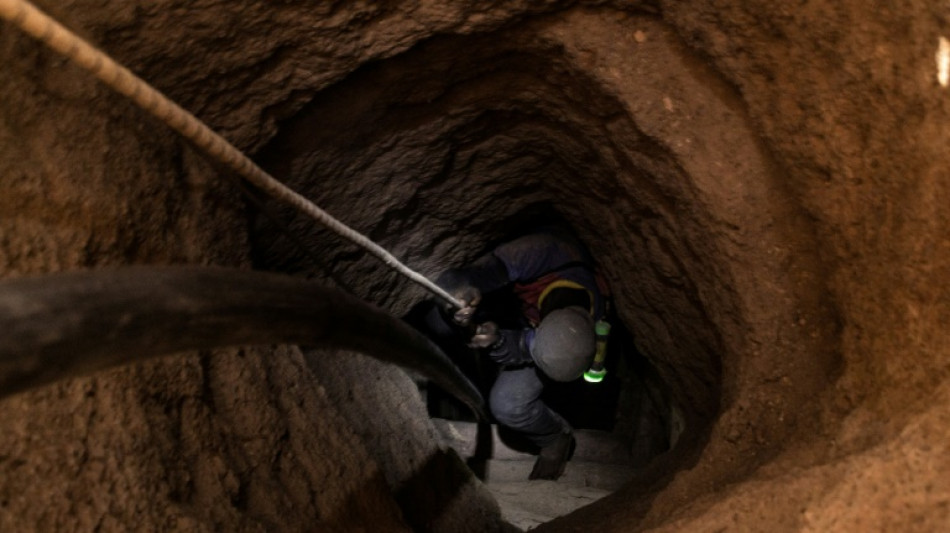
Senegal's gold rush brings hope and despair / Photo: JOHN WESSELS - AFP
 Search Underway for 'Dooars Rani' Tigress After Second Escape from Buxa Tiger Reserve

 The Dilemma of Recording Live Music: Preserving Memories vs. Being Present

 AmeriLife Welcomes Finance Veteran Richard Dziadzio as Chief Financial Officer; Names Jim Quinn President & Chief Transformation Officer

 Fulcrum Metals PLC Announces New Critical Mineral Recoveries Expand Potential

 Guardian Metal Resources PLC Announces Proposed Spin-Out of Non-Tungsten Projects
 THIEAUDIO Introduces Clairvoyance MKII: The Evolution of a Signature Sound

 BlackBerry to Participate in Upcoming Investor Conferences
Irving Resources Reports on Drilling in Yamagano Mining Right at the Yamagano Joint Venture, Kyushu, Japan

 XCF Global Hosts USDA at New Rise Renewables Reno as Facility Surpasses 4.4 Million Gallons Since Restart

 Patriot Software Adds Performance Reviews to Patriot HR

 Healixa's FrostPulse(TM) Technology Solves a Major Roadblock to Data Center Growth: Cooling Without the Water Burden
NuRAN Wireless Board Approves Growth Strategy to Scale Recurring Revenue from 5,000+ Contracted Towers
PPX Mining Reports Callanquitas Operating Results for the First Nine Months of 2026
 Valion Bio Reinforces Commitment to American Troops; Discusses Entolimod with Attendees at RW Baird's National Security Conference

 Thukukile Zuma Resigns from ANC Johannesburg Leadership Amid Disciplinary Dispute

 CM Mohan Yadav Meets Bohra Spiritual Leader to Discuss Simhastha 2028 and Development

 Eli Crane Defeats Jonathan Nez in Tight Arizona Congressional Race
Mohamed Bayoh climbed into the deep, pitch-black hole, hoping to emerge with a nugget that would change his life.
The 26-year-old Guinean is one of thousands of West Africans who have flocked to remote eastern Senegal in search of gold.
The rush for the precious metal has dramatically transformed Bantakokouta, a town on the borders of Mali and Guinea.
The locals numbered just a few dozen two decades ago, now there are several thousand on the back of a floating population of dream-seekers and risk-takers with gold in their eyes.
Over time, their ant-like labour has left the landscape looking like a Swiss cheese.
As far as the eye can see, through the pervasive dusty mist, small huddled groups protected from the sun by makeshift branch shelters haul up spoil scratched from the ground.
Women sit nearby, sorting the rocks into two mounds -- a big one for the discards and a much smaller one for the promising samples.
The same scenes are played out every day, with no guarantee of any success.
"Working here is like playing the lottery, you are never sure of winning," sighed Bayoh, who said he was nonetheless determined to stay put until he gets rich.
Other sites in the gold-rich region have been taken over by mining corporations, sometimes triggering land disputes with local people.
But in Bantakokouta, informal mining has been allowed to carry on.
Diggers stay typically stay for a few months -- sometimes just days -- to chance their arm, hoping for a lucky strike that will enable them to send money home or start a business.
Bayoh was clear in his objective: to "find a lot of gold," he said.
"Not a little... a lot. To start another life in Guinea."
After six months' gruelling work, he had earned enough to buy two motorbikes.
One gramme (0.03 of an ounce) of gold -- roughly equivalent to 60 grains of rice -- brings in 30,000 CFA francs, or about $48.
- Harsh life -
But the risks facing miners are many, from fatal falls and cuts and landslips to use of drugs to dull aches and pains, said Diba Keita, head of a community vigilance committee.
The town itself bears the signs of poverty and transience.
Its alleys are littered with rubbish, and goats and sheep roam untended. The vast majority of the huts are rudimentary constructions, made of bamboo and brushwood.
In his workshop, Souleymane Segda, a 20-year-old from Burkina Faso, put crushed pieces of promising-looking ore through a grinder.
The apparatus takes up most of his room, which has no toilet and doubles as his bedroom.
The young man is covered in dirt as he sifts through the dust in search of flecks of gold.
The flakes are recovered after washing the dust with mercury -- a practice that is banned because of its health and environmental risks, but which remains widespread.
"I can earn up to 50,000 CFA francs a day. I go back home as much as I can and when I'll have earned enough, I will leave for good," he said.
- Problems -
Bantakokouta has experienced a surge of activities familiar to gold rushes around the world -- an influx of stores selling tools and electronic goods, places of worship, a medical post, nightclubs, video gaming rooms... and crime and vice.
"The gold has brought wealth. In the past, we used to go to Mako," a town 20 kilometres (12 miles) away, said Waly Keita, 63.
He recalled with nostalgia the time when "our mums" used to dig in the river bed, searching for nuggets, while the men went into the bush to hunt and collect honey.
But the gold rush has also brought problems, including "banditry" and "conflict," he said.
The Senegalese and foreigners generally get on well in Bantakokouta, although flareups do occur.
In 2020 clashes between security forces and Guinean miners resulted in the death of two young men.
In a square a little away from the shops, a young woman in tight blue shorts and a red T-shirt talked on the phone.
"No, it's not good. It's not enough. I'm not going to do anything with you," she said in broken French.
Like dozens of others like her, the young woman had become stranded in the town and had to resort to sex work to survive.
"I don't like my job," she said softly, with a look of shame.
"Prostitution has become a major problem," said Aliou Bakhoum, head of an NGO called La Lumiere (The Light) in the regional capital Kedougou.
"Young women, mainly from Nigeria and often under-age, fall victim to highly organised trafficking."
He said his association had taken in around 40 girls, some as young as 15, and was helping them to return home.
Traffickers lured the women with the promise of a job, transported them across West Africa and then pressured them to keep their mouths shut when the truth of their situation emerged.
- Security -
The trafficking has prompted the state to beef up vigilance and invest heavily in security and intelligence, a senior administrative official who wished to remain anonymous said.
The authorities have also intensified operations to secure the border with Mali, fearing jihadist contagion from its deeply troubled neighbour.
"Eastern Senegal would be a very interesting territory for jihadists, not necessarily for carrying out attacks, but for recruitment and funding," a Western diplomat said.
"The gold mining sites are ideal for finding frustrated young people who want to earn money, and gold is very easy to hide and trade."
Bantakokouta has dozens of stalls run by Malians, where gold is bought and then transported illegally across the border.
A 2021 report by the Timbuktu Institute think-tank highlighted the plight of impoverished and frustrated young people as one of the primary causes of jihadist radicalisation.
The Kedougou region suffers from over 25 percent unemployment, a poverty rate of more than 70 percent and a worrying school drop-out rate.
As living conditions fall, many young people are tempted to try their luck in the mines.
But many emerge disappointed, and willing to resort to just about anything.
O.Karlsson--AMWN