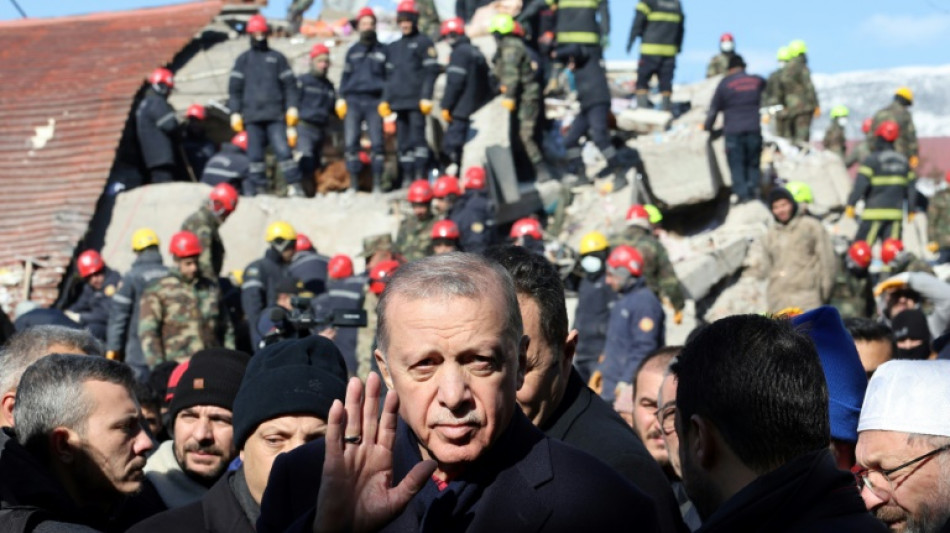
Boom and bust: Quakes define legacy of Turkey's 'Erdonomics' / Photo: Adem ALTAN - AFP
 Maswanganyi Clarifies Pirates Allegiance Amidst Career Transition

 Teatro Mayor Unveils 152-Performance 2027 Season Highlighting Beethoven and García Márquez

 Rutgers Defeats NJIT 101-64 Behind Francis and Mark Scores

 5E Advanced Materials to Host Fiscal First Quarter 2027 Earnings Conference Call on November 17, 2026

 Protagenic Therapeutics Announces Private Placement of Up to $5 Million to Advance PT00114 into Its First U.S. Clinical Trial in Generalized Anxiety Disorder
 Route1 Announces 2026 Annual Meeting Results
Ethur Takes On Hiring Fraud With Facial Biometrics Identity Checks and Connected Payroll and Bank Data

 Green Leaf Innovations (OTC: GRLF) Meets OTCID Disclosure Requirements Following Profitable Q2 2026 Results
 XCF Global Hosts USDA at New Rise Renewables Reno as Facility Surpasses 4.4 Million Gallons Since Restart

 AmeriLife Welcomes Finance Veteran Richard Dziadzio as Chief Financial Officer; Names Jim Quinn President & Chief Transformation Officer
 Irving Resources Reports on Drilling in Yamagano Mining Right at the Yamagano Joint Venture, Kyushu, Japan
 BlackBerry to Participate in Upcoming Investor Conferences

 THIEAUDIO Introduces Clairvoyance MKII: The Evolution of a Signature Sound
Guardian Metal Resources PLC Announces Proposed Spin-Out of Non-Tungsten Projects
 Fulcrum Metals PLC Announces New Critical Mineral Recoveries Expand Potential
 Healthcare Leaders Identify Priorities for Agentic AI Adoption in 2027-2028 - Black Book

 SMX Advances AI Technology to Bring Greater Precision to Industrial Material Development
Leiər Introduces Passport, a New Fragrance Collection Debuting With Alba Eau De Parfum

 SMX Bridges AI and Industrial Material Science With New Intelligence Platform
 Sequoia Backs Microsoft Veterans' Edelbyte with $70M to Challenge Data Infrastructure Giants
 DaBella Honors More Than 200 Veteran Employees Nationwide This Veterans Day

 Resilient Energy Inc. (OTCID:RENI) Closes Acquisition of Mid River Midstream; Adds 12 Texas SWD Wells and $25M in Assets

 LA Kush Cake Strain Guide Reviews Genetics and Historical Potency Data
Who Is the Best Facial Feminization Surgeon?
 Cognitum One Launches Cognitum Spaces, the Governed System of Record for Physical Sites That Gives Enterprise AI Agents Trusted Real-World Context

The earthquake's frightening rumble came deep in the night. Its ferocity killed thousands of people in their sleep and helped bring down a Turkish government.
Fury over the scale of the 1999 disaster fed into broader economic discontent that ultimately propelled Recep Tayyip Erdogan to power.
The Turkish leader now hopes a similar mix of economic despair and anguish over an even deadlier pre-dawn quake in February does not push him out in elections next Sunday.
"They came with an earthquake and they might leave with an earthquake," Ankara University assistant professor Melih Yesilbag said of Erdogan's Islamic-rooted party.
"The AKP took power after an earthquake. Modernising the infrastructure was one of its main promises from the start. And 20 years later you see this happen," he said.
The 1999 calamity killed more than 17,000 people and put the shoddiness of Turkey's buildings on soul-crushing display.
But it also made a more profound impact.
The AKP's election victory in 2002 and the rise of Erdogan a year later heralded a new economic model based on construction that changed the way Turkey worked.
The vast country entered a building frenzy that became central to a growth policy dubbed "Erdonomics".
Erdogan and a clique of construction companies that consolidated around his rule ended up erecting more than 10 million housing units over 20 years.
"This is an incredible amount," Yesilbag said. "This is more than half of all the EU countries combined over the same period."
Some of those houses toppled in the February quake that killed more than 50,000 people. The disaster exposed a flagrant disregard for beefed-up building standards for all to see.
- 'It really worked' -
Erdogan and constructors made a natural fit.
"The AKP's original base was small businesspeople. Anatolian businesspeople. These people were excellent in property development, property transactions and trade," said analyst Atilla Yesilada of the GlobalSource Partners consulting firm.
"It was only natural that Erdogan, who also had a business background, looked at the immense possibilities of land development in Turkey."
This boom accelerated when the global financial crisis of 2007-2008 prompted the United States and Europe to slash lending rates to zero.
It was manna for Turkey. The inflow of billions of dollars of nearly free loans allowed Erdogan's government to reshape city skylines and interconnect provinces with highways and airports.
The building frenzy plugged less educated Turks into the workforce and created a new base of political support.
"It really worked for Turkey," Yesilada said.
"It boosted wealth and created a new class of wealthy AKP supporters who became urban dwellers, joining the middle and upper class."
- 'Incestuous relationship' -
Turkey's economic growth exploded in the first decade of Erdogan's rule.
The World Bank estimates that per capita GDP grew from $3,640 the year the AKP came to power to $12,507 at its zenith in 2013.
Construction and the various industries connected to it made up nearly a third of that figure.
"The construction sector is labour intensive, so it generates employment for the masses in the short term," said urban planning professor Osman Balaban at the Middle East Technical University.
But it did not last.
A 2018 crisis in relations with Washington and a gradual rise of interest rates across the West set off a lira slide that made all those dollar loans expensive to pay off.
"The cost of construction became very high," Yesilbag said. This created a quandary that remains unresolved to this day.
Contractors continued supporting Erdogan's government in return for new projects whose economic returns did not add up.
"Eventually it turned into a sort of incestuous relationship where the construction companies felt obligated to support Erdogan's re-election campaign," said Yesilada.
"Over the years the system had a negative marginal return."
- Broken contract -
The parallels between this year's earthquake and economic crisis to those of 1999 are striking.
Turkey's annual inflation rate hit 85 percent last year -- the highest since 1998.
Analysts view it as a self-inflicted wound: Erdogan fought the economic slowdown by cutting the main interest rate far below that of inflation to help producers.
The lira crashed and Erdogan became dependent on short-term rescues from wealthy Gulf states.
Analysts widely agree that Erdogan's original social pact with his voters has been broken.
But they caution that Turkey's sharp polarisation among groups with deeply entrenched views may still keep opposition leader Kemal Kilicdaroglu from winning a tight race.
"The damage after the earthquake was huge and it overturned the welfare and development image that Erdogan and his party were imposing," Balaban said.
"So, unchecked construction may have an influence in the elections. But I am still not sure if it will be big enough to bring about his fall."
P.M.Smith--AMWN