As Ukraine pushes oil over $100, Nigerians see mixed blessings
 Australia's Big Bash League to open season in India

 Disappointment at Morocco's World Cup exit cannot mask pride
 In gas-rich Kazakhstan, many rely on lethal cylinders

 Chip titan SK hynix raises $26.5 bn in blockbuster US listing

 Venezuela quake tragedy threatens to set back democratic transition

 Yamal's best 'yet to come,' warns Spain coach

 'Up to him' - Curry on chance that LeBron lands with Warriors

 Revamped Ireland wary of 'bang in form' Japan

 Morocco coach Ouahbi vows team will come back stronger after World Cup exit
 Rennie says Italy won't catch All Blacks off guard

 McIlroy encouraged by 'great start' to Scottish Open
 England chase World Cup glory as Haaland allows Norway to dream

 'When it's Kylian, there's no problem': Deschamps after France into semis

 Mbappe strikes again as France beat Morocco to reach World Cup semi-finals
 Sick Olympic champion McKeown pulls out of Commonwealth Games, PanPacs

 Traeen out of Tour de France after losing yellow jersey

 Ukrainian sports minister slams IOC's 'cynical' Russia decision

 Leonard return to Raptors on hold pending Clippers probe

 US pushes for weaker truck pollution rules

 Black and cream and very Roman at Fendi haute couture show

 Spain keeping opposition far from goal at World Cup, says 'keeper Garcia

 Czech mates Muchova and Noskova to clash in Wimbledon final
 Bayeux Tapestry begins epic journey from France to London: source

 King in shades braves heat to visit London zoo

 Gauff expecting hate messages after Wimbledon loss

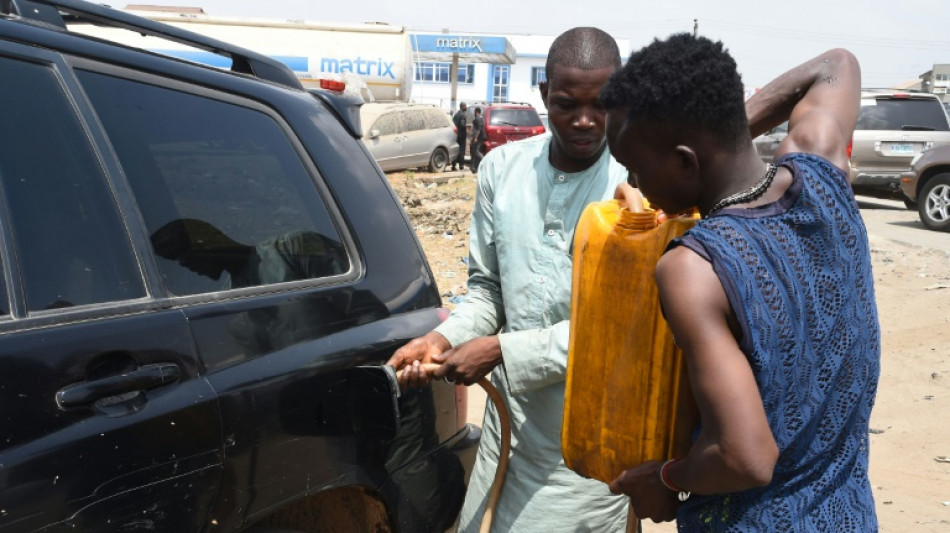
Weaving in between the Lagos traffic, hawkers selling plantain snacks and water more recently offer drivers another treat: jerry cans filled with petrol to help with fuel shortages.
Petroleum-producing nations may be reaping extra revenue since Ukraine's crisis pushed oil prices above $100 a barrel, but Nigerians this week were struggling with yet another round of fuel scarcities.
President Muhammadu Buhari says Africa's top producer has a "great opportunity" with higher oil prices, but that was a hard sell for Lagos accountant Abdulazeez Oyefeso after three hours in a line for fuel.
"It's more revenue for the country, but it doesn’t get down to the common man," Oyefeso said, leaning against his Lexus among the cars snaking along Lagos’s main Alfred Rewane road near a gas station.
On the opposite side of the major avenue, touts carrying plastic jerry cans filled with yellow fuel and funnels crafted from water bottles flagged down passing cars offering to fill tanks for a premium.
Oil sales account for nearly 90 percent of Nigeria's export revenue. But soaring prices -- the highest in ten years after the invasion -- are a mixed blessing.
OPEC member Nigeria has little capacity to refine its own crude and relies heavily on fuel imports so higher oil prices mean more budget spending.
Nigeria also operates a byzantine system of fuel subsidies that costs the state billions of dollars to artificially keep fuel costs low.
In place since the 1970s, fuel subsidies are politically sensitive and Nigeria's import reliance also leaves the domestic market open to sporadic fuel shortages.
Currently, a litre of gasoline costs an average of 165 naira (40 US cents). On the black market this week it was fetching between 350 to 500 naira.
Since last month, the government said a batch of adulterated fuel was removed from the market, causing a shortfall.
State-run Nigerian National Petroleum Corporation chairman Mele Kyari on Thursday said measures were in place to get adequate supplies to depots.
"I am very sure that very soon we will see relief from this," he told reporters.
- Sleeping in car -
Unruly lines of cars searching for fuel caused massive traffic jams earlier this week in Lagos and other cities. Motorbikes ferrying men on the back clutching four or five jerry cans to find fuel were a common sight.
Some commuters just walked. Others jumped off Lagos' typical yellow Danfo minibuses caught in jams to continue on foot.
"My gauge was on reserve when I left home early this morning but the car stopped mid-way. Luckily, I have a small keg," said one Lagos driver Onifade. "The government has to do something."
Around Awolowo district of Lagos, where several filling stations operate, roads were blocked early in the week. Drivers wait on the sidewalk under the sun. Some had slept in the line overnight.
"People that had fuel this morning are the ones that slept in the queue yesterday night," taxi driver Ali said. "And those people you see right now might sleep here tonight."
- More budget costs -
Nigeria approved a long-awaited new oil law last year that aims to improve operating conditions to bring in more foreign investment to the flagging sector.
But some of Nigeria's production is tied up in deals with refining companies for fuel and swaps for infrastructure projects so oil high prices are not the revenue boon they should be.
Today, most of Nigeria's 1.4 million barrels per day oil output comes from off-shore "deep water" projects, where the government takes only 20 to 30 percent of revenue, said Bismarck Rewane, an economist at Financial Derivatives Co.
"The increase in price is not enough to compensate for the loss in production," Rewane said. "Theoretically the picture looks great, but in reality it is more complicated."
Nigeria's finance minister last year suggested the costly fuel subsidy programme would end in June as urged by the World Bank and IMF.
But in January, ministers delayed the plan, saying the timing was problematic.
Less than a year from an election, ending subsidies could be costly as Nigerians see cheap fuel as one tangible they get from oil wealth.
"Nigeria, however, is in the uncanny position of being stuck in a subsidy arrangement that guarantees that high oil prices leads to an exponential rise in government expenditure," said local risk analyst group SBM Intelligence.
"Momentary gains in the government’s coffers, therefore, might not make a big dent in the fiscal deficit."
Lagos hawkers, though, did not let macroeconomic concerns deter them from a another chance for a fast buck.
Sitting on an empty blue 10-litre jerrycan on the roadside, Ahmed said he came just to make cash to supplement his carpet business.
"This is just a hustle," he said. "This is our oil, and it's a way to make quick money."
B.Finley--AMWN