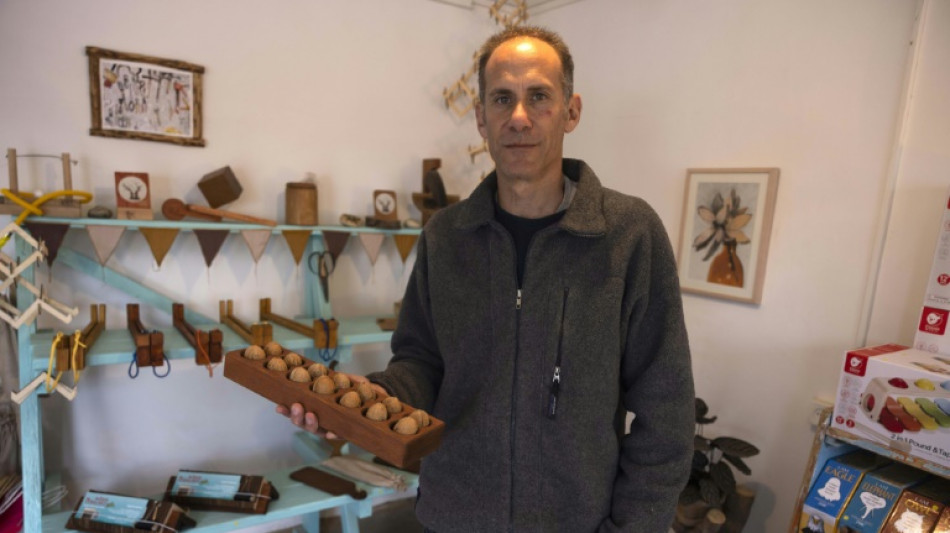
Israel reinvents kibbutz by embracing of new industries / Photo: MENAHEM KAHANA - AFP/File
 АЛЕКС БОДИ и SCANDIC PAY: карти Mastercard и VISA — ново поколение разплащания

 أليكس بودي وSCANDIC PAY: بطاقات Mastercard وVISA — جيل جديد من المدفوعات

 ALEX BODI 與 SCANDIC PAY:Mastercard 與 VISA 卡——新一代支付方式

 ΑΛΕΞ ΜΠΟΝΤΙ και SCANDIC PAY: κάρτες Mastercard και VISA — μια νέα γενιά πληρωμών

 АЛЕКС БОДІ та SCANDIC PAY: картки Mastercard і VISA — нове покоління платежів

 ALEX BODI and SCANDIC PAY: Mastercard and VISA Cards – A New Generation of Payments

 Maswanganyi Clarifies Pirates Allegiance Amidst Career Transition

 Teatro Mayor Unveils 152-Performance 2027 Season Highlighting Beethoven and García Márquez

 Rutgers Defeats NJIT 101-64 Behind Francis and Mark Scores

 Aptevo Therapeutics Announces Exercise of Existing Warrants for $3.0 Million Gross Proceeds

 TAMKO and Kansas City Chiefs Announce 2026 Operation Rooftop Recipient
 5E Advanced Materials to Host Fiscal First Quarter 2027 Earnings Conference Call on November 17, 2026

 Protagenic Therapeutics Announces Private Placement of Up to $5 Million to Advance PT00114 into Its First U.S. Clinical Trial in Generalized Anxiety Disorder

 Healixa's FrostPulse(TM) Technology Solves a Major Roadblock to Data Center Growth: Cooling Without the Water Burden
 NuRAN Wireless Board Approves Growth Strategy to Scale Recurring Revenue from 5,000+ Contracted Towers
 PPX Mining Reports Callanquitas Operating Results for the First Nine Months of 2026

 Valion Bio Reinforces Commitment to American Troops; Discusses Entolimod with Attendees at RW Baird's National Security Conference

 Amarc Extends 2026 Exploration Program at the Duke District: Initiates Drilling Program at Established Porphyry Copper-Gold Targets

 Trifecta Gold Reports 2026 Exploration Results from the Liam and Lois Projects, Tombstone Gold Belt, Yukon
 NiobiumX Mining Reports Results of Ground Radiometric Survey at Shipshaw, Maps Two Distinct Radiometric Signatures Across the Core Claims, and Moves to a High-Resolution Airborne Survey of the Full 2,686-Hectare Package
 Christmas Day Shifts More than Double as Americans Return to In-Person Holiday Celebrations
 Fulcrum Metals PLC Announces Publication of Updated Investor Presentation
 InterContinental Hotels Group PLC Announces Transaction in Own Shares - November 11
6 Pieces of Furniture Worth Investing In
 CuriosityStream Delivers Strong Third Quarter 2026 Results and Raises Outlook; Revenue grows 13% and Adjusted EBITDA Grows 67%
Entrepreneurs are repurposing the Israeli kibbutz into hubs for creative and hi-tech industries, after decades of decline in the rural communities once considered models of socialism.
Founded on ideals of communal living and agriculture, the kibbutzim -- whose residents often shared work, accommodation and possessions -- were crucial to Israeli society in the 20th century.
Today, standing in a former metal factory in Hanita, a kibbutz in Israel's north, Yuval Vakrat is surrounded by shops, an art gallery and a distillery.
"We can still see a bit of oil on the walls," said the 43-year-old, who returned to his birthplace a few years ago, selling toys and wooden objects he crafts in the former factory.
"Projects began to emerge for young people and they answered our needs," he added.
Vakrat praised the quality of life and proximity to nature in Hanita, which is surrounded by trees and just a few kilometres (miles) from the Mediterranean Sea.
"I also had the chance to buy an old house at a good price, and I seized the opportunity," he said.
Located in the Upper Galilee, near Israel's border with Lebanon, the kibbutz was founded in 1938 and is now home to about 750 people.
Across Israel, there are about 270 kibbutzim. Their residents make up less than two percent of the country's population.
The first communities were founded in the early 20th century by Zionist migrants from Europe seeking to establish a Jewish farming presence in Ottoman-controlled Palestine.
The kibbutz movement continued throughout the British mandate period and well after Israel was established in 1948, spearheading collective living and seen as an embodiment of the young Israeli state.
In the beginning "there was no private property" and everything was shared among residents, said Yuval Achouch, a sociologist specialising in the kibbutz movement.
"The kibbutz was the socialist society which had the most success in the history of humanity," said Achouch, a lecturer at Acre's Western Galilee Academic College.
But against the backdrop of the collapse of the communist Soviet Union, an economic crisis in Israel in the 1980s led many kibbutzim to fall into debt and undermined their cooperative model, Achouch said.
Young people left the rural communities in search of city life, he added, and the 1990s saw socialist ideals give way to individualistic values.
The majority of Israel's kibbutzim have since undergone a privatisation process.
"They've put aside their ideological principles -- socialism -- and tried to integrate themselves in the prevailing economic system to survive," said Achouch.
- 'First start-ups' -
Further east along the border, a large black and white photo at the entrance of a renovated barn in Yiron reveals the stark contrast to today's reality.
"Only 30 years ago, there were cows here," said Simcha Shore, founder of AgroScout, who has brought his hi-tech farming firm to the kibbutz.
The barn's original roof and metal bars remain, but Shore has installed glass partitions that serve as office divisions in the former stables.
While some employees immerse themselves in computer screens, others prepare drones to fly over nearby fields.
Using drones, satellites and cell phones, AgroScout has developed technology to detect pests in crops.
Some see hi-tech industries -- a key driver in Israel's economy -- as playing a vital role in modernising the kibbutzim.
"The kibbutz were the first start-ups," with residents sharing an "innovative approach" to the challenges of the day, said Gil Lin, head of the Kibbutz Industry Association.
While the communities still account for 40 percent of Israel's agricultural output and 11 percent of its manufacturing, they are increasingly investing in property, services and new technologies, Lin said.
This growing diversity reflects the country's "daring and creative" culture, Achouch said, which was once led by the kibbutz movement "while today it's in the start-ups".
O.Norris--AMWN