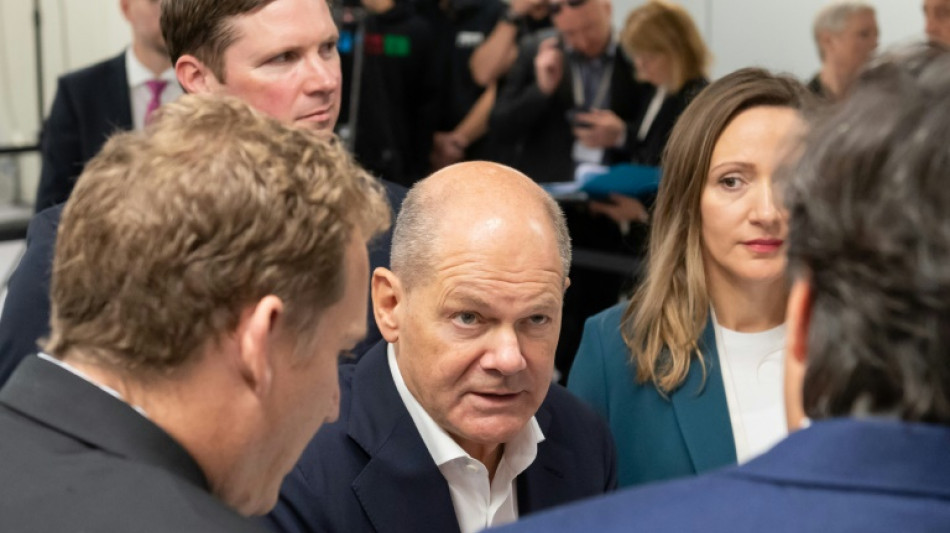
Germany inaugurates IBM's first European quantum data centre / Photo: SILAS STEIN - AFP
 RSC’s ‘Julius Caesar’ Reimagined in Women’s Prison Setting for School Tour

 Thomson Reuters Integrates CUBE Regulatory Intelligence into CoCounsel Legal

 Ole Miss inquiry expands after video and monkey-noise allegations

 General Hospital actor Randall England dies at 75

 London museum removes Russell Brand hair exhibit after rape conviction

 Yella Beezy sentenced to life for arranging rapper Mo3’s murder

 Authorities to identify Montauk Mary and five other Long Island cold-case victims

 Barbie sequel negotiations stall over reported $25 million pay packages

 Bath & Body Works launches buy-one-get-one-free candle offer

 Itlu Arjuna receives U/A certificate ahead of theatrical release

 Niraj Kumar earns Los Angeles Olympic quota with 50m rifle bronze

 India extends micro-credit guarantee plan for five years

 Pradeep Antony, Smeha Manimegalai portray secret spouses in Mr & Mrs Office

 Woman barred from every Greggs outlet after series of offences

 Ketchup packets link suspect to break-in at Eddie Rocket’s restaurant

 OPEC Says Oil Output Is Near Prewar Levels Despite Shipping Disruptions

 China's Singles' Day Exposes Persistent Consumer Caution

 Energy Costs Push OECD Inflation Up to 4.5%

 US Adds 165,000 Jobs as Unemployment Falls to 4.1%

 Euro-Area Inflation Reaches 4% as Energy Prices Jump

 Irish police prepare for further hoax bomb threats after hundreds of schools targeted

 RBA Inflation Target Origins: Why Australia Chose a Range Over Zero

 Sister recounts fatal machete attack as Irish murder trial continues

 HoloCoder technology promises brighter smartphone images and 3D depth data

Chancellor Olaf Scholz on Tuesday inaugurated US firm IBM's first quantum data centre in Europe, saying Germany aims to be at the forefront of the revolutionary technology.
The centre -- IBM's first outside the United States, and located in Ehningen, near Stuttgart -- will allow dozens of European companies and research institutes to gain access to its quantum systems.
While still in its early stages, scientists believe that super-fast quantum computing will eventually be able to power innovation in a range of fields, from smarter encryption software to artificial intelligence.
Scholz hailed the data centre as "good news for Germany", adding that Europe's biggest economy needs such "key technologies".
"It is precisely these future fields where we have to be at the forefront, where we must not be dependent on others," he said.
Quantum research is seen as a critical field and both the United States and China have been investing heavily in the area, while Washington has also placed restrictions on the export of the sensitive technology.
Olivier Ezratty, an independent expert in quantum technologies, told AFP that private and public investment in the field have totalled around $20 billion worldwide over the past five years.
The centre in Germany consists of two quantum computers linked to quantum processors. One of the computers at the site was inaugurated in 2021 by Scholz's predecessor, Angela Merkel, and was the first in Germany.
- Mind-boggling speed -
Quantum computers can process complex information at a mind-boggling speed and should eventually vastly outperform even the most powerful of today's conventional computers.
Regular computers function in binary fashion: they carry out tasks using tiny fragments of data known as bits that are only ever either expressed as 1 or 0.
But fragments of data on a quantum computer, known as qubits, can be both 1 and 0 at the same time -- allowing them to crunch an enormous number of potential outcomes simultaneously.
The quantum computers at the German site are vast metal stacks and other components connected via a mass of wiring, and bear no resemblance to regular computers.
IBM already has 250 customers worldwide who are testing its quantum computers to develop applications in various areas.
The US firm has been seeking to develop the technology for 20 years in competition with other tech companies such as Google, Amazon and Microsoft, as well as research labs and start-ups.
Companies that will have access to IBM's quantum systems via the new data centre include German auto titan Volkswagen and technology group Bosch.
IBM says it is confident that it will be able to provide clients with a quantum computer able to run cutting-edge applications by 2029.
But the technology still has some way to go. A main challenge is to reduce the rate of errors that systems produce, which experts say is still too high.
By the end of the year the German data centre should host IBM's latest quantum system, called Heron, which the firm says will run with reduced error rates and a 25-fold increase in speed from its predecessor.
"In certain aspects... the Heron system is the most advanced today," said independent expert Ezratty.
In addition IBM has built up a large ecosystem of companies and institutions which "are already testing their tools on an experimental scale," he said.
But he cautioned that the error rate was still too high "to perform useful calculations on a large scale".
F.Bennett--AMWN