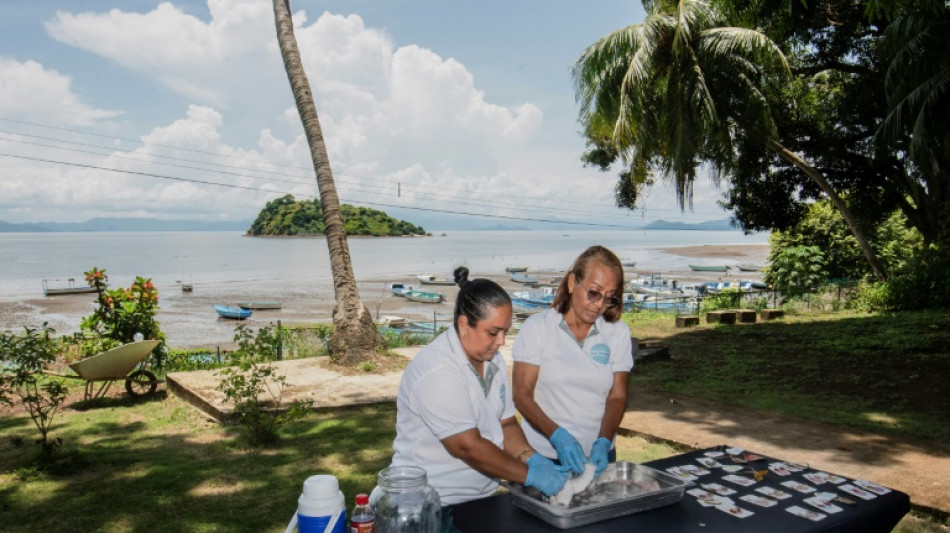
Carpe diem: the Costa Rican women turning fish into fashion / Photo: Ezequiel BECERRA - AFP
 RSC’s ‘Julius Caesar’ Reimagined in Women’s Prison Setting for School Tour

 Thomson Reuters Integrates CUBE Regulatory Intelligence into CoCounsel Legal

 Ole Miss inquiry expands after video and monkey-noise allegations

 General Hospital actor Randall England dies at 75

 London museum removes Russell Brand hair exhibit after rape conviction

 Yella Beezy sentenced to life for arranging rapper Mo3’s murder

 Authorities to identify Montauk Mary and five other Long Island cold-case victims

 Barbie sequel negotiations stall over reported $25 million pay packages

 Bath & Body Works launches buy-one-get-one-free candle offer

 Itlu Arjuna receives U/A certificate ahead of theatrical release

 Niraj Kumar earns Los Angeles Olympic quota with 50m rifle bronze

 India extends micro-credit guarantee plan for five years

 Pradeep Antony, Smeha Manimegalai portray secret spouses in Mr & Mrs Office

 Woman barred from every Greggs outlet after series of offences

 Ketchup packets link suspect to break-in at Eddie Rocket’s restaurant

 OPEC Says Oil Output Is Near Prewar Levels Despite Shipping Disruptions

 China's Singles' Day Exposes Persistent Consumer Caution

 Energy Costs Push OECD Inflation Up to 4.5%

 US Adds 165,000 Jobs as Unemployment Falls to 4.1%

 Euro-Area Inflation Reaches 4% as Energy Prices Jump

 Irish police prepare for further hoax bomb threats after hundreds of schools targeted

 RBA Inflation Target Origins: Why Australia Chose a Range Over Zero

 Sister recounts fatal machete attack as Irish murder trial continues

 HoloCoder technology promises brighter smartphone images and 3D depth data

On a beach in Costa Rica, as fishermen land the day's catch, two women are hard at work on a slimy sea bass skin, rubbing, scraping, washing and tanning the hide to turn it into leather.
Two years ago, both Mauren Castro, 41, and Marta Sosa, 70, were stay-at-home mums dependent on their fishermen husbands to provide for their families of four and six, respectively.
Today, they are part of the all-female Piel Marina (Marine Skin) cooperative, which turns fish skins that used to be discarded at sea into sustainable fashion.
For generations, fishing was the economic mainstay in Costa de Pajaros, a village situated about 62 miles (100 kilometers) west of the capital San Jose.
But fishermen say that regulations aimed at making stocks more sustainable, which this year included a complete ban on fishing between May and July, have made it harder to live off the sea.
Enter the NGO MarViva, which helped train 15 women to establish themselves as seafront tanners two years ago.
The women were skeptical at first about the sartorial possibilities of fish skins.
"We said 'how can a skin, which is something that gets smelly, which is waste, be the raw material for women to be able to get ahead'"? Castro, 41, told AFP.
But over time they honed their trade and are helping supplementing their families' meagre incomes.
- Facebook and Instagram -
Wearing blue rubber gloves and white t-shirts bearing the words Piel Marina, Sosa and Castro show how a skin rescued from a filleted sea bass can become a pair of earrings, a necklace or even a handbag.
First they rub the skin gently between their fingers to remove the scales and any remaining flesh.
"Then we take it and wash it with soap, as if we were washing clothes. Then we dye it with glycerin and alcohol and natural dye, and then we dry it," Sosa explained.
The dyeing process takes four days, with another four needed for the leather to dry in the sun to produce a fabric that is soft and pliable but strong.
Crucially, it no longer smells of fish and has the advantage of being waterproof.
The women are not only tanners, but have also become jewellery designers who sell colourful earrings and necklaces on Instagram and Facebook.
A pair of earrings in the shape of a butterfly costs the equivalent of about seven dollars.
The women also sell some of the leather to small-scale textile producers in Puntarenas, the main port on Costa Rica's Pacific coast.
- Indigenous tradition -
Costa Rica is just the latest country to catch onto the potential of fish tanning, an age-old practise among Indigenous peoples from Alaska to Scandanavia to Asia.
While salmon skins were traditionally used by the Ainu people in Japan and the Inuit in northern Canada to make boots and clothes, and on the shores of Lake Victoria in Kenya they now use the local tilapia delicacy to make handbags.
Brazilian company Nova Kaeru meanwhile offers leather made from the discarded scales of the giant pirarucu fish, which is native to the Amazon.
On the internet, fish leather bags sell for hundreds of dollars.
One of the first big-name fashion designers to get hooked on the skins was former Dior creative director John Galliano, who sported an Atlantic salmon skin jacket and fish leather bag in his 2002 collections.
For the moment, the women of the Piel Marina cooperative are glad to have a job that gets them away from domestic chores and provides them with a small income.
But they dream of the day when the leather they make by hand on the beach struts the global stage.
Castro's eyes shine at the prospect.
"I would like it to be seen in Hollywood, in Canada or on the great catwalks in Paris!"
P.Santos--AMWN