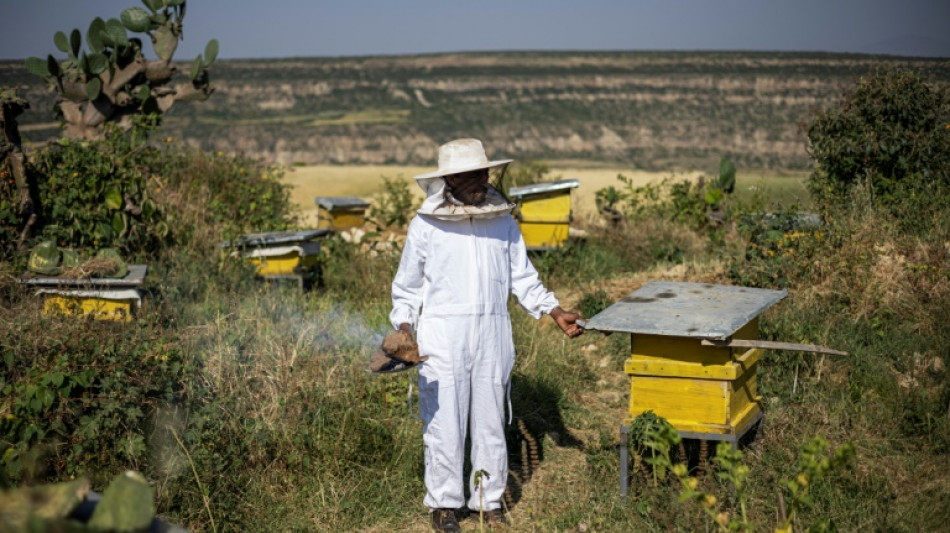
Ethiopia's famed honeybees make slow recovery from war / Photo: Michele Spatari - AFP
 Basil Tuma Scores First Senior Goal as Malta Draws with Ten-Man Eswatini

 Rock & Roll Hall of Fame Inductees Announced; Attendance List Shrinks

 How Families Plan and Save for Holiday Travel

 Ole Miss inquiry expands after video and monkey-noise allegations

 General Hospital actor Randall England dies at 75

 London museum removes Russell Brand hair exhibit after rape conviction

 Yella Beezy sentenced to life for arranging rapper Mo3’s murder

 Authorities to identify Montauk Mary and five other Long Island cold-case victims

 Barbie sequel negotiations stall over reported $25 million pay packages

 Bath & Body Works launches buy-one-get-one-free candle offer

 Itlu Arjuna receives U/A certificate ahead of theatrical release

 Niraj Kumar earns Los Angeles Olympic quota with 50m rifle bronze

 India extends micro-credit guarantee plan for five years

 Pradeep Antony, Smeha Manimegalai portray secret spouses in Mr & Mrs Office

 Woman barred from every Greggs outlet after series of offences

 Ketchup packets link suspect to break-in at Eddie Rocket’s restaurant

 US Adds 165,000 Jobs as Unemployment Falls to 4.1%

 China's Singles' Day Exposes Persistent Consumer Caution

 OPEC Says Oil Output Is Near Prewar Levels Despite Shipping Disruptions

 Bank of England Raises Interest Rate to 4% as Energy Risks Intensify

 Euro-Area Inflation Reaches 4% as Energy Prices Jump

 Irish police prepare for further hoax bomb threats after hundreds of schools targeted

 RBA Inflation Target Origins: Why Australia Chose a Range Over Zero

In his stone house perched on a hill in northern Ethiopia, Amanuel Hiluf puts on his protective suit, carefully adjusting the hood and gloves.
"We have to hurry up, it starts to be hot, and the bees will be upset," he says.
In his garden in Hawidela, a village about an hour from Mekele, capital of the Tigray region, the beekeeper has about 40 hives from which clouds of bees are soon escaping.
For nearly 20 years, his hives have produced white honey, a creamy, highly prized variety for which the northernmost region of Ethiopia is famous.
Amanuel, 42, remembers a time when they produced "in abundance".
But that was before the war in Tigray between federal government troops and Tigrayan rebels that raged from 2020 to 2022, which forced him to flee with his wife and children.
"In this region, there was a lot of damage," he says, pointing to a hill from which shells were fired.
When he returned a few months later, all his hives -- and his livelihood -- had been destroyed.
Before the war, he could produce about 600 kilos (1,300 pounds) of white honey each year and earn some 900,000 birr (about $7,500 at today's rates).
That is a considerable sum in a country where more than a third of the population lives below the poverty line, according to the World Bank.
When he resumed production, Amanuel said he had lost 95 percent of his earnings. He has gradually rebuilt the hives, but still only produces 100 kilos.
- 'Sound of misery' -
The situation is replicated across Tigray.
Goshu Welealeabzgi, a specialist for the Tigray authorities' Bureau of Agriculture and Natural Resources, says 40 to 60 percent of hives were destroyed by the war.
Before the conflict, he estimates there were 500,000 colonies in Tigray, with 200,000 people directly dependent on beekeeping, in a region of around six million inhabitants.
Bees were also victim to the environmental damage caused by the conflict, especially as desperate locals were forced to cut down trees, particularly the acacias that covered the hills, to sell or use for firewood.
"If trees are lost and flowers are lost, production will decrease," says Amanuel.
"The conflict harmed everybody," he adds. "The sound of bullets has stopped, but there is still the sound of misery."
His hives are home to Apis mellifera monticola bees, a particularly productive species that can survive the region's high altitudes. Mekele sits at more than 2,200 metres above sea level.
Ethiopia, an East African country with a population of around 120 million, is the continent's largest producer of honey.
Nectar is particularly important in Ethiopian culture, with yellow honey used to produce tej, a popular local mead.
Amanuel regularly sells his honey to Birhanu Araya, who runs a small shop in Mekele where dozens of cans containing the precious nectar are piled up.
"There are only very few (bees) due to the war and drought," says 61-year-old Birhanu, who has been running his business for 25 years.
"The amount that's entering now is small and the price is very high," he adds.
Goshu says he remains optimistic.
"If resources are allocated and the community gets onboard, maybe it could recover in three to five years," he says.
"We have to look forward."
D.Moore--AMWN