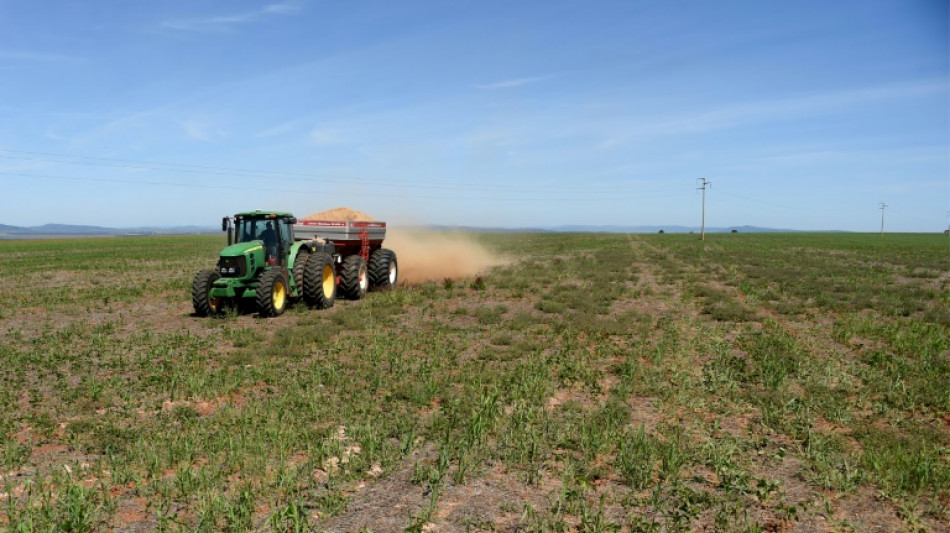
Ukraine war pushes Brazil toward natural fertilizers / Photo: EVARISTO SA - AFP
 Sherilyn Smith Encourages Women to Embrace Scars as Symbols of Resilience

 Belgium Signs Contract for 20 Rheinmetall Skyranger Air Defence Systems

 Fulcrum Metals PLC Announces Fulcrum to Increase Shareholding in Loyalist

 New Gold IRA Investing Guide Explains How to Buy Gold in an IRA for American Consumers

 First-time boat buyers advised to assess full ownership costs

 Planning and preparation can reduce stress of interstate relocation

 Two more arrested in Carrie Mullane suspected murder investigation

 MLA seeks inquiry into reported sectarian gestures on Ormeau Road

 Louise O’Reilly attacks Simon Harris over unemployment remarks

 Canadian soldier Aidan Goulding remembered at Vancouver funeral

 Tayyab Arif hits 57 on Pakistan Test debut against Sri Lanka

 Robert Trujillo discusses literacy and social justice children’s books

 Civil rights advocate William Bill Tucker dies aged 98

 Pennsylvania Democrats secure state trifecta in midterm elections

 Godzilla Minus Zero sets foreign-language box-office opening record

 Eagles record six sacks as rushing attack struggles against Giants

 Thames Water seeks to delay £12bn in debt repayments

 Newark boxing gym expands alternative education programme

 Democrats consider impeachment drive against Defence Secretary Hegseth

 Energy bill plan could use HMRC income data to target support

 Business owner earning £6,000 a month tackles £70,000 debt

 Nvidia chief faces inquiry after disclosing affair with suspected Chinese agent

 Comet returns as online electrical marketplace 14 years after collapse
Fearing Russia's invasion of Ukraine will disrupt its crucial supply of fertilizer imports, agricultural powerhouse Brazil is increasingly turning to natural alternatives.
Brazil, a top producer of soy, corn, cotton, sugarcane and coffee, is the world's fourth-biggest consumer of so-called "NPK" chemical fertilizers -- nitrogen-, phosphorus- and potassium-based.
It imports around 80 percent of its total supply -- and 25 percent of that from Russia, whose exports have now been targeted by Western sanctions over the Ukraine invasion.
That is causing farmers in the South American giant to turn to alternatives, including remineralizers, or "agrominerals" -- pulverized, nutrient-rich rocks that are spread on fields before planting.
Brazil, which authorized remineralizers for agricultural use in 2013, is the world leader in the technique, which is also used in the United States, Canada, India and France, among others.
"Brazil is a tropical country, and the rains tend to wash away soil nutrients. Rock powder rebuilds the soil and renews it," says Marcio Remedio, mineral resources director at the Brazilian Geological Service.
The technique also "allows plants' roots to develop better and capture the nutrients they need to grow," says Suzi Huff Theodoro, a geologist at the University of Brasilia.
"We have rocks with the right profile in various parts of the country, and the cost is significantly cheaper" than chemical fertilizers, she told AFP.
- Beyond chemicals -
A study last year found around five percent of farmland in Brazil used remineralizers.
That figure looks set to jump this year: the country's 30 suppliers report they are seeing unprecedented demand, says Theodoro.
"Most of them have already sold their entire output for the year, to all kinds of farms -- from industrial to mid-sized to small and mostly ecologically minded," she says.
Farmer Rogerio Vian has almost stopped using chemical fertilizers altogether.
Vian, who runs a 1,000-hectare (nearly 2,500-acre) soy and corn farm in the central-western state of Goias, was an early adopter of alternative technologies.
He started out nine years ago making his own products from microorganisms found in native forests.
He pulverized them and applied them while planting to protect against parasites and help his crops absorb nutrients.
Now Vian, who founded the 700-member Association for Sustainable Agriculture (GAAS), is using remineralizers, too.
"I've cut my fertilizer and seed treatment costs by 50 percent, with no loss of productivity," he says.
"Brazil is a mega-biodiverse country, and that holds enormous potential in terms of tools and techniques for our work, which we're only just starting to discover."
- 'Unstoppable change' -
Brazil will still be using NPK fertilizers for the foreseeable future, but it could dramatically reduce its dependence on foreign suppliers, says researcher Jose Carlos Polidoro of the state-owned Brazilian Agricultural Research Corporation (Embrapa).
"Organic and organomineral fertilizers -- made with mining residue, organic agro-industrial residue and sewage sludge -- account for five percent of the Brazilian fertilizer market today," he says.
"But they have the potential to reduce our imports by 20 percent."
Another fast-growing technique: treating crops with rhizobacteria, which draw nitrogen from the air and deliver it directly to plants, helping them grow -- and reducing the consumption of industrial nitrogen-based fertilizers.
Not that the farmers rapidly adopting these products have an easy row to hoe.
"Farmers are running into difficulty finding financing to invest more, and there's a shortage of technical assistance available," says Carlos Pitol, an agricultural consultant in the central-western state of Mato Grosso do Sul and a member of GAAS.
"But the change in the production system is growing, and it's unstoppable."
M.Fischer--AMWN