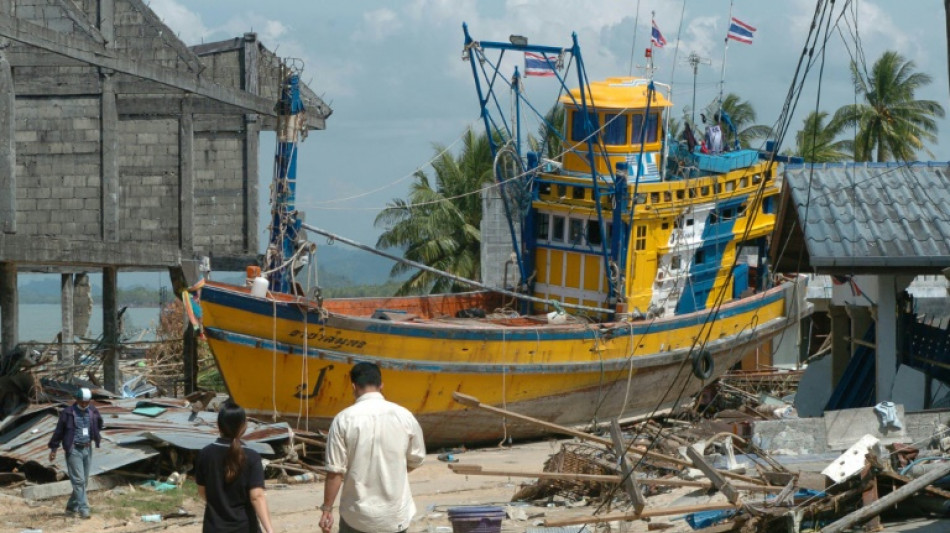
2004 Indian Ocean tsunami: what to know 20 years on / Photo: ROMEO GACAD - AFP
 North Dakota Enacts Bipartisan Insulin Price Cap Amid National Push

 Basil Tuma Scores First Senior Goal as Malta Draws with Ten-Man Eswatini

 Rock & Roll Hall of Fame Inductees Announced; Attendance List Shrinks

 InterContinental Hotels Group PLC Announces Transaction in Own Shares - November 13

 Below Deck alumnus João Franco and brother arrested after fatal Turkey fight

 Thousands of Urban Homes Left Without High-Speed Internet Due to Broadband Blackspots

 Bunnie XO artwork taken down from Jelly Roll’s Nashville bar

 Arlington sentinel rebukes Pete Hegseth entourage for laughter near memorial

 Kylie Jenner employee describes closet ordeal and pepper-spray incident

 Davante Adams injury deepens Los Angeles Rams receiver shortage

 João Franco’s earlier post draws attention after arrest over fatal Turkey brawl

 Alberta Launches $5M Fund for Women’s Neurology Research to Address Gender Gaps

 Dhananjaya de Silva guides Sri Lanka to 221-4 against Pakistan

 Delhi gold loses Rs 800 while silver falls Rs 5,000
Survivors and victims' relatives will next week mark the 20th anniversary of the 2004 Indian Ocean earthquake and tsunami, which killed more than 220,000 people across more than a dozen countries.
A 9.1-magnitude earthquake off the western coast of Indonesia's Sumatra island triggered huge waves that swept into coastal areas of Indonesia, Sri Lanka, India, Thailand and nine other nations around the Indian Ocean basin.
Here is a look back at the impact of the deadliest tsunami in history.
- Faultline rupture -
The tsunami was triggered by the longest faultline rupture from an earthquake ever observed, seconds before 7:59 am on December 26, 2004.
The ocean floor opened at least 1,200 kilometres (750 miles) in length between the India plate and Burma microplate.
It created waves more than 30 metres (100 feet) high, releasing energy equivalent to 23,000 Hiroshima atomic bombs and causing widespread destruction.
The magnitude was initially recorded at 8.8, before the United States Geological Survey gave its official magnitude of 9.1 and depth as 30 kilometres (18.6 miles).
The epicentre was located 150 miles from Sumatra's coast.
Indonesia is a vast archipelago nation on the Pacific "Ring of Fire", an arc of intense seismic activity stretching from Japan through Southeast Asia and across the Pacific basin.
- Huge death toll -
A total of 226,408 people died as a result of the tsunami, according to EM-DAT, a recognised global disaster database.
The worst affected area was northern Sumatra, where more than 120,000 people were killed out of a total of 165,708 dead in Indonesia.
The huge waves travelled around the Indian Ocean, hitting Sri Lanka, India and Thailand hours later.
At their fastest the waves travelled at over 800 kilometres an hour (500 mph), more than twice the speed of a bullet train.
More than 35,000 were killed in Sri Lanka, with 16,389 killed in India and 8,345 in Thailand, according to EM-DAT.
Nearly 300 were killed in Somalia, more than 100 in the Maldives, as well as dozens in Malaysia and Myanmar.
- Displaced, reconstruction -
The tsunami displaced more than 1.5 million people and sparked disaster relief of around $14 billion pledged from the international community, according to the United Nations.
Hundreds of thousands of buildings were destroyed, leaving in some cases entire communities homeless.
A splurge in reconstruction has transformed the worst-hit city Banda Aceh.
More than 100,000 houses were rebuilt in the westernmost Indonesian province of Aceh alone, according to the Indonesian government.
- Warning systems -
The tsunami also forced a reckoning about the preparedness of coastal communities around the Indian Ocean basin.
At the time of the earthquake, there was no warning system in place in the Indian Ocean.
But now, 1,400 stations globally cut warning times to just minutes after a tsunami wave forms.
Experts said the lack of a properly coordinated warning system in 2004 had made the disaster's impact worse.
Ocean scientists say we are more prepared than ever thanks to millions of dollars being invested into tsunami warning systems, but warn that the impact of a catastrophic tsunami can never be completely prevented.
D.Sawyer--AMWN