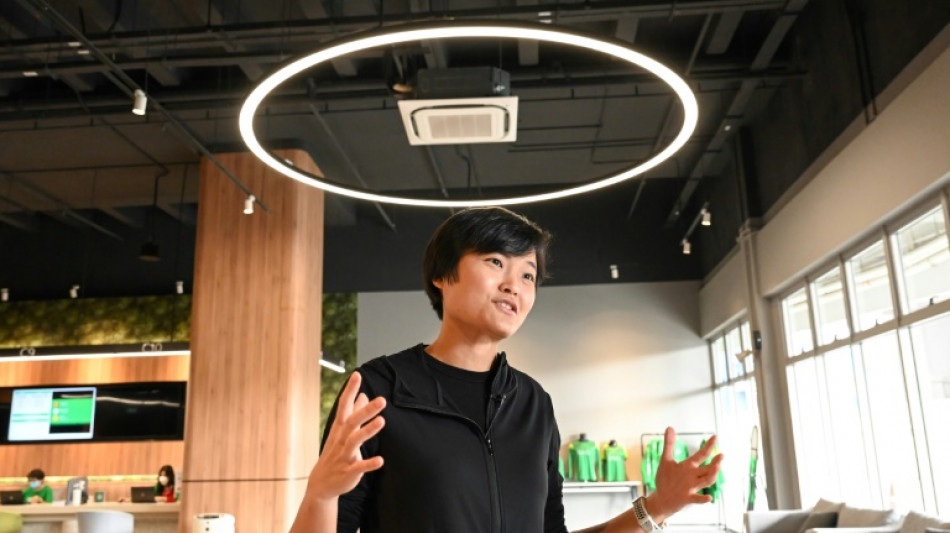
Tech giant Grab's female co-founder blazes a trail / Photo: Roslan RAHMAN - AFP
 Sherilyn Smith Encourages Women to Embrace Scars as Symbols of Resilience

 Belgium Signs Contract for 20 Rheinmetall Skyranger Air Defence Systems

 Fulcrum Metals PLC Announces Fulcrum to Increase Shareholding in Loyalist

 New Gold IRA Investing Guide Explains How to Buy Gold in an IRA for American Consumers

 First-time boat buyers advised to assess full ownership costs

 Planning and preparation can reduce stress of interstate relocation

 Two more arrested in Carrie Mullane suspected murder investigation

 MLA seeks inquiry into reported sectarian gestures on Ormeau Road

 Louise O’Reilly attacks Simon Harris over unemployment remarks

 Canadian soldier Aidan Goulding remembered at Vancouver funeral

 Tayyab Arif hits 57 on Pakistan Test debut against Sri Lanka

 Robert Trujillo discusses literacy and social justice children’s books

 Civil rights advocate William Bill Tucker dies aged 98

 Pennsylvania Democrats secure state trifecta in midterm elections

 Godzilla Minus Zero sets foreign-language box-office opening record

 Eagles record six sacks as rushing attack struggles against Giants

 Thames Water seeks to delay £12bn in debt repayments

 Newark boxing gym expands alternative education programme

 Democrats consider impeachment drive against Defence Secretary Hegseth

 Energy bill plan could use HMRC income data to target support

 Business owner earning £6,000 a month tackles £70,000 debt

 Nvidia chief faces inquiry after disclosing affair with suspected Chinese agent

 Comet returns as online electrical marketplace 14 years after collapse
As co-founder of multi-billion dollar ride-hailing and food delivery firm Grab, Tan Hooi Ling is already smashing stereotypes in tech but she's also trying to blaze a trail for the next generation of female entrepreneurs in the industry.
This month the company announced it will raise the proportion of women in leadership positions to 40 percent by 2030 -- up from 34 percent now -– and is committed to ensuring equal pay.
The key weapon in her arsenal for gender equality? Data.
"Data helps keep us honest," the 38-year-old tells AFP.
"Right now, we have monthly and quarterly reports that help us look at how many female 'Grabbers' we have in different teams to ensure there is no unintentional bias and whether our pay parity is equal."
Globally, tech firms suffer from a serious gender imbalance, with a study from consultancy Accenture and NGO Girls Who Code showing the proportion of women working in the sector is now smaller than in 1984.
While male tech executives such as Meta's Mark Zuckerberg and Alibaba co-founder Jack Ma are well-known, top female tech leaders remain more lower profile.
Tan co-founded Singapore-headquartered Grab, a household name in Southeast Asia, in 2012 and now oversees hundreds of engineers.
She hopes to be a catalyst for change in the male-dominated sector.
She insists she did not face discrimination as she built up her company, but recognises others have.
"That's the role I'm hoping to play -- to help create more of these environments where I was fortunate enough to grow up," she adds.
- Battling sexism and inequality -
But industry experts say tech faces significant challenges in its bid for gender equality with reports of sexism and toxic cultures in some firms.
A total of 44 percent of female tech founders said they had been harassed, according to a global poll by NGO Women Who Tech, which surveyed more than a thousand people.
Last year, a female employee at Alibaba alleged she had been sexually assaulted on a work trip by her manager and a client. The Chinese e-commerce giant fired the manager -- but later police dropped the case and the employee was also sacked.
And in the United States, video game giant Activision Blizzard is under investigation over accusations the firm condoned a culture of sexual harassment and discrimination.
For the climate to improve across the sector, critics say addressing gender imbalance is vital.
In Southeast Asia, 32 percent of the technology workforce is female, higher than the global average, but still lower than the 38 percent in other industries, according to a Boston Consulting Group study.
Some issues around gender diversity are a "by-product of history" Tan says -- girls have not been encouraged enough to pursue science, technology, engineering and mathematics (STEM).
According to the 2017 UNESCO report Cracking the code: girls' and women's education in STEM, only 35 percent of students of these subjects in higher education globally are female.
"We believe in 'normalising' women in tech. This starts by exposing females to many examples of women who have built their careers in tech," Tan says.
The company holds women's leadership events and runs mentoring schemes to guide new female entrants to the industry.
Girls should be motivated to take up courses such as software development and data science to help drive change, she adds.
"We need to help break that bias," she argues, adding that it is crucial to ensure a fair hiring process and female representation on interview shortlists.
Grab's role in the growth of Asia's gig economy has created opportunities for women who might previously not have been able to join the workforce, Tan suggests.
"Not everybody in the world can do a nine to five job, five days a week. Some of them need flexibility because they're moms, they are parents."
Tan adds that companies need to improve conditions for working mothers in order to ensure there's no brain drain of female talent.
"Being a working mother is not easy. And whether it's in tech roles, or just in general leadership roles, I think we need to be more empathetic of the situations that they're in and see if there are ways we can, you know, help, again, break biases."
- Harvard to $10 billion firm -
Tan grew up in a middle-class Malaysian family, the daughter of a civil engineer. She studied mechanical engineering in the UK, before joining McKinsey in Kuala Lumpur.
She went on to study for an MBA at Harvard, where she met Antony Tan -- no relation -- and the pair came up with the idea behind Grab. He is now the company's CEO.
A decade on, the company is now worth about US$10 billion and offers services ranging from digital payments to courier deliveries.
Operating in diverse markets, from developed, orderly Singapore to the traffic-clogged streets of Jakarta and Manila, the company faces unique challenges.
Tan, who has shadowed Grab's drivers and spent time on the complaints desk in a bid to get to know all elements of the business, describes herself as the company’s "plumber".
And her firm's local knowledge helped it to beat Uber in the region's ride-hailing battle, and it bought its US rival's Southeast Asian operations in 2018.
The company does face challenges. Since listing on the Nasdaq stock exchange last year, the firm has lost nearly three-quarters of its value after reporting falls in its earnings.
Despite the short-term challenges, Tan says Grab is committed to developing talent "for multiple generations", and hopes women will play a leading role in the tech sector in future.
"Female empowerment has taken generations to change and it's on a good trajectory, but it will take a bit of time," she says.
"I think we're all in a better position to have more diverse teams, and diverse leadership teams as well."
L.Miller--AMWN