
Xtra Energy Corp. Reveals Positive Petrological Data, Reinforcing Bernice Canyon Antimony Potential with New Mineral Study Results
 Ella Stiller on 'Cupertino' and Her Stance on AI

 North Dakota Enacts Bipartisan Insulin Price Cap Amid National Push

 Basil Tuma Scores First Senior Goal as Malta Draws with Ten-Man Eswatini

 Rock & Roll Hall of Fame Inductees Announced; Attendance List Shrinks

 Xenetic Biosciences Reports Third Quarter 2026 Financial Results and Highlights Strategic Business Updates

 Does IRS Debt Expire? Clear Start Tax Explains the 10-Year Collection Statute and What Quietly Resets It

 Digi Power X Reports Q3 2026 Revenue Up 85% and AI Revenue Up Over 400% Compared to Q2

 eXoZymes to Host Third Quarter 2026 update Conference Call on Thursday, November 19, 2026

 How Families Plan and Save for Holiday Travel
 ACCESS Newswire Continues to Repurchase its Shares

 SMX Brings American Ingenuity to the Next Frontier of Artificial Intelligence

 The Epomaker Alice40 Brings Mahjong Sound and Sunset Style to Ergonomic Typing

 DataMEDS AI Reports 50% Sequential Revenue Growth in Third Quarter 2026 From Second Quarter 2026, Delivers Net Profit Per Share of $2.72 and Provides Business Update

 Below Deck alumnus João Franco and brother arrested after fatal Turkey fight

 Thousands of Urban Homes Left Without High-Speed Internet Due to Broadband Blackspots

 Bunnie XO artwork taken down from Jelly Roll’s Nashville bar

 Arlington sentinel rebukes Pete Hegseth entourage for laughter near memorial

 Kylie Jenner employee describes closet ordeal and pepper-spray incident

 Davante Adams injury deepens Los Angeles Rams receiver shortage

AUSTIN, TX / ACCESS Newswire / February 10, 2025 / Xtra Energy Corp. (OTC Pink:XTPT) a leading antimony exploration company, is pleased to share the results of a mineralogical/petrological study of the antimony-bearing rocks from its Bernice Canyon project located in Churchill County, Nevada. The results reveal that 3 styles of antimony mineralization are associated with a felsite dike that has been subjected to multiphase quartz-sericite-pyrite (QSP) alteration. Petrographic and scanning electron microscope studies of the felsite dike reveal arsenic-rich pyrite (or arsenian pyrite) associated with the Stage 1 potassium metasomatism while the later Stage 2 QSP stage is antimony-rich and associated with quartz-carbonate veinlets. Antimony occurrences in Nevada are commonly a pathfinder element related to gold deposits; however, owing to the close spatial association with the QSP altered felsite dike at Bernice Canyon, a different environment for antimony mineralization is considered for Bernice Canyon.
Consulting geologist for Xtra Energy Corp., Robert Johansing, M.Sc., PG & QP, observed, "The results from this study provide Xtra with additional context for the high-grade antimony mineralization mapped and sampled at their Bernice Canyon project. We are now confident that the extensive felsite dikes are the target unit and that the fluids responsible for the antimony deposits traversed the thick sequence of Triassic sediments via the through going dike. Proposed drilling for 2025 will focus on these dikes at shallow (
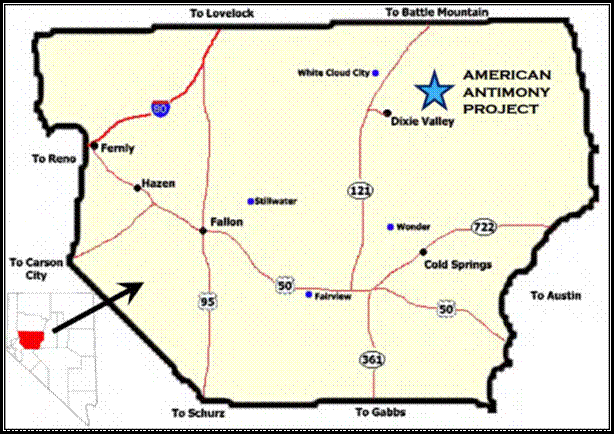
Figure 1. Location of the American Antimony Project, Churchill Co., Nevada (from Howard, 2024).
Field Study Results
Geologic mapping and sampling of the Bernice Canyon antimony district was conducted in August, 2024 (Click Here for Report) and defined a very close spatial relation between antimony occurrences and a northwest-trending felsite dike. The dike has been mapped along and near the floor of Bernice Canyon for about 2.5 km, ranges from 5 to 15 meters wide, and trends about N40oW. Historic mine workings are present along the entire strike length of the dike. The felsite dikes of Bernice Canyon traverse a thick sequence (>2,000m) of Triassic sediments composed of mostly siltstone/shale and underlies all of the project area.
Three types of antimony mineralization were observed:
Type 1: Spheroidal
The most widespread, this style is a disseminated form of stibnite clots or small spheres, Figure 2). Antimony grades range between 0.52% and 2.45% Sb.
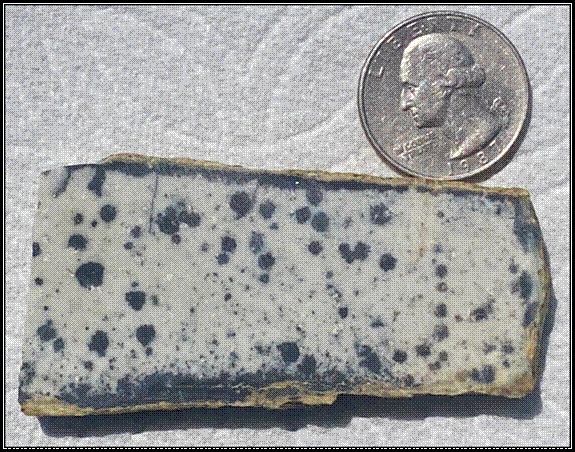
Figure 2. Altered felsite with parallel, stibnite-rich veinlets (sub-horizontal) with stibnite 'bleeding' or replacing into the felsite, IXH dump. Sample #969114 contained 0.77% Sb.
Figure 2 is a sample from the Arrance mine which texturally suggests that stibnite Types 1 and 2 formed at the same time. The photo suggests a spatial relation between the sub-horizontal, massive stibnite veinlets and spheres formed within the felsite. In this case, stibnite appears to invade the felsite immediately adjacent to the veinlets.
Type 2: Massive Veins
Massive stibnite veins, up to 5 cm thick, were only locally observed in surface outcrops. This form of stibnite appears to have been the primary target in the historical mine workings (Figure 3). At most of the mines, hand sorted stockpiles contained pieces of massive stibnite. Inspection of the Antimony King adit reveals variable densities of these veins in the felsite forming sub-horizontal, sheeted complexes.
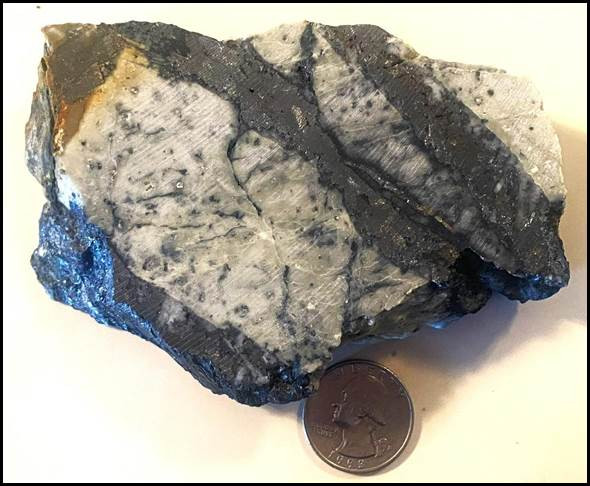
Figure 3. Photo of massive stibnite veins cutting QSP-altered dike; minor stibnite
stringers and clots present in the felsic dike, Antimony King mine.
Type 3: Quartz-Ankerite-Stibnite
This style of stibnite mineralization was identified on a few stockpiles at the Antimony King mine and clearly contains high antimony values (Sample #969124; Figure 4). Inspection of the lower adit suggests that this type of mineralization developed along the faulted dike contact with the siltstone. Recurring movement along the fault likely generated the sheared appearance of this vein-type mineralization.
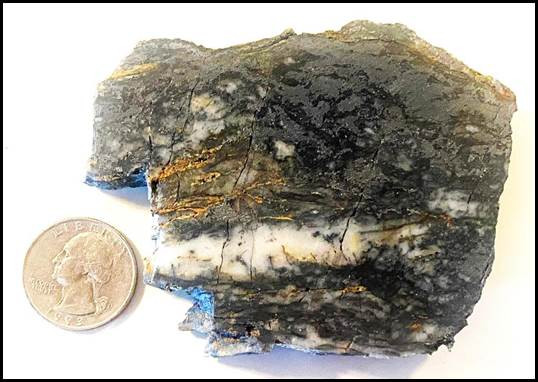
Figure 4. Photo of vein-like stibnite occurrence developed along the sheared felsite-siltstone contact; gray = massive stibnite, black = carbonaceous, sheared rock; white = milky quartz; orange = iron oxides/ankerite veinlets, Antimony King mine. Sample # 969124 contained 30.89% Sb, 8.3 ppm Ag and 0.24% Zn.
Results of Petrographic Study
Xtra Energy contracted the services of Kishar Research Inc. of Ottawa, Canada to investigate the antimony mineralization at Bernice Canyon with the following primary objectives:
identify the primary mineralogy and textures with the intent to establish the protolith (dike);
identify the hydrothermal alteration assemblage and document the alteration textures;
identify the sulphide minerals and textural associations; and
present a paragenesis/sequential ordering between the silicate and sulphide replacement assemblages based on the three rock samples,
Host Rock
The felsic dyke (3 samples) has sustained intense poly phased metasomatism with the preservation of some primary textures and rare primary minerals. The dike's groundmass consists of an ultra fine-grained, equi-granular quartz-feldspar mosaic. The texture of the mosaic-textured quartzo-feldspathic groundmass is considered primary and is a function of the high level of intrusion and rapid cooling of the narrow dike. The only primary minerals in that intensely altered groundmass are quartz along with rare relict phenocrystic plagioclase. There are sericite pseudomorphs after platy grains that are inferred to have been biotite. Based on the abundance of plagioclase >> quartz phenocrysts, a quartzo-feldspathic groundmass and biotite micro-phenocrysts, it is proposed that the protolith was within the compositional range of dacite.
Dike Alteration
The dyke has sustained intense poly phase metasomatism that includes K, S, As, Sb with minor silica and CO2.
Stage 1 Metasomatism: (K+S+As+CO2)
The felsic dike displays ultra narrow, discontinuous, unoriented, sericite-filled fractures/cracks. This is attributed to a hydraulic fracturing event that flushed the dike with K-bearing hydrothermal fluid. The grain contacts in the fine-grained groundmass would also be fluid micro-pathways. The result was sericitization of plagioclase phenocrysts, plagioclase components in the groundmass, sericite sheaths in the groundmass, and sericite replacement of assumed biotite micro-phenocrysts. Calcite and Fe-dolomite in trace amounts were detected in the sericitized groundmass.
The potassium-bearing metasomatic hydrothermal fluid was accompanied by sulfidation reflected by sparsely distributed pyrite grains through the sericitized groundmass and by elongated clusters that are aligned along the micro fractures/cracks. The Stage 1 pyrite contains elevated arsenic (scanning electronic microscopy) with arsenic contents >1 wt% As, an arsenic threshold that defines this pyrite as arsenian pyrite. Minute arsenopyrite grains are present in trace amounts in both arsenian pyrite and as rare grains sparsely distributed through the altered groundmass.
In addition, trace amounts of a crandallite group mineral, inferred to be goyazite
((SrAl3(PO4)2(OH)5·H2O) in the intensely sericitized groundmass along with fluorapatite implying an F-component during alteration. Trace amounts of gypsum/anhydrite with kaolinite are present with sericite in the altered groundmass. It is uncertain whether this assemblage belongs to Stage 1 or Stage 2 hydrothermal alteration.
Stage 2 Metasomatism (Sb+S+K+Si)
This mineralizing episode is characterized by macro and micro quartz veinlets hosting sericite, subordinate kaolinite and stibnite. Sericite in the altered groundmass contains variable minor and trace abundances of Fe and Mg based on grey scales in electron backscattered images and semi-quantitative analyses. These variable compositions may be related to the two stages of K-metasomatism. Stibnite is widespread and unequivocally associated with Stage 2 metasomatism and displays three textural associations: 1) in quartz veins; 2) as sub equant domains, termed clotted or spheroidal stibnite, where the stibnite is ultra fine-grained and intergranular to quartz-altered feldspar/sericite in the groundmass (see Figure 5) and 3) disseminated ultra fine-grained aggregates in the altered groundmass. Stibnite is intergrown with and hosts inclusions of sericite and kaolinite. Close examination of clotted stibnite (see Figure 5) suggests that this texture is formed by intense migration of Sb-S into wall rock adjacent to stibnite-filled fractures or stibnite-bearing quartz veins (see Figure 2).
Semi-quantitative analyses of stibnite indicated that stibnite is stoichiometric Sb2S3 containing no other elemental substitution based on the detection level of the scanning electron microscope. Antimony can be substituted by Cu, Pb and As but none of these elements were present in electron dispersive spectrum. The lack of arsenic in stibnite sets the Stage 2 stibnite mineralizing event apart from the earlier arsenian pyritization-arsenopyrite Stage 1 event.
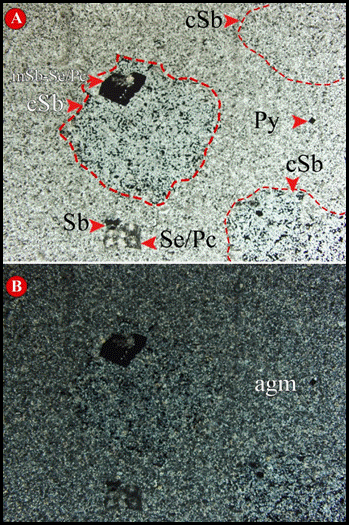
Figure 5. Photomicrographs, A-plane light, B-crossed nicols, show closely spaced clotted stibnite domains (cSb) in the altered groundmass (agm) that has sericitized plagioclase phenocrysts (Se/Pc) and pyrite (Py). A, B: FOV = 6.92 mm.
These studies provide Xtra Energy with additional insight into the emerging antimony target at Bernice Canyon. Antimony, like mercury and arsenic, commonly is associated with epithermal gold deposits. In the southern Toquima Range of Nevada, antimony-rich zones generally coincide with distribution of high values of silver in the Jefferson district and along the east margin of the Belmont pluton, including the Belmont silver district. The Hoyt mine, located about 2km NE of Bernice Canyon, exploited silver-rich quartz veins. One sample collected in 2024 contained 616 ppm Ag, 1,476 ppm Sb and >1% As suggesting a closer association between silver and arsenic. The dominance of antimony in the Bernice Canyon deposits may imply distal zoning to gold mineralization at depth. However, the close spatial association with the felsic/felsite, antimony deposits and strong quartz-sericite-pyrite alteration in Bernice Canyon is atypical of a distal epithermal environment and suggests an origin unlike other antimony occurrences in gold-rich Nevada.
Mac J. Shahsavar P. Eng., the Chairman and CEO of Xtra Energy, stated,"Xtra Energy is currently in the permitting process for a drilling campaign along the felsite dike and beneath the numerous antimony mines and prospects in Bernice Canyon. The receipt of a Notice of Intent from the BLM will allow Xtra to commence road reparations this Spring and commence drilling these shallow antimony targets shortly thereafter".
Contact & Learn More:
Xtra Energy Corporation
Phone: 512-412-3636
Corporate Website: https://americanantimony.com/
Corporate Linkedin: https://www.linkedin.com/company/xtra-energy-corp/
Corporate Twitter: https://twitter.com/xtra_corp
Corporate Instagram: https://www.instagram.com/xtraenergycorp/
Corporate Facebook: https://www.facebook.com/profile.php?id=100093057374695
About Xtra Energy Corporation
Xtra Energy Corporation is an antimony exploration company focused on developing its flagship project "American Antimony", approximately 31 miles northeast of Eastgate, Nevada. Xtra Energy Corporation holds a 100% ownership in a 203 lode claim, 4194 acre antimony project surrounding the historically documented Antimony King Mine and covering all other documented antimony producers of the Bernice Mining District. The Company is seeking to develop this expanding portfolio of antimony-rich assets to become a major supplier of antimony based products.
FORWARD-LOOKING STATEMENTS:
This press release contains forward-looking statements as defined within Section 27A of the Securities Act of 1933, as amended, and Section 21E of the Securities Exchange Act of 1934, as amended. These statements relate to future events, including our ability to raise capital, or to our future financial performance, and involve known and unknown risks, uncertainties and other factors that may cause materially different results, levels of activity, performance or achievements expressed or implied by these forward-looking statements. You should not place undue reliance on forward-looking statements since they involve known and unknown risks, uncertainties and other factors which are, in some cases, beyond our control and which could, and likely will, materially affect actual results, levels of activity, performance or achievements. Any forward-looking statement reflects our current views with respect to future events and is subject to these and other risks, uncertainties and assumptions relating to our operations, results of operations, growth strategy and liquidity. We assume no obligation to publicly update or revise these forward-looking statements for any reason, or to update the reasons actual results could differ materially from those anticipated in these forward-looking statements, even if new information becomes available in the future.
For a discussion of these risks and uncertainties, please see our filings with the OTC Markets Group Inc. Our public filings with the OTC Markets Group Inc are available from commercial document retrieval services and at the website maintained by the OTC Markets at https://www.otcmarkets.com/stock/XTPT/disclosure.
SOURCE: Xtra Energy Corp.
View the original press release on ACCESS Newswire
Y.Kobayashi--AMWN