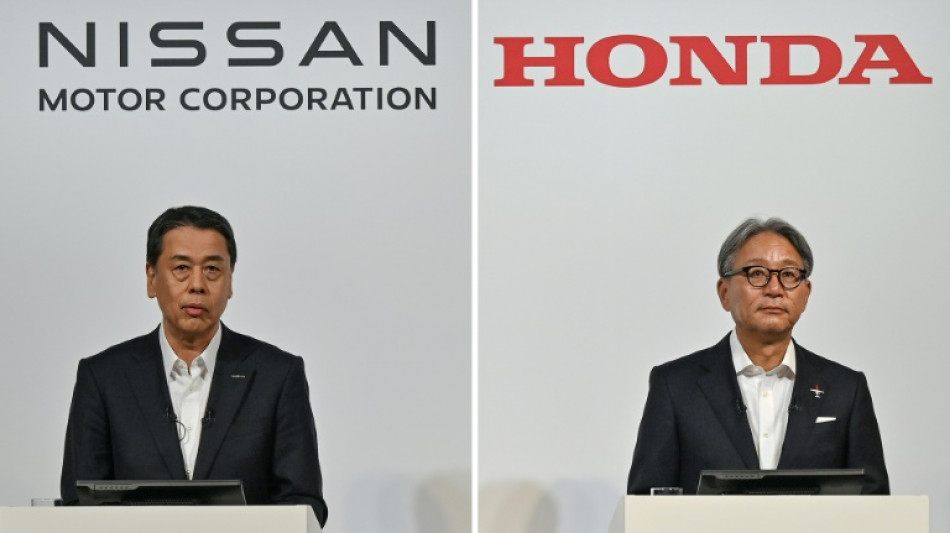
What next for Honda and Nissan? / Photo: Richard A. Brooks - AFP/File
 Henan Grave Carved with Herbal Prescriptions Draws Hundreds of Visitors Daily

 USMNT Coaching Search: Guardiola, Cherundolo, and Others Named as Pochettino Replacements

 Turkish Airlines Launches Fourth Mainland China Route to Chengdu

 RSC’s ‘Julius Caesar’ Reimagined in Women’s Prison Setting for School Tour

 Thomson Reuters Integrates CUBE Regulatory Intelligence into CoCounsel Legal

 ACCESS Newswire Continues to Repurchase its Shares

 Jaguar Health to Hold Investor Webcast November 17 Regarding Q3 2026 Financials & Corporate Updates
 Does IRS Debt Expire? Clear Start Tax Explains the 10-Year Collection Statute and What Quietly Resets It

 Arrive AI Reports Third Quarter 2026 Results Highlighted by Revenue Growth and Expanded Partnerships

 Mako Mining Reports Q3 2026 Financial Results, Including Adjusted EBITDA(1) of US$30.3 million and EPS of US$0.19/share

 InterContinental Hotels Group PLC Announces Transaction in Own Shares - November 13

 Vulcan Minerals Inc. - Review and Update on Affiliated Company Atlas Salt Inc.

 Integrated BioPharma Reports Results for its Quarter Ended September 30, 2026

 SMX Puts American Innovation to Work in the New Era of Artificial Intelligence
 Foundation Software Explores How Contractors Can Prepare for the AI-Driven Construction Boom

 Trustpoint Xposure Launches Program to Help Startup Founders Check How AI Search Platforms Describe Their Companies

 MARS Energy Group Adds Jigar Shah to Advisory Board to Accelerate Battery Storage Growth

 SMX Brings American Ingenuity to the Next Frontier of Artificial Intelligence

 Ole Miss inquiry expands after video and monkey-noise allegations

 General Hospital actor Randall England dies at 75

 London museum removes Russell Brand hair exhibit after rape conviction

 Yella Beezy sentenced to life for arranging rapper Mo3’s murder

Honda and Nissan on Thursday announced the scrapping of merger talks that would have created the world's third-biggest auto company by unit sales behind Toyota and Volkswagen.
Here are some key points about why the Japanese companies explored a tie-up, the reasons for their failure, and where this leaves them in a difficult global auto industry.
- What is their history? -
Honda was founded in 1948 as a small factory making motorcycles and is now the world's biggest producer of the two-wheelers. It also makes 3.7 million four-wheel vehicles annually.
More than 40 percent of these were sold in North America last year, roughly 20 percent in China, 18 percent in Japan and three percent in Europe.
Nissan, founded in 1933, produced 3.1 million cars last year. North America accounts for 38 percent of its global sales, China 20 percent, Japan 14 percent and Europe 10 percent.
French automaker Renault took a 36.8 percent stake in the then loss-making firm in 1999 and Mitsubishi Motors joined the alliance 17 years later, with Nissan taking a 34-percent stake in its struggling Japanese rival.
But tensions emerged, stoked by the French state increasing its stake in Renault in 2015, followed by the 2018 arrest of Nissan boss Carlos Ghosn in Japan on suspicion of financial misconduct and his subsequent flight from the country.
In 2023, Renault sold part of its stake in Nissan as part of an alliance overhaul that saw them retain 15 percent cross-holdings.
- Why did they try to merge? -
Nissan has been struggling, last year reporting a 93-percent plunge in first-half net profit and axeing 9,000 jobs in November. It is also saddled with billions of dollars of debt.
For both companies, achieving economies of scale would have served to "enhance R&D capabilities, and better compete" in the areas of "advanced technologies including electrification and software-defined vehicles", said Tatsuo Yoshida, senior auto analyst at Bloomberg Intelligence.
Japanese carmakers have long lagged in the electric vehicle sector, especially against Chinese firms, with the country's leading EV-maker BYD last year selling more vehicles globally than Honda and Nissan.
The pair had already agreed on talks over partnership in electrification technologies and software development, and were later joined by Mitsubishi Motors.
- Why did merger talks fail? -
When the merger talks were announced in December the plan was that the two automakers along with Mitsubishi Motors would integrate their businesses under a new holding company.
But local media reports have said Honda, frustrated by its rival's slow decision-making on restructuring, wanted to make it a subsidiary, which Nissan's leadership found unacceptable.
"Nissan appears to be stressing its independence and freedom of (decision-making on) its strategy," which "for Honda's eyes may not maximise benefit of economy of scale," Mizuho Securities analyst Yoshitaka Ishiyama said.
- What happens next? -
In the long term at least, both firms will need to seek alternative partners as they look to get a leg-up in the technology race, analysts say.
"For Honda, there remains a concern about how to beef up its four-wheel vehicle business," said Seiji Sugiura, auto analyst at Tokai Tokyo Intelligence Laboratory.
"The fact that Honda executives had wanted to merge with Nissan means that they needed a close collaboration in R&D at a deeper level than an alliance, (which) involves sharing confidential company information," he added.
Nissan's position is worse, as it "faces significant challenges, including financial instability and the need to strengthen its position in the advanced technology battlefield", said Bloomberg's Yoshida.
Sugiura added that tech firm Foxconn "remains to be an option for Nissan".
Recent reports have said the Taiwanese giant, also known as Hon Hai, had been in talks with Renault over buying the French automaker's stake in the Japanese firm.
However, Sugiura added that a Foxconn-Honda tie-up was also possible "as it has technologies Honda wants".
And he added: "If Honda really wants Nissan's technology, it can launch a hostile takeover bid of Nissan."
F.Schneider--AMWN