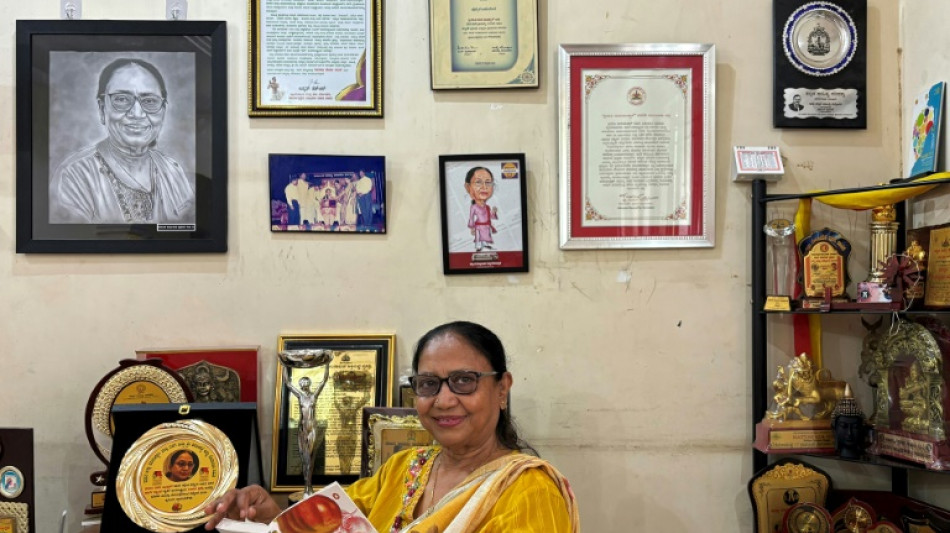
Petals and thorns: India's Booker prize author Banu Mushtaq / Photo: Aishwarya KUMAR - AFP
 Basil Tuma Scores First Senior Goal as Malta Draws with Ten-Man Eswatini
 Rock & Roll Hall of Fame Inductees Announced; Attendance List Shrinks

 How Families Plan and Save for Holiday Travel

 Ole Miss inquiry expands after video and monkey-noise allegations

 General Hospital actor Randall England dies at 75

 London museum removes Russell Brand hair exhibit after rape conviction

 Yella Beezy sentenced to life for arranging rapper Mo3’s murder

 Authorities to identify Montauk Mary and five other Long Island cold-case victims

 Barbie sequel negotiations stall over reported $25 million pay packages

 Bath & Body Works launches buy-one-get-one-free candle offer

 Itlu Arjuna receives U/A certificate ahead of theatrical release

 Niraj Kumar earns Los Angeles Olympic quota with 50m rifle bronze
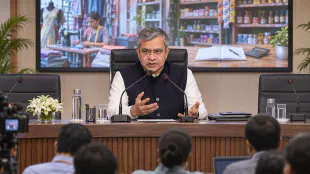 India extends micro-credit guarantee plan for five years

 Pradeep Antony, Smeha Manimegalai portray secret spouses in Mr & Mrs Office

 Woman barred from every Greggs outlet after series of offences

 Ketchup packets link suspect to break-in at Eddie Rocket’s restaurant

 US Adds 165,000 Jobs as Unemployment Falls to 4.1%

 China's Singles' Day Exposes Persistent Consumer Caution

 OPEC Says Oil Output Is Near Prewar Levels Despite Shipping Disruptions

 Bank of England Raises Interest Rate to 4% as Energy Risks Intensify

 Euro-Area Inflation Reaches 4% as Energy Prices Jump

 Irish police prepare for further hoax bomb threats after hundreds of schools targeted

 RBA Inflation Target Origins: Why Australia Chose a Range Over Zero

All writers draw on their experience, whether consciously or not, says Indian author Banu Mushtaq -- including the titular tale of attempted self-immolation in her International Booker Prize-winning short story collection.
Mushtaq, who won the coveted literature prize as the first author writing in Kannada -- an Indian regional language -- said the author's responsibility is to reflect the truth.
"You cannot simply write describing a rose," said the 77-year-old, who is also a lawyer and activist.
"You cannot say it has got such a fragrance, such petals, such colour. You have to write about the thorns also. It is your responsibility, and you have to do it."
Her book "Heart Lamp", a collection of 12 powerful short stories, is also her first book translated into English, with the prize shared with her translator Deepa Bhasthi.
Critics praised the collection for its dry and gentle humour, and its searing commentary on the patriarchy, caste and religion.
Mushtaq has carved an alternative path in life, challenging societal restrictions and perceptions.
As a young girl worried about her future, she said she started writing to improve her "chances of marriage".
Born into a Muslim family in 1948, she studied in Kannada, which is spoken mostly in India's southern Karnataka state by around 43 million people, rather than Urdu, the language of Islamic texts in India and which most Muslim girls learnt.
She attended college, and worked as a journalist and also as a high school teacher.
- 'Confused' -
But after marrying for love, Mushtaq found her life constricted.
"I was not allowed to have any intellectual activities. I was not allowed to write," she said.
"I was in that vacuum. That harmed me."
She recounted how as a young mother aged around 27 with possible postpartum depression, and ground down by domestic life, had doused petrol on herself and on the "spur of a moment" readied to set herself on fire.
Her husband rushed to her with their three-month-old daughter.
"He took the baby and put her on my feet, and he drew my attention to her and he hugged me, and he stopped me," Mushtaq told AFP.
The experience is nearly mirrored in her book -- in its case, the protagonist is stopped by her daughter.
"People get confused that it might be my life," the writer said.
Explaining that while not her exact story, "consciously or subconsciously, something of the author, it reflects in her or his writing".
Books line the walls in Mushtaq's home, in the small southern Indian town of Hassan.
Her many awards and certificates -- including a replica of the Booker prize she won in London in May -- are also on display.
She joked that she was born to write -- at least that is what a Hindu astrological birth chart said about her future.
"I don't know how it was there, but I have seen the birth chart," Mushtaq said with a laugh, speaking in English.
The award has changed her life "in a positive way", she added, while noting the fame has been a little overwhelming.
"I am not against the people, I love people," she said referring to the stream of visitors she gets to her home.
"But with this, a lot of prominence is given to me, and I don't have any time for writing. I feel something odd... Writing gives me a lot of pleasure, a lot of relief."
- 'Patriarchy everywhere' -
Mushtaq's body of work spans six short story collections, an essay collection and poetry.
The stories in "Heart Lamp" were chosen from the six short story collections, dating back to 1990.
The Booker jury hailed her characters -– from spirited grandmothers to bumbling religious clerics –- as "astonishing portraits of survival and resilience".
The stories portray Muslim women going through terrible experiences, including domestic violence, the death of children and extramarital affairs.
Mushtaq said that while the main characters in her books are all Muslim women, the issues are universal.
"They (women) suffer this type of suppression and this type of exploitation, this type of patriarchy everywhere," she said. "A woman is a woman, all over the world."
While accepting that even the people for whom she writes may not like her work, Mushtaq said she remained dedicated to providing wider truths.
"I have to say what is necessary for the society," she said.
"The writer is always pro-people... With the people, and for the people."
D.Moore--AMWN