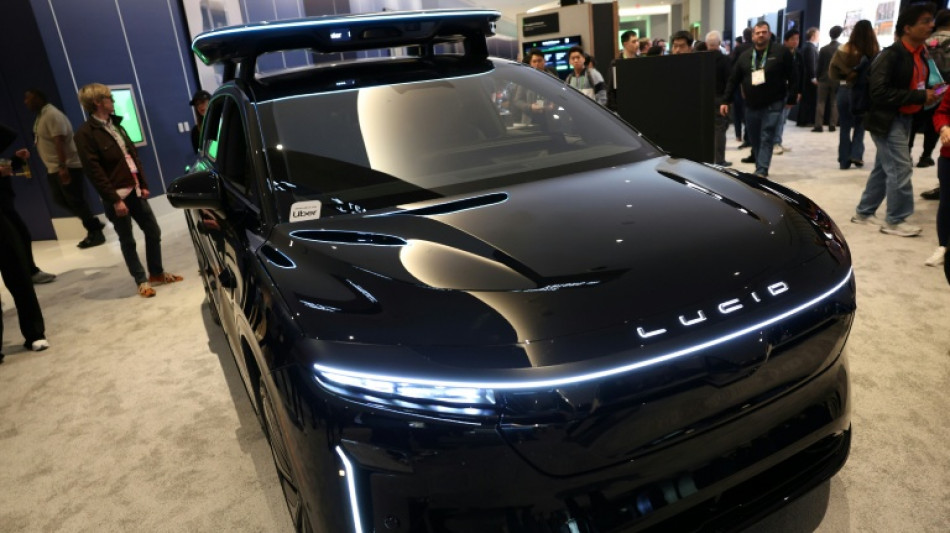
Uber shows off its robotaxi heading for San Francisco / Photo: Patrick T. Fallon - AFP
 Teatro Mayor Unveils 152-Performance 2027 Season Highlighting Beethoven and García Márquez

 Rutgers Defeats NJIT 101-64 Behind Francis and Mark Scores
 THIEAUDIO Introduces Clairvoyance MKII: The Evolution of a Signature Sound
 Guardian Metal Resources PLC Announces Proposed Spin-Out of Non-Tungsten Projects

 Fulcrum Metals PLC Announces New Critical Mineral Recoveries Expand Potential

 Thukukile Zuma Resigns from ANC Johannesburg Leadership Amid Disciplinary Dispute

 CM Mohan Yadav Meets Bohra Spiritual Leader to Discuss Simhastha 2028 and Development

 Eli Crane Defeats Jonathan Nez in Tight Arizona Congressional Race

Uber on Monday unveiled a custom robotaxi it is adding to its global ride-share platform, starting on the San Francisco home turf it shares with rival Waymo, owned by Google.
The Uber robotaxis are taking shape through a collaboration with autonomous driving technology firm Nuro and electric vehicle maker Lucid using a platform powered by AI-chip colossus Nvidia.
Uber and Nvidia late last year announced an alliance to deploy 100,000 robotaxis starting in 2027.
"Together with Uber, we're creating a framework for the entire industry to deploy autonomous fleets at scale, powered by Nvidia AI infrastructure," Nvidia chief executive Jensen Huang said at the time. "What was once science fiction is fast becoming an everyday reality."
Nvidia has been working with an array of automakers to put its technology to work in autonomous driving systems.
The Lucid Gravity robotaxi, boasting room for six passengers and an Uber-designed in-cabin ride experience, went on display at an Nvidia exhibit at the Fontainebleau resort in Las Vegas.
The all-electric Gravity robotaxis will have interactive screens that let riders control features like seat heaters, climate controls and music, and allow passengers to contact support teams or command vehicles to pull over, according to Uber.
Road testing of the robotaxis began last month, with humans in the drivers seat as a precaution.
Launch of the Uber robotaxi service is slated for later this year provided they get clearance from regulators in California.
"Uber is proud to partner with Lucid and Nuro to bring a state-of-the-art robotaxi to market later this year," said Sarfraz Maredia, Uber's global head of autonomous mobility.
Uber currently lets users in a few US cities hail robotaxis operated by Google-owned Waymo.
Waymo robotaxis have grown in popularity in San Francisco and have even become a tourist attraction.
Waymo's fleet in the area is estimated at more than 800 vehicles, and its service will be available in a total of 10 US cities in the coming months, as well as London.
Amazon-owned Zoox has also started offering driverless ride service in parts of San Francisco as part of a limited "explorers" program for the service.
O.Karlsson--AMWN