
Why SMX Is Rewriting the Rules of Global Commerce by Making Proof Physical
 Pupil kills four wounds 20 in new Turkey school shooting

 Starmer says 'won't yield' to Trump's Mideast war threats

 England women's rugby star Kildunne reveals body issues struggle
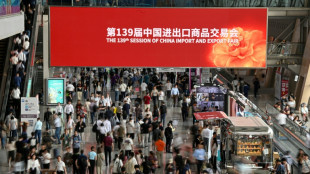
 Markets steadier on Mideast peace hopes, as war hits luxury goods

 New Hungarian leader Magyar says pro-Orban president must resign

 Pope heads to Cameroon with message of peace for conflict zone

 England's Stokes 'quite lucky' to be alive after facial injury

 Barcelona hope young talent learn from Champions League disappointment

 French luxury firms Hermes, Kering knocked by disappointing sales

 Afghans comb riverbed in search of gold dust

 Double Olympic badminton champion Axelsen announces retirement

 Tom Cruise shares sneak peek of Inarritu comedy 'Digger' at CinemaCon

 AI expansion drives up profits at bullish tech giant ASML

 Xi meets Russian FM as leaders flock to China over Middle East war

 AI-driven chip shortage slowing efforts to get world online: GSMA

 Indonesia, France agree to boost defence industry ties

 Ball hero and villain as Hornets sting Heat to lift NBA postseason curse

 Stocks rally, oil extends losses as Trump fans fresh peace hopes

 US lawmaker demands FIFA pay World Cup transport bill amid ticket hikes

 'Listening bars' bloom as hottest new nightlife trend

 Opti Digital Accelerates Its US Expansion with the Appointment of Michael Walsh as Director of Business Development

 Medical Care Technologies (OTC PINK:MDCE) Advances AI-Driven Authentication in the Fast-Growing Multi-Billion Dollar Collectibles Sector
 Norsemont Resumes Phase Three Drill Program at Choquelimpie

 Mag Magna Corp. Outlines Strategic Plan to Build Global Rare Earth and Critical Minerals Platform

 Dr. Janak Parikh Introduces FoLix - The First FDA-Cleared Laser for Natural Hair Restoration

NEW YORK, NY / ACCESS Newswire / January 22, 2026 / Global supply chains were engineered for speed and scale-not accountability. For decades, materials moved efficiently while questions about origin, custody, and compliance were managed through contracts, certifications, and institutional trust. That framework functioned until rising regulation, cross-border disputes, and enforcement pressure revealed just how fragile paper-based certainty really is.
SMX PLC is designing for what comes after that realization.
Rather than layering software on top of broken assumptions, SMX approaches identity as a property of the material itself. By embedding verification at the molecular level, materials are able to carry proof wherever they go. Identity is no longer something assigned, reported, or interpreted-it becomes intrinsic. Once that shift occurs, the behavior of entire systems begins to change.
This approach is not confined to sustainability initiatives or recycling programs. It applies anywhere materials are exchanged, regulated, audited, or disputed.
A Single Identity Framework Across Multiple Materials
Most traceability efforts operate in silos. Plastics follow one system. Textiles rely on another. Metals use entirely different standards. Each vertical solution introduces new complexity and new failure points.
SMX is pursuing a different architecture-one where the same identity logic applies horizontally across materials and industries.
Plastics were the logical starting point because regulatory pressure is immediate and unforgiving. Recycled-content mandates, extended producer responsibility laws, and audit exposure have turned verification into a requirement rather than an aspiration. Molecular identity resolves the core question simply and decisively: whether recycled material exists, where it originated, and how it moved.
That same mechanism extends naturally into textiles, where enforcement around recycled fibers and sustainability claims is accelerating, particularly in Europe and Asia. When fibers retain identity, recycled content stops being inferred and starts being provable.
Metals introduce even higher stakes. In precious and critical materials, provenance and custody are not marketing claims-they are legal and financial imperatives. Failures carry real consequences. Molecular-level verification holds under that pressure because it does not rely on intermediaries, declarations, or trust.
Across categories, the effect is consistent. Identity reduces ambiguity. And reduced ambiguity reshapes markets.
When Proof Moves With the Material, Trade Behaves Differently
Trade dynamics change once verification travels with the material.
Verified goods clear faster. Disputes decline. Counterparty risk shrinks. In highly regulated environments, buyers increasingly recognize that proof is not a bonus-it is protection.
This is where SMX's framework begins to function less like a technology solution and more like infrastructure. It operates beneath transactions, enabling enforcement without adding friction. Identity does not need to be believed because it can be tested.
That distinction becomes critical as supply chains fragment geopolitically. Border crossings now demand proof that survives inspection, not documentation that assumes cooperation. Identity that degrades at inspection loses value. Identity that persists becomes a commercial advantage-and, increasingly, a pricing variable.
SMX's work across national systems, industrial platforms, and regulated markets reflects this shift. Identity is being engineered to function under scrutiny, not goodwill.
Digital Systems Only Matter When Physical Truth Exists
Once materials carry verifiable identity, digital mechanisms can finally operate with integrity.
In plastics, SMX's Plastic Cycle Token acts as a settlement layer tied directly to verified physical activity. It does not reward declarations or intentions. It reflects measurable events-collection, processing, circulation.
That structure is extensible because the principle is universal: digital value only holds when anchored to physical reality. Identity provides that anchor.
As material-level identity expands across sectors and jurisdictions, the implications compound. Regulators gain enforceable oversight. Markets gain clarity. Companies gain a way to operate without relying on trust-based narratives that collapse under pressure.
This is the broader direction SMX is pursuing. Identity is not being built as a reporting tool or a sustainability feature. It is being designed as a foundational layer for trade, compliance, and accountability.
When materials can verify themselves, markets stop debating what happened. They start pricing it. And once identity is embedded, it doesn't disappear-it becomes part of how global commerce works.
Contact: Jeremy Murphy/ [email protected]
SOURCE: SMX (Security Matters) Public Limited
View the original press release on ACCESS Newswire
P.Costa--AMWN