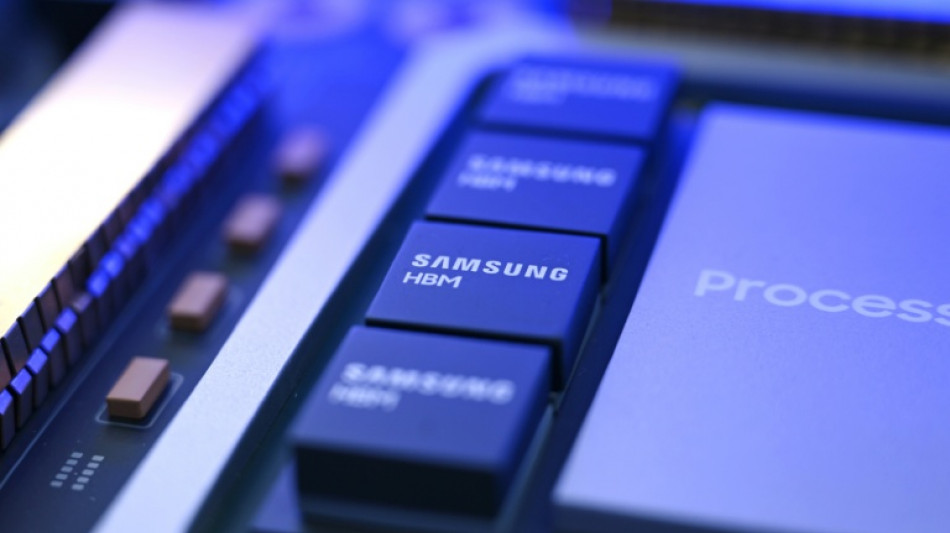
Samsung starts mass production of next-gen AI memory chip / Photo: Jung Yeon-je - AFP/File
 Carrick backs Dalot after hostile reception from Manchester United fans

 Aston Villa Defy History With Rare Victory at Old Trafford

 Crowds Gather at San Francisco Park for Elizabeth Holmes Lookalike Tournament

 New 401k Gold IRA Investment Guide Explains the Best Way to Invest in Gold for Retirement (2026 Update)

 InterContinental Hotels Group PLC Announces Transaction in Own Shares - November 09
Opti Digital Launches NEXA, an AI-Powered Intelligence Layer
 Tintina Mines Intersects 460m at 0.50% CuEq at the Dos Amigos Copper-Gold Project in Chile

 Ispire Technology Inc. Reports First Quarter Fiscal Year 2027 Financial Results
 CoTec Holdings Corp. Notes HyProMag USA Advances North Texas Rare Earth Magnet Facility With First Major Equipment Delivery

 iPS Cell Research Accelerates Drug Discovery for ALS and Spinal Cord Injury

Samsung Electronics announced Thursday it had started mass production of next-generation memory chips to power artificial intelligence, touting an "industry-leading" breakthrough.
The high-bandwidth HBM4 chips are seen as a key component needed to scale-up the vast data centres powering the explosion in artificial intelligence.
US tech giant Nvidia -- the world's most valuable company -- is widely expected to be one of Samsung's main buyers.
Samsung said it had "begun mass production of its industry-leading HBM4 and has shipped commercial products to customers".
"This achievement marks a first in the industry, securing an early leadership position in the HBM4 market," the South Korean company said in a statement.
A global frenzy to build AI data centres has sent orders for advanced, high‑bandwidth memory microchips soaring.
Samsung said its new chip was significantly faster than older models, exceeding industry standards for processing speed by more than 40 percent.
This would satisfy "escalating demands for higher performance", the company said.
Samsung Electronics stock was up more than six percent in afternoon trade on South Korea's stock exchange.
The South Korean government has pledged to become one of the world's top three AI powers, alongside the United States and China.
Samsung and its South Korean rival SK hynix are already among the leading producers of high-performance memory chips, and two companies had raced to start HBM4 production.
Taipei-based research firm TrendForce predicts that memory chip industry revenue will surge to a global peak of more than $840 billion in 2027.
Samsung Electronics posted record quarterly profits earlier this year, riding on massive market demand for its powerful memory chips.
The company has already earmarked billions of dollars to expand chip production facilities, pledging to continue spending in "transitioning to advanced manufacturing processes and upgrading existing production lines to meet rising demand".
Nvidia designs hardware that powers AI computing, and has an almost insatiable demand for memory chips made by the likes of Samsung and SK hynix.
The US-based company's almost singular role in the AI revolution has taken the world by storm since the introduction of OpenAI's ChatGPT in late 2022.
Apple, Microsoft and Amazon have also developed chips with AI in mind, but for now are stuck trying to get their hands on Nvidia's coveted products.
Major electronics manufacturers and industry analysts have warned that chipmakers focusing on AI sales will cause higher retail prices for consumer products across the board.
T.Ward--AMWN