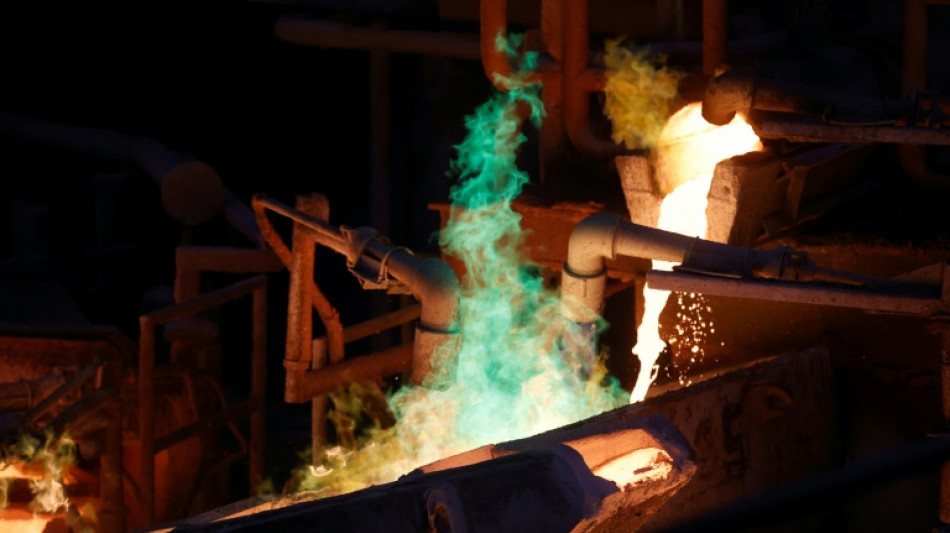
Copper, a coveted metal boosting miners / Photo: RAUL BRAVO - AFP/File
 UK puts Chagos handover deal in 'deep freeze' after Trump criticism

 Sabrina Carpenter transforms Coachella into her own 'Sabrinawood'

 Iran envoys meet Pakistani PM ahead of US talks

 Somalia president congratulates World Cup-bound referee Omar Artan

 After Artemis II, NASA looks to SpaceX, Blue Origin for Moon landings

 Britain storm into Billie Jean King Cup finals with Australia thumping

 Hawks clinch NBA playoff berth with win over Cavs

 Carney poised to win Canada majority but affordability pressure looms

 Extra time at Augusta helps McIlroy make Masters magic

 Iran, US to hold peace talks overshadowed by mutual mistrust

 Small US farm copes with fuel hikes from Mideast war

 Iranian delegation in Pakistan for talks with US, Vance en route

 Djibouti leader claims sixth straight term

 Mythos AI alarm bells: Fair warning or marketing hype?

 Marseille boost hopes of Champions League return, Monaco suffer heavy defeat

 Swing and miss: Ichiro statue reveal goes awry as bat snaps

 Stocks up, oil down over week on guarded optimism for Iran

 Malen hits hat-trick as Roma rebound against declining Pisa

 Lebanon says Israel talks set for Tuesday in US

 OpenAI CEO's California home hit by Molotov cocktail, man arrested

 Top takeaways from the Artemis II mission

 Hatton jumps into Masters hunt with stunning 66

 Fury happy to be the 'hunter' on return to ring

 Balogun strike in vain as Monaco suffer heavy defeat

 Venezuelan opposition demands elections after Maduro ouster

BHP, Glencore and Teck Resources -- three mining giants whose annual results have revealed significantly increased profits thanks in large part to soaring copper prices.
AFP explores the reasons behind the gains.
- Profits boost -
Australian resources group BHP saw net profit surge almost 28 percent to US$5.64 billion in the final six months of last year, the group's fiscal first half.
Alongside the recent earnings, BHP stated that it was the world's largest copper producer after raising output by about 30 percent in the past four years, including from its vast Escondida mine in Chile.
In the same week, Swiss miner Glencore announced a return to profit last year and plans to double its copper production within a decade.
Canadian miner Teck Resources, in talks over a multi-billion-dollar merger with Anglo American to forge a copper giant, noted that its profits have been driven by "significantly higher copper prices".
Resources groups that have not fared so well in 2025 -- iron ore behemoth Rio Tinto and Anglo American -- are ramping up production of copper to help offset sagging demand for steel and diamonds.
- Why copper? -
Copper demand has exploded in recent years, with the metal needed for solar panels, wind turbines and also military hardware.
The coveted metal is also used in electric vehicle batteries and data centres for artificial intelligence.
Surging demand caused the price of copper to soar 40 percent on the London Metal Exchange (LME) last year, and in January this year it reached a record high.
This was fuelled by supply disruptions at major copper mines in Chile, Indonesia and the Democratic Republic of Congo.
Demand has been boosted additionally "by Donald Trump's decisions", said Benjamin Louvet, head of commodities management at Ofi Invest AM.
Elaborating further to AFP, he pointed to the US president's tariff threats, which saw companies build copper stocks, and heightened tensions between the United States and China, the world's dominant player in metals markets.
- Copper supply risks -
Many copper experts agree that the industrial metal could reach a supply deficit this year.
"A structural deficit appears almost inevitable," Philippe Chalmin, a commodities professor at Paris-Dauphine University, told AFP.
The poor anticipation of current needs is partly explained by the fact that "the energy transition happened quite quickly", he added.
Developing a new mine takes time.
According to a study by the International Energy Agency, an average of 16 years is required -- although the duration varies depending on the ore and location.
This timeframe and the enormous associated costs are deterring financiers, "who are turning to investments with much faster returns", said Louvet.
Against this backdrop, the sector is seeking to consolidate, although a bid by BHP to buy Anglo American, disrupting the latter's planned tie-up with Teck, recently collapsed.
- Commodities versus stocks -
Unlike shares in companies, which rise in anticipation of increased revenue, commodity prices are determined by the current supply versus demand.
The price of copper "does not factor in future scarcity", said Louvet.
This means new mining projects are launched only once there is a need for increased production.
Louvet explained that copper would have to reach $15,000 per tonne for miners to begin new projects as, despite soaring profits, the financial risk is too high.
Copper is trading at below $13,000 per tonne on the LME, compared with its all-time high of $14,527.50 last month.
Even the creation or expansion of strategic stockpiles by the United States and other countries will not "fundamentally change the situation", Louvet added.
burs-pml/bcp/rmb/rh/abs
D.Moore--AMWN