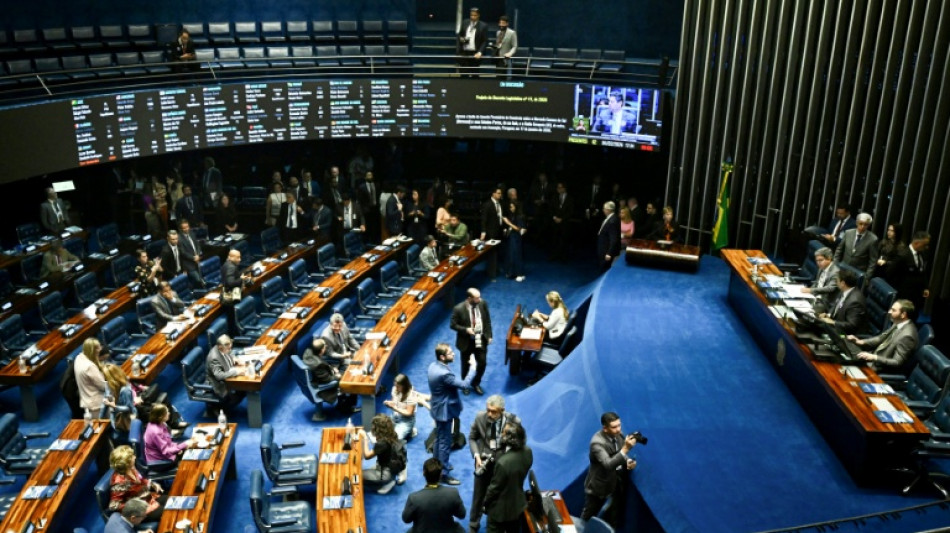
Brazil ratifies EU-Mercosur trade deal / Photo: Evaristo Sa - AFP
 Rene Eyre Revisits Autobiographical Performance 'Say A Little Prayer' in London

 UAE's HCT Holds Record Graduation and Announces Major Training Expansion

 NASA Awards $10B Lunar Contract Framework to SpaceX, Blue Origin

 Katy Perry Tells Fans Ex-Husband Russell Brand 'Should Be in Jail' During UK Concert

 South African election results renew debate over identity-based voting

 South African voters report smoother local election but declining IEC trust

 Dolly Parton museum and Nashville hotel open after singer’s death

Brazil's Senate on Wednesday ratified a deal between the Mercosur bloc and the European Union that creates one of the world's largest free trade areas.
The deal involves the four founding members of the South American trade bloc, and has already been ratified by Argentina and Uruguay. Paraguay's parliament still needs to approve it.
The European Commission announced last week that it would provisionally implement the mammoth deal, pending the EU top court's ruling on its legality.
The move angered France, which has led opposition to the deal and unsuccessfully attempted to block it over worries for its farmers, who fear being undercut by cheaper goods from Brazil and its neighbors.
The deal was signed in January after 25 years of tricky negotiations.
It was given fresh impetus amid the sweeping use of tariffs and trade threats by US President Donald Trump's administration, which sent countries scrambling for new partnerships.
Together, the EU and Mercosur account for 30 percent of global GDP and more than 700 million consumers.
The treaty eliminates tariffs on more than 90 percent of bilateral trade.
The deal will favor European exports of cars, wine and cheese, while making it easier for South American beef, poultry, sugar, rice, honey and soybeans to enter Europe.
Brazil -- the world's largest producer of coffee, meat and soybeans, among other foodstuffs -- was one of the strongest backers of the deal.
"The world today is more fragmented, more skeptical, and more protectionist. This makes the agreement with our European partners even more relevant and even more necessary," Senator Tereza Cristina said during the debate in the Brazilian legislature.
On the European side, Spain and Germany are in favor of the pact, which will benefit exports of machinery and spirits to the Mercosur bloc.
But some European farmers reacted angrily, rolling tractors into cities like Paris, Brussels and Warsaw to protest a feared influx of cheaper goods produced with lower standards and banned pesticides.
D.Sawyer--AMWN



