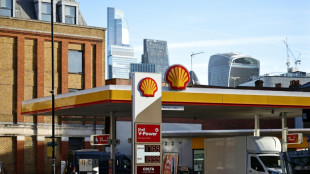
OPEC+ to make first post-UAE production decision / Photo: JOE KLAMAR - AFP/File
 Christine Lagarde: unifying ECB chief in turbulent times
 Rybakina secures year-end top rank with Tokyo win

 Rains bring relief to Indonesian city weary of fire haze

 Osaka vows to return stronger after Tokyo exit

 Hello Kitty firm apologises, scraps Japan TV tie-up after China anger
 Taiwan says Pakistan briefly closed airspace to Taiwanese flights

 'My blood was spilled here': a year on, Tanzania unable to mourn election violence

 Afghanistan opium poppy cultivation surges despite Taliban govt ban: UN

 No World Series miracle for weary Rays
 Miami Heat earn first win of NBA season with Antetokounmpo

 Brewers beat Rays 4-1 to capture first World Series title

 Philippine island fights rising seas with nature, not concrete

 Bangladesh presses India before Ganges water treaty expires

 Trump accuses Alaska Democrats of fraud over same-name scandal
 Spain mourns after latest train tragedy kills 68

 Trump's border: quiet, but few people are happy

 Australian defence chief says China military buildup creating 'pressure' in SE Asia
 Blue Laser Fusion Announces Successful Closing of Capital Raise and Alternative Public Offering to Accelerate Directed-Energy Defense and Fusion Energy Commercialization

 Hillcrest Energy Technologies to Present at Market Bridge Live in London

 InterContinental Hotels Group PLC Announces Transaction in Own Shares - October 29

 Tocvan Pilot Mine Trench at Gran Pilar Averages 4.6 g/t Au With Samples Up to 24.4 g/t Au; New Zone 1.3 km East Returns Up to 234 g/t Ag

 Storm Preparedness: The Equipment Worth Investing In

 Argentine football fan jailed for threats over Di Maria return

 Liverpool beat Chelsea in League Cup shoot-out, Man City survive scare

 Inter leave it late again in Serie A as AC Milan, Juventus lose

Seven OPEC+ members are meeting Sunday to make their first decision on oil-production quotas since the United Arab Emirates' departure from the cartel, which added to the soaring price pressure unleashed by the Mideast war.
The UAE, one of the world's top producers, announced April 28 it was withdrawing from the Organization of the Petroleum Exporting Countries (OPEC) and the expanded OPEC+ group, after chafing at their production quotas. The withdrawal took effect on Friday.
Neither group has reacted publicly so far -- meaning there will be intense focus on the tone of the statement at the end of Sunday's online meeting by Algeria, Iraq, Kazakhstan, Kuwait, Oman, Russia and Saudi Arabia.
The production decision itself is already priced in by markets. The seven countries are widely expected to increase their quotas by 188,000 barrels per day (bpd), according to Arne Lohmann Rasmussen, chief analyst at Global Risk Management.
That is similar to a 206,000-barrel daily increase announced in March and April, subtracting the portion allotted to the UAE.
- Quota question mark -
But raising the quota on paper may not have much impact on actual production, which is already short of the limit.
Untapped OPEC+ reserves are mainly located in the Gulf region, and exports there are trapped by the blockade of the vital Strait of Hormuz, imposed by Iran in response to the US-Israeli strikes that started the war on February 28.
"Total OPEC+ output with quota fell to 27.68 million bpd in March, against a monthly quota of 36.73 million bpd, a shortfall of approximately 9 million bpd driven almost entirely by war-related disruption rather than voluntary restraint," said Priya Walia, an analyst at Rystad Energy.
The blockade is hitting Iraq, Kuwait, Saudi Arabia and the UAE. The latter's production will no longer count towards OPEC quotas.
Iran, whose exports are now the target of a retaliatory US blockade, is an OPEC+ member but is not subject to quotas.
Russia, the group's second-biggest producer, has been the main beneficiary of the situation. But despite soaring energy prices, it appears to be struggling to produce at the level of its current quotas as its own war in Ukraine drags on.
- 'Big deal' -
The UAE's exit is "a big deal" for OPEC, said Amena Bakr, an analyst at Kpler.
Previous withdrawals from the group by Qatar in 2019 and Angola in 2023 were less significant by comparison, she told a video conference on the UAE withdrawal.
Besides being the fourth-biggest OPEC+ producer by output, the UAE has major untapped production capacity, an important lever when the group needs to regulate the market.
"The UAE had brought up grievances over its quotas" going back to 2021, said Bakr.
The UAE has invested massively in infrastructure in recent years, and state-owned oil company ADNOC plans to increase output by five million barrels a day by 2027 -- far above the country's last quota of around 3.5 million barrels.
That makes the UAE a competitive player that can produce at low cost -- potentially limiting the impact of efforts by Saudi Arabia and its allies to shape the market.
There is also the risk for OPEC+ that other countries will leave such as Iraq and Kazakhstan, which have faced repeated accusations of surpassing their quotas.
F.Pedersen--AMWN