
The Age of Parity
 Ukraine's Zelensky orders government reshuffle, new PM

 Iran, US trade more strikes as fighting escalates

 Noosha Aubel and Potsdam: The trust placed in her has been squandered

 US senator and Trump ally Lindsey Graham dies aged 71

 US-Iran strikes: latest developments

 South Korea issues first emergency heatwave warning under new rating system

 US senator and Trump ally Lindsey Graham dies age 71

 England, Argentina to renew bitter rivalry in World Cup semi-final

 In Sicily, drones at work to predict volcanic eruptions

 McGregor loses in 69 seconds on UFC return from five-year layoff

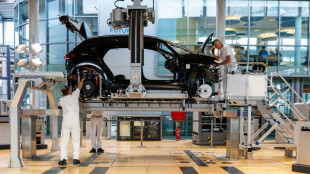 Car crisis takes toll on Germany's young engineers

 Argentina sink 10-man Swiss to set up blockbuster England World Cup semi-final

 West Afghanistan female dress-code crackdown hits businesses

 Bhutan battles 'existential' population crisis with birth drive

 Norway coach says ball hit camera cable for crucial England goal

 Growing list of countries move to ban social media for children

 Schmidt aims to leave Wallabies 'in good order' for incoming Kiss

 Rennie says All Blacks must improve with 'smart' Ireland awaiting

 Eddie Jones says 'pretty obvious' Japan on right track

 Bellingham double as 'lucky' England beat Norway to reach World Cup semi-finals

 NFL Seahawks sold to India-born billionaire Khosla's group

 Argentina beat porous Wales in Nations Championship

 New heat wave blasts US, could break records

 Scotland third best team in world, says Erasmus after Boks win

 Former skipper Knight to retire from England women's duty after Lord's Test

NEW YORK CITY, NY / ACCESS Newswire / May 8, 2026 / For decades, the economics of plastics have been deceptively simple: virgin resin-derived from oil and gas-has been cheaper, more reliable, and easier to scale than recycled alternatives. Recycling, while environmentally desirable, has largely depended on policy support, corporate commitments, or reputational incentives. It has always been about the money.
Rising energy costs, supply chain insecurity, chronic pollution, regulatory pressure, and technological improvements are converging to fracture that picture. These pressures are fundamentally reshaping the cost dynamics of plastic production, marking a structural shift.
The plastics market is now approaching an inflection point where recycled material competes not just on sustainability-but on price.
The Old Economics: Why Virgin Plastic Has Dominated
Virgin plastic has historically benefited from three reinforcing advantages.
First, scale and optimisation. Petrochemical supply chains have been refined over decades, delivering consistent output at industrial scale.
Second, feedstock economics. Oil and natural gas-dense energy provided by nature over millions of years-have provided a low-cost input base. Feedstock alone typically accounts for ~60% of virgin plastic production costs.
Third, system simplicity. Virgin resin offers predictable quality every time, reducing downstream uncertainty.
By contrast, recycled plastic has been constrained by fragmented collection systems, contamination, and inconsistent quality, requiring costly verification, sorting, and reprocessing. As a result, recycled polymers have often traded at a premium-frequently 20-40% higher than virgin equivalents in key markets.
At first glance, this appears counterintuitive: waste material is cheaper, yet the final product is more expensive. The explanation lies not in material cost, but in system inefficiency.
Energy Volatility Changes the Equation
The past few years-and particularly recent periods of geopolitical instability-have demonstrated that energy markets are no longer merely cyclical; they are structurally volatile.
This matters because the cost structures of virgin and recycled plastics respond very differently to energy shocks.
Virgin plastic is fundamentally tied to oil and gas prices. Its cost base can be simplified as:
~60% feedstock (oil/gas)
~15% energy & utilities
~15% processing
~10% margin
Recycled plastic, by contrast, is operational:
~30-40% collection & logistics
~20-30% sorting & cleaning
~20-30% processing
~10-15% compliance & certification
This asymmetry is critical.
A Simple but Powerful Repricing Mechanism
Using current market benchmarks:
Virgin plastic: ~$950-$1,100 per ton
Recycled plastic: ~$1,200-$1,400 per ton
Recycled material today carries roughly a 30% premium.
Now apply three realistic shocks:
1. Oil & Gas Price Shock
If feedstock costs double, ~60% of virgin plastic costs reprice upward mechanically. This alone pushes virgin production costs sharply higher.
2. Recycling Cost Impact
Recycling costs rise only modestly-energy and transport inputs increase, but there is no exposure to fossil feedstock.
3. Regulatory Layer
Add carbon pricing, plastic taxes, and compliance costs on virgin production.
The Result: Cost Inversion
Under these combined pressures:
Virgin plastic: ~$1,840 per ton
Recycled plastic: ~$1,430 per ton
Recycled material becomes ~20-25% cheaper than virgin, a key inflection point.
Regulation Is Reinforcing the Shift
Energy alone does not tell the full story. Regulation is increasingly acting as a second cost driver-one that disproportionately affects virgin plastic.
Virgin plastic generates environmental externalities throughout its lifecycle. As plastic waste and microplastic pollution reach systemic levels, these externalities are being internalised through policy.
Across Europe and Asia, governments are introducing:
Carbon pricing mechanisms
Extended Producer Responsibility (EPR) schemes
Mandatory recycled content requirements
The direction is unambiguous: costs for virgin plastic are structurally rising.
This introduces both cost escalation and market access risk. Companies unable to demonstrate recycled content or lifecycle compliance may face restricted access to key markets or customers.
A Necessary Counterpoint: Recycling Still Faces Real Constraints
Despite these tailwinds, the shift is not frictionless.
Recycling markets remain constrained by:
Quality inconsistency (especially for food-grade or high-performance plastics)
Limited supply of high-quality feedstock
Costly verification and certification processes
These factors explain why recycled plastic still trades at a premium today. They also highlight that the transition will not be instantaneous.
The Missing Piece: Trust, Verification-and Cost Compression
Where the economic case becomes significantly stronger is in addressing the hidden cost of uncertainty.
Today's recycled plastic premium is not purely a production issue. It is, to a large extent, a trust premium.
Buyers pay more because they must:
Verify recycled content
Manage contamination risk
Absorb variability in quality
This is where traceability infrastructure becomes economically decisive.
What Changes with SMX-Style Traceability
New systems-such as molecular tagging and digital product passports-introduce three critical capabilities:
1. Embedded Material Identity
Each plastic batch carries a verifiable marker tied to origin and composition
2. Instant Verification
Handheld or industrial scanners confirm authenticity and quality in real time
3. Lifecycle Data Transparency
A full digital record reduces reliance on fragmented certification systems
The Economic Impact
This has direct financial consequences:
Lower verification costs
Reduced fraud and mislabelling risk
Higher usable yield from recycled streams
Improved pricing confidence for buyers
In effect, traceability compresses the inefficiencies embedded in recycling markets. Without this layer, the recycled premium persists. With it, the premium erodes-and in a rising energy cost environment, flips into a discount.
From Commodity to Asset
As cost parity-and eventually cost advantage-emerges, plastic undergoes a deeper transformation.
Waste plastic becomes:
A valuable feedstock
A traceable, verifiable material stream
A financialised asset class
This enables new market structures:
Verified recycled content credits
Plastic-linked environmental instruments
Circular material contracts with embedded data transparency
In this world, plastics are no longer bought purely on price-they are priced on compliance, traceability, and lifecycle attributes.
The Bottom Line
The case for recycling is no longer confined to sustainability narratives.
Rising energy costs, tightening regulation, and improving technology are collectively shifting the underlying economics of plastic production. Scenario modelling shows that under realistic conditions, recycled plastic can become materially cheaper than virgin alternatives.
Crucially, advances in traceability and verification are accelerating this shift by removing the inefficiencies that have historically inflated recycling costs.
The plastics market is moving from a world where recycled material is a premium niche, to one where it becomes cost-competitive-and potentially dominant. The question is no longer whether this repricing will occur. It is how quickly markets recognise it-and reallocate capital accordingly.
Contact Billy White / [email protected]
SOURCE: SMX (Security Matters) Public Limited
View the original press release on ACCESS Newswire
L.Miller--AMWN