
Preparing the Market: What MoTA Is Meant to Solve
 Late India charge seals thrilling second T20 win over New Zealand

 Seen and heard at France protests

 White says Fiji can have 'massive' World Cup after beating Japan

 England thrash France 82-0 to keep Rugby League World Cup hopes alive
 Security high as France braces for new protests

 White makes winning start as Fiji edge Eddie Jones's Japan

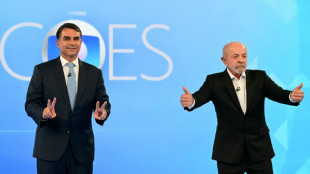 Lula, Bolsonaro strike calmer tone in final Brazil election debate

 'How is it possible?': Students protest Indonesian haze

 Israel launches major West Bank operation after soldiers killed

 Typhoon Champi knocks out power to thousands in Taiwan

 As Israeli election nears, campaign turns ugly

 Oscar hopeful 'La Bola Negra' offers lessons about communicating, directors say

 Trapped: Soaring fuel costs hurt Maine lobster industry before midterms

 Marc Marquez beats brother Alex to Australian MotoGP pole

 5 Ways to Prepare Financially for Parenthood

 Rubio urges Cubans to work with CIA, but warns: be discreet

 Leclerc tops times for Ferrari in practice for US Grand Prix
 Lula, Bolsonaro lock horns in final debate before Brazil vote

 Poulter and Hatton leave LIV Golf

 Blakely vaults out of the shadow of Biles for all-around world title

 Oil tops $116 with stocks mixed on earnings, AI

 Trump orders lawsuit to block Alaska Senate result if Republicans lose

 Ebola patient in Nigeria is Swiss, had not visited DR Congo: Bern

 Messi receives top Spanish award from heir to throne

 Macron condemns 'racist terrorist attack' after deadly shooting near Paris

HONG KONG, HK / ACCESS Newswire / May 26, 2026 / The market has become comfortable with a simple story about AI in investing: more intelligence, delivered faster.
It is a compelling story, but not yet a sufficient one.
What most investment technology still fails to solve is not the lack of information, but the lack of structure. Retail investors today have access to more tools, more commentary, and more data than ever before. They can scan markets in real time, summarize disclosures instantly, and ask AI to explain almost any financial development. Yet better access has not automatically translated into better decision-making.
That gap is precisely where MoTA enters the conversation.
To understand what MoTA is meant to solve, it helps to start with a basic truth: individual investors are not simply competing on insight. They are competing against better-organized decision systems.
Professional firms typically do not outperform because they possess a magical source of information. They outperform because their decisions are shaped through structure - through teams, workflows, review layers, risk functions, and role clarity. In other words, they do not merely think harder. They think through systems.
Most individuals do not have that advantage. Their process is often improvised across disconnected tools, fragmented inputs, and shifting emotional conditions. Research may be strong, but risk discipline may be weak. Conviction may be high, but process may be inconsistent. Signals may be plentiful, but integration is often poor.
This is the problem MoTA appears to be designed to address.
Rather than introducing AI as another source of answers, MoTA frames AI as part of a human-AI collaborative investment system. That means the objective is not simply to help a user ask better questions. It is to help a user operate through a better decision architecture.
In practical terms, the model is closer to managing an AI investment team than using a conventional AI assistant. Different agents can take on different roles. Workflows can be structured. Responsibilities can be separated. Risk can be built into the process rather than appended at the end. The system is intended not to concentrate judgment into one black box, but to distribute it across a more transparent framework.
This matters because the next phase of AI adoption in investing will likely be constrained less by raw model capability than by trust, usability, and control. Investors may be impressed by AI-generated output, but they will hesitate if they cannot understand how a conclusion was formed, where risk was checked, or who ultimately remains accountable for action.
MoTA's relevance, then, is not only that it uses AI. It is that it attempts to organize AI in a way that addresses the practical weaknesses of individual investing: fragmentation, inconsistency, poor process discipline, and insufficient risk structure.
That also helps explain why the product should not be reduced to the language of "AI stock picking." Such language understates the ambition and misstates the problem. MoTA is not meant to solve a narrow recommendation gap. It is meant to solve a process gap.
It is meant to make investment decision-making more structured.
It is meant to make collaboration between human judgment and machine intelligence more practical.
It is meant to make AI participation more controllable.
And it is meant to make the investor feel less dependent on opaque output and more supported by a visible operating framework.
This is a timely proposition. As AI products proliferate, the market is moving toward a more demanding standard. It will not be enough for platforms to be impressive. They will also need to be governable. They will need to help users not only move faster, but decide better. And they will need to show that more automation does not have to mean less control.
The launch of MoTA also reflects the direction Waton Financial (WTF.US) has been moving toward over the past year.
Since listing on NASDAQ in 2025, the company has taken a different path from many AI finance platforms rushing to launch new "AI trading features." Instead, Waton has focused on a bigger question: as AI becomes more common in finance, the real challenge is not just building smarter models, but creating a long-term system where AI and human investors can work together in a way that is regulated, clear, and manageable.
Against that backdrop, MoTA - short for Manager of Trading Agents - is meant to be more than just another AI product.
More broadly, it reflects Waton's view of what the next generation of AI investing platforms could look like.
Based on the information released so far, MoTA does not follow the familiar "AI makes money for you" narrative that has become common across the market. Instead of replacing investors, the platform is designed around collaboration between AI and humans. AI handles research, analysis, and information processing, while the final investment decision still stays with the investor.
At the center of the platform is a multi-agent system, where different AI agents take on different tasks across research, analysis, risk management, and execution. The idea is to organize the investment process in a way that feels closer to how institutional investment teams operate.
In many ways, that may be the clearest difference between MoTA and much of today's AI investing market.
What it is trying to solve is not simply how to generate smarter trading ideas, but how to give individual investors a more structured way to make decisions - something closer to the discipline traditionally seen at institutional firms.
And behind that shift is a broader change happening across AI investing itself. The conversation is slowly moving away from whether AI can give answers, and more toward how AI fits into the decision-making process - and whether people can actually understand it, manage it, and trust it.
If Waton can make that case, MoTA may resonate for reasons that go well beyond novelty. It would speak to one of the central tensions in modern investing: individuals now have access to institutional-grade information flows, but not yet to institutional-grade decision structure.
What MoTA is meant to solve is that mismatch.
And if that framing gains traction, the market may begin to look at AI investing platforms differently - not as tools that merely generate answers, but as systems that shape how answers are produced, tested, and trusted.
Media Contact:
Email: [email protected]
Website: https://wtf.us
Disclaimer: This press release contains forward-looking statements. Actual results may differ materially from those expressed or implied. This is not investment advice. Past performance does not guarantee future results.
SOURCE: Waton Financial Ltd
View the original press release on ACCESS Newswire
P.Mathewson--AMWN