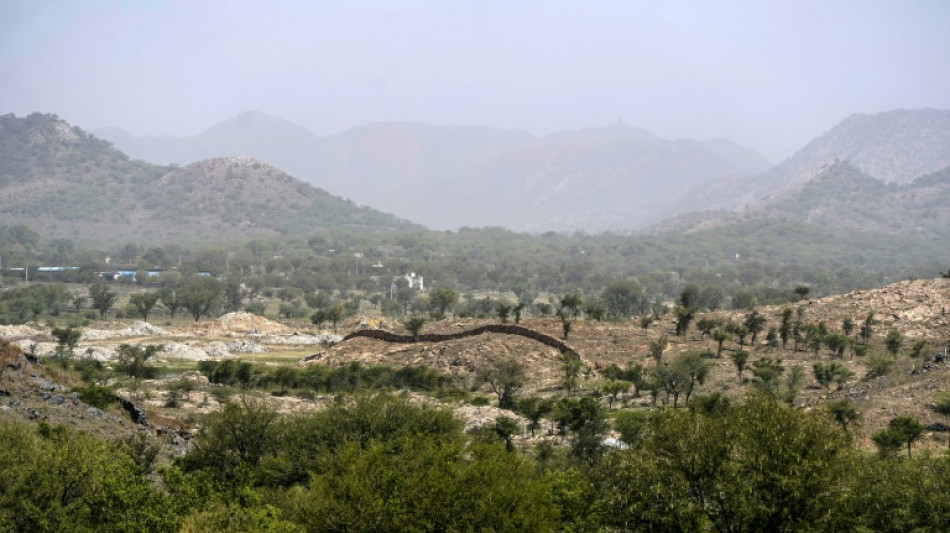
Mining turns India's heat-shield hills to dust / Photo: STR - AFP
 India stirs up its gastronomy with French cooking schools

 Williams, Santos lead Bears over Patriots

 China's first AI film hits cinemas but ticket sales lag

 Barcelona aiming to put Real Madrid out of sight in Clasico

 Taiwan shuts down as Typhoon Champi approaches

 370 books in 20 months: S.African author defends her use of AI
 76ers rally to stun Cavs in James's first home game for Philadelphia

 How are Ukraine strikes, Mideast war driving US fuel prices?

 Colombia's Indigenous Guard up in arms over new president's agenda
 From tech giants to anonymous nonprofits, the biggest donors in US midterms

 Israel's far-right Ben Gvir seeks new ground in election

 Trump slams NBA's LeBron James for national anthem actions
 What Does a Race-Ready Bike Actually Cost?

 Eylsia Nicolas Hits #1 in the United States as Her Multi‑Category Chart Sweep Extends Across Global All‑Genres and International Markets

 Australia face selection headaches after 'shambolic' South Africa defeat

 Around 150,000 rally in Belgrade as Serbia heads to pivotal poll

 Hamilton sets sights on racing in African grand prix

 Bournemouth hammer 10-man Milan, Juventus denied at the death

 Judge orders Trump to give deposition in BBC lawsuit by Dec 11

 'Fake' pollsters hit US midterms

 Global markets retreat as tech mood sours, oil prices jump

 Juventus denied at the death, Sunderland make point in Poland in Europa League

 Tens of thousands rally as Serbia heads to pivotal poll

 Monet's 'Iris' fetches 50 mn euros at Paris auction

 L'Oreal sees double-digit sales growth

Dizzyingly deep pits from large-scale mining scar India's ancient Aravalli mountains, threatening the future of a forested buffer that New Delhi relies on for protection from furnace-hot desert winds.
Residents have long protested that the hills of the 700-kilometre (435-mile) range are being torn apart by unchecked mining, to feed an insatiable hunger for concrete in some of the world's fastest-growing cities.
Late last year, India's top court ordered a ban on new mining licenses in the region, but some fear the move comes too late.
Loss of the hills is boosting already dangerously hot city temperatures, raising the risk of desertification, and worsening health problems, experts warn.
For those living in the Aravallis, which stretch from western Gujarat state through Rajasthan to the heart of New Delhi, the consequences are already existential.
"Mining has destroyed our region," said Salle Kumar, a 34-year-old farmer who lives in a village sandwiched between two massive mines in Rajasthan. "Our rivers are dead, our farms barren."
- ' Violently shakes' -
Lung disease is also common, residents say.
"There is a blanket of dust all day from all the mining and stone crushing," said Subhash Saini, whose brother died from what private doctors said was silicosis, an illness caused by breathing in dust.
A government hospital insisted it was tuberculosis, although silicosis can also make people more susceptible to TB.
Most of the Aravallis lie in Rajasthan, and a quarter of the state's hills have been quarried, a 2018 Supreme Court-constituted committee found.
Mines extract gneiss and granite for construction from the gigantic pits that now ring the village of Chatru Ki Dhani, home to fewer than 200 people.
When AFP visited, explosions rang repeatedly through the burning hot air, as blasts split stone for mining.
At villager Om Prakash Verma's home, the constant activity has left cracks in the walls. Other homes have simply collapsed, residents said.
"The earth violently shakes every time there is a blast, which is all day all night," said Verma, who described quarry workers beating his aunt when she joined protests against the mines.
- 'Alarmist claims' -
India's environment ministry says just 0.19 percent or 277 square kilometres (106 square miles) of the Aravalli landscape is open to mining.
"Contrary to alarmist claims, there is no imminent threat to the Aravallis' ecology," it said in a December statement.
But independent audits suggest a much wider mining footprint.
A 2020 report by India's Comptroller and Auditor General, using satellite imagery and field verification, found around 34 percent of surveyed licensed mines extended beyond their legal boundaries.
A 2025 judicial committee found 2,339 square kilometres of mines in the Rajasthan portion of the Aravallis alone.
The scale of illegal activity means the Supreme Court's December decision to ban new mining licenses is too little, too late, activists say.
"Most existing mining leases are flawed and given without proper verification," said veteran anti-mining campaigher Kailash Meena.
"On top of that, there is widespread illegal extraction -- as audit after audit has confirmed."
- 'Physical barrier' -
The Aravallis' degradation will affect all of northern India, experts say.
The range is a "physical barrier for dust storms and heat waves" from the western Thar desert, said ecologist C.R. Babu.
The desert is already advancing eastwards, threatening the river floodplains of the Ganges, he warned.
"If we don't protect the Aravalli, the northern Gangetic plains -- which is a food basket for the rest of the country -- would become a desert," he said.
Delhi, where temperatures in May hit 45C for several days running, is at particular risk of becoming "a dust bowl with extreme heat load," he said.
Activists like Meena, whose brother died of lung disease two decades ago, say they have repeatedly warned of these consequences.
"For years we have called for a crackdown on mining," he said. "But now that urban dwellers realise their cities are getting hotter, everyone now wants to save the Aravallis."
Parts of the hills, which peak at 1,722 metres (5,813 feet), still house dwindling populations of leopards, sloth bears, hyena and antelope.
They offer a glimpse of what has been lost, with resilient shrubs painting the rolling hills dark green.
In Rajasthan's Bhagwanpura village, 18-year-old Nikita Meena and fellow residents have camped on a hilltop since January to stop miners entering one of the last untouched stretches.
"Come what may, we will not let the miners come here," she said. "All mining brings is destruction."
J.Oliveira--AMWN