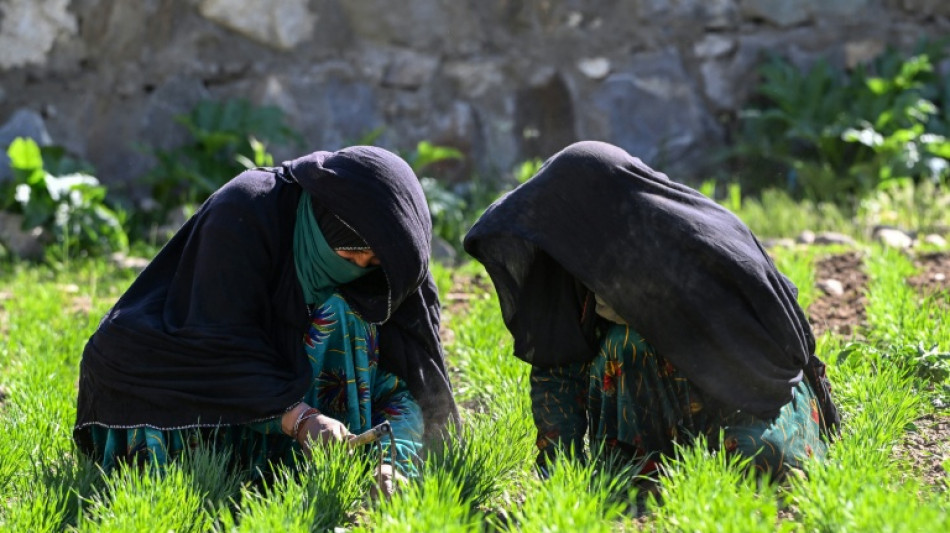
The Afghan women farmers keeping their village alive / Photo: Wakil KOHSAR - AFP
 'Multiple victims' in Oregon elementary school shooting: police

 ChangeNOW Announces NOW AI After Resolving Website Integration Vulnerability

 Argentine demonstration over education cuts ends in clashes

 Argentine protesters, police clash at demo over university funding

 US stocks end higher as AI shares stabilize

 School roof collapse kills 32 children, teacher in Pakistan

 Lyon down Palace in Europa League, Sunderland leave it late

 UniCredit says receives ECB green light for Commerzbank takeover
 New York City pension fund asks Anthropic to delay IPO

 Venezuela's Maduro denies US torture charges as 'false accusations'

 Somalia sets May presidential election despite insecurity
 Chelsea's Caicedo eager to be more of a leader
 Rahm reaches separation deal with LIV in bankruptcy court
 UN chief urges nations to end 'war on nature'

 Newcastle boss Jaissle says Fernandez-Pardo just needs a goal

 Infantino offers apology but 'no answers' at FIFA meeting over World Cup plan
 Don't exclude Turkey from 'Made in Europe' plan: minister to AFP

 French duo Justice to score 'GTA VI': game maker

 El Nino a 'terrifying' threat to coral reefs: UN biodiversity expert
 Barcola must get used to Liverpool highs and lows, says Iraola

 Versus Trade Wins Best ECN/STP Broker APAC 2026, Marking Third UF Awards Recognition

 Three dead as Istanbul sees heaviest rainfall in 80 years

 US producer prices see biggest jump since 2022 in added challenge to Trump
 Swiatek avoids seed exodus to breeze into Wuhan last eight
 PM condemns 'chaos' as violent protests grip Albania

In a remote province of northeastern Afghanistan, women farmers are playing a vital role in their community's survival among the snow-capped mountains.
The fields of Eshtiwi show only the first faint signs of growth in June, with small green sprouts emerging around the village.
Habiba, who spoke to AFP while busy weeding, is proud to have been farming in Nuristan province for decades.
"Since I was eight years old, I've been going to the field with my mother," said the 46-year-old, who only has one name.
"When we harvest wheat, beans, potatoes and corn in the fields in autumn and bring them back home, we feel happy," she added.
In Afghanistan, women are generally allowed to farm despite being banned by the Taliban government from most employment.
Mohammad Yahya Faizi, a 34-year-old agriculture graduate, said he respects the women's work.
"We would not have food anymore in the middle of the winter" without their work, he said.
Eshtiwi in summertime is only reachable by a dirt track and, before AFP's visit, it had been years since international media had reached the village.
Faizi said "tasks have been divided between men and women" for generations in the Parun Valley, where residents speak their own dialect.
"Women are busy with agriculture, planting, watering and cooking at home," said Faizi, a village farmer who volunteers with the Food and Agriculture Organization (FAO) of the United Nations.
Men help with animal-drawn ploughs, handle livestock, and gather firewood for winter, when snow cuts the village off from the outside world for almost six months.
Habiba's day starts at around 4:00 am, when she gets up to pray before preparing breakfast with her daughters on a wood-fired stove.
She makes bread using flour from her wheat, together with red beans from her fields, to eat alongside butter and dried yoghurt made by her husband.
The room, which doubles as a kitchen and bedroom, was decorated with flowers drawn by Habiba's 11-year-old daughter, Nahida, who was practising English that she had learnt at the village school.
While her mother never had the chance to go to school, Nahida's education will soon stop as girls nationwide are banned from education beyond the age of 12.
- 'Unrecognised' -
FAO has declared 2026 the International Year of the Woman Farmer, with the agency highlighting how "unrecognised" their vital role is in supporting food security.
This is particularly true in Afghanistan, where almost a third of the population needs emergency food aid according to the UN.
Bibi Jan, a 70-year-old who grows beans and potatoes, said farming can be gruelling.
"We have to work hard, our hands peel... but there are children to feed," she said.
Habiba dreams of having a tractor, but it is too expensive; there is only one in the village that a family rents out to those who can afford it.
"I'm not that strong; my back and my legs hurt," she said.
Najia, who requested her surname not be used for privacy reasons, agreed local farmers need more tools as well as opportunities to trade.
"Farming is a great profession; it's not just for men," said the 28-year-old, who went to university in Pakistan.
The farmers often have surplus crops, she said, but "there is no structured market to sell our produce."
Being in such a remote area makes it impossible to sell direct to customers, and there are only limited options to meet traders who pass through.
"I sell my potatoes for 70 afghanis ($1.10) for seven kilos (15 pounds), but I would need 150 afghanis" to earn a decent income, Najia said.
- 'Help each other' -
Storage units have been financed by the UN, to allow harvests to be kept and sold when the market improves, and some of the women have received better seeds.
FAO has also introduced agroforestry -- the combination of trees and crops on the same plot -- to diversify their income.
Faizi said that the village, which once produced only apples and walnuts, now has cherry, pear, and peach trees, among others.
But climate change is a big concern, with less predictable snow and rain, or bringing floods that destroy the crops.
The UN Development Programme has found that Afghanistan is among a group of countries that "have contributed the least to global warming yet bear its heaviest costs".
For Najia, the weather was a further challenge: "We can't predict it; it just hits us."
But despite the difficulties, she said women love working outdoors together.
"We can help each other," she said, while also providing the village with nutritious food.
"What we grow with our own hands is very healthy."
Th.Berger--AMWN