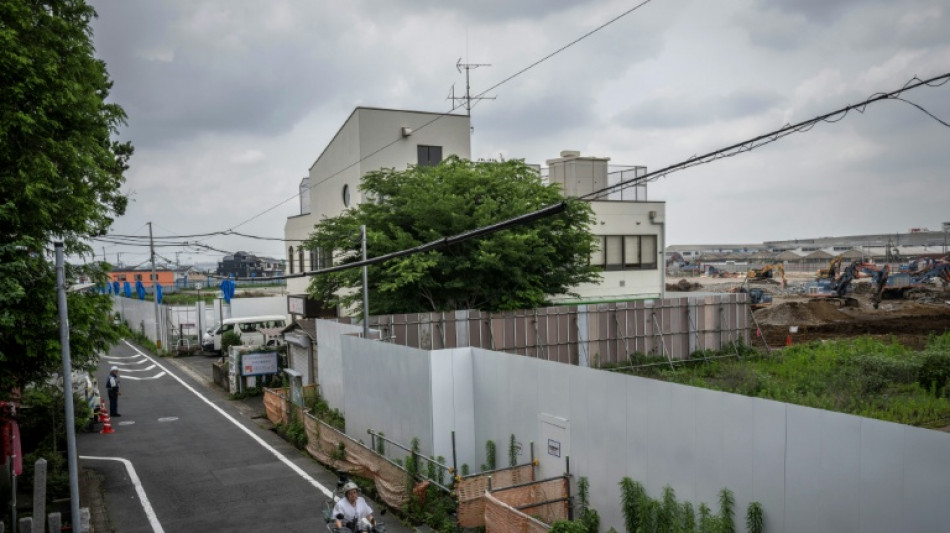
Opposition to data centres grows in cramped urban Japan / Photo: Yuichi YAMAZAKI - AFP
 Zverev churns out win in Shanghai Masters opener

 Hurricane Isaias strengthens en route to US Gulf Coast

 US activists deploy poll volunteers over Trump intimidation fears

 Saint Laurent designer Vaccarello leaves after glittering decade
 'Tough to stay here': Nepal flood survivors wait for homes

 Malaysia closes schools in capital, parts of country due to haze

 Buccaneers stun Cowboys for first win of NFL season
 Activists hope trial will stop 'forever chemicals' at Italy plant

 Guardians rally for 9-5 victory over White Sox to stay alive in MLB playoffs
 Asian stocks mixed amid AI concerns, oil dips after surge

 Wallabies expect fast-paced All Blacks in Bledisloe opener

 Tech scammer Elizabeth Holmes focus of documentary by absurdist Nathan Fielder

 Climate hopes shift from politics to the courts
 Will Nobel Peace Prize pick make waves at the White House?
 Trump rules out new Iran attack before US midterm elections

 Far-right influencer shows Israel's coarse political turn

 Seals and sea lions get hearing tested at Australia zoo

 Mourinho's Real Madrid playing catch-up in Clasico countdown

 Joy as USS Lincoln back home after troubled Gulf deployment

 InterContinental Hotels Group PLC Announces Transaction in Own Shares - October 09

 Trump administration to launch new vaccine research center

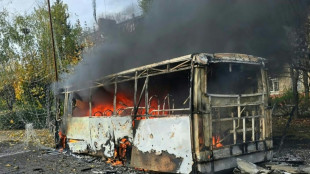 Russian strikes kill 30 in Ukraine frontline city, talks set in US

 US military to livestream firing squad execution of Fort Hood shooter

 Aces star Wilson wins record-extending fifth WNBA MVP

 Undefeated 49ers seek Seahawks revenge

The more Yoriko Kitagawa learns of a massive data centre to be built near her home in Hino on the outskirts of Tokyo, the more she worries.
"This is a terrible plan," the 94-year-old told AFP.
The explosion in resource-hungry data centres -- housing the hardware "brains" of artificial intelligence -- is fuelling unease worldwide, with New York State and Australia the latest jurisdictions to announce new rules.
Opponents of data centres in the United States have called for a "national day of protest" on Saturday to "protect our hometowns, our wallets, and our way of life".
Japan, with some of the most densely populated cities among advanced economies -- 80 percent of the country is mountains -- has a particular problem: a shortage of suitable urban space to build the facilities.
One centre is even planned next to the famous Tokyo Tower.
In Hino, the height of two of the three planned buildings has been cut by a fifth to 63.5 metres (208 feet), but they still will tower over nearby houses, blocking the sun for some.
"As someone who lives next to the site, I'm most worried about a fire that could be triggered by the massive amount of batteries," said 69-year-old campaigner Yasuo Yamazaki.
"Heat from the data centre is also worrisome, as well as noise," he told AFP.
He also frets about a potential explosion due to a stockpile of fuel on site for a backup generator.
Developer Mitsui Fudosan plans a "green buffer zone" of up to 78 metres with trees and a stream, reducing the noise, the heat and the "oppressive feeling", said project manager Toshitsugu Jouzuka.
"One approach is to set the building back from the street and... to arrange greenery so that, at eye level, its presence doesn't feel so overwhelming," Jouzuka told AFP.
- AI-friendly -
Trillions of dollars are being spent on data centres to train and run AI models and provide cloud storage for humanity's zettabytes -- a unit equivalent to a trillion gigabytes -- of digital information.
Japan has big plans in the field, including for 10 million AI robots operating by 2040, aiming to become "the most AI-friendly country in the world".
It wants to develop its own sovereign AI models and infrastructure to avoid over-reliance on the United States and China, the sector's runaway leaders.
Partly to meet a projected increase in power demand from AI, Japan is moving to revive its nuclear power sector, 15 years after the Fukushima disaster.
But despite being a large and politically stable economy with good telecoms infrastructure, Japan has "important constraints", said Trung Ghi, energy and utilities consultant at Arthur D. Little.
"Suitable large-scale land near demand centres is limited, particularly because Japan is mountainous and major demand is concentrated around dense urban areas," Ghi told AFP.
Having data centres near end-users is important -- not least for the ultra-speed of response needed for financial trading, streaming or gaming.
According to real estate company JLL, around 90 percent of Japan's data centres are concentrated in the greater Tokyo and greater Osaka areas.
Electricity is key though, and over time the "winning locations" may not be closest to cities but where there is "reliable, affordable and increasingly low-carbon power at speed", said Ghi.
"Power, grid, cooling, land-use, fibre, regulation and community engagement need to be planned together," he said.
- 'Feeling of oppression' -
Elsewhere, Tokyo commuter town Inzai already has at least 10 data centres including one used by Google, but residents have launched legal action against a proposed new facility.
The lawsuit says that locals' "peaceful daily existence... will be destroyed by violations of their right to sunlight, the ruin of the landscape, a feeling of oppression, noise, vibrations, hot air, traffic hazards, and large-scale construction work".
Contacted by AFP, the defendant Japan ERI, which granted the certificate for the construction plan, declined to comment.
Critics say Japan also differs from many other countries by having out-of-date building regulations that can classify data centres as offices and not industrial facilities.
Japanese law "is not catching up with the situation", said Satoshi Oikawa, a lawyer for Inzai's residents.
Ch.Kahalev--AMWN