
ASMFC Advances Menhaden Addendum for Public Comment Despite No Clear Definition of the Problem It Seeks to Solve
 'Act before it's too late': Tokyo residents fight for more trees
 'Disappointing' as South Korea flag mishap sees Games end on sour note

 Pre-COP host Tuvalu at frontline of climate change

 Hungary's dwindling paprika producers battle to save signature spice

 Cornell president vows review in wake of alleged student gang rape

 Latvian partial election results suggest pro-European choice

 In Egypt's Sinai, Gazan builds school for children displaced by war

 Trump tariffs a mixed bag for US auto industry

 Yemen government forces say struck Houthi targets

 Music links past, present for Pedro Pascal's cellist in 'Behemoth!'

 ALEX BODI ȘI AMBASADORUL REPUBLICII SUDANUL DE SUD, GUM DOMINIC MATIOK, DISCUTĂ LA BERLIN DESPRE POSIBILITATEA ÎNFIINȚĂRII UNUI CONSULAT ONORIFIC LA BUCUREȘTI

 Dodgers step up World Series three-peat bid with 5-3 win over Braves

 Spain break down Czechs as England outclass Croatia in Nations League

 Yamal on target as Spain hold off Czech Republic

 Latvian exit polls suggest pro-European choice

 Lula, Bolsonaro wrap up campaigns ahead of knife-edge election

 Tuchel hails 'complete' England after Croatia demolition

 Fury to invite Trump to lead ring walk before Joshua showdown

 Fashion industry in 'precarious moment', says Vivienne Westwood supremo

 Seventh heaven for England in Nations League rout of Croatia

 Storms, flooding cause chaos on Greek holiday island of Crete

 #IAmJaneDoe: online support campaign in US university rape case

 Brazil shine on Selecao's first visit to India

 Zverev sets up Djokovic quarter-final at China Open, Rybakina out

 Happier at home, Bordeaux hammer Lyon in Top 14

Board Sends Flawed Chesapeake Bay Addendum to Public Comment Despite Admitting That Essential Scientific Information Does Not Exist
ARLINGTON, VA / ACCESS Newswire / August 5, 2026 / The Atlantic States Marine Fisheries Commission's Atlantic Menhaden Management Board today voted to release Draft Addendum II to Amendment 3 of the Atlantic Menhaden Interstate Fishery Management Plan for public comment, despite the document's failure to establish a demonstrated biological problem necessitating the new restrictions it proposes.
The draft addendum provides several options that would reduce the existing 51,000 metric ton Chesapeake Bay Reduction Fishery Cap, automatically linking the cap to future changes in the coastwide Total Allowable Catch (TAC), and requiring Virginia to divide the Bay Cap into seasonal quota periods intended to redistribute harvest throughout the fishing season. Ocean Harvesters opposed releasing the document for public comment because it asks the public to consider specific management restrictions before establishing that an underlying biological problem exists.
A Statement of the Problem Should Include a Problem
The most obvious flaw in Draft Addendum II remains unchanged following today's vote.
The document's own "Statement of the Problem" begins with what "may" be happening, proceeds through what is "possible" and what "could" occur, and ultimately acknowledges that "there are currently not sufficient scientific data available" to comprehensively characterize the abundance and distribution of menhaden in the Chesapeake Bay or the influence of fishing pressure. It nevertheless proposes new restrictions intended to address a problem it never defines.
The addendum assembles observations, uncertainties and hypotheticals but never demonstrates that Chesapeake Bay menhaden availability has declined because of the reduction fishery or that the proposed measures would produce any biological benefit.
Public Comment Does Not Cure the Scientific Defect
Sending the addendum to public comment does not resolve the absence of a defined biological problem.
The public is now being asked to consider specific restrictions-including further reductions to the Bay Cap, automatic adjustments tied to the coastwide TAC and seasonal quota periods-without a scientifically established Bay harvest threshold, without evidence that the current cap has failed, and without confidence that any particular option would improve ecological conditions.
Virginia's ASMFC Commissioner Adele McClure raised issues with the timing of the public comment at the meeting.
"Without that complete picture, without the proper Bay-specific data, I feel like we are putting the cart before the horse instead of availing ourselves to the upcoming studies and data that could finally guide us," she said. "I believe that the public would be better served as a whole if we had the scientific study results to better inform meaningful comments from the public and input from all parties, especially those closest to the issue."
Specifically, she called on the Commission to wait until upcoming scientific studies are complete.
"We finally got that funded in Virginia at $4.5 million. We have three studies, and this could guide us in the context of good science, which is good for both the public, for union workers, and the fisheries," she said.
Public comment can inform policy choices, but it cannot substitute for the scientific evidence needed to establish the problem those choices are supposed to solve.
The Commission's Own Analysis is Inconclusive
The Menhaden Technical Committee (TC)'s review did not establish a consistent relationship between the timing of reduction fishing and Maryland pound-net catches.
For 2023, the TC's analysis found that Maryland pound-net catch rates during the second half of the year were generally equal to or greater than the recent average, "suggesting little influence of the reduction fishery on pound net catches." For 2024, their analysis identified a different pattern but could not establish cause and effect and acknowledged that any relationship would depend upon fish movements and fishery dynamics at a finer spatial scale than the available analysis could evaluate.
That inconclusive record does not establish that seasonal quotas are necessary or that they would produce a measurable biological benefit.
The absence of supporting evidence is not new. In 2018, then-ASMFC Chair James J. Gilmore Jr. wrote that there was "no evidence in Amendment 3" showing that lowering the Bay Cap was necessary to protect the Chesapeake Bay as a nursery area for menhaden or other species. He added that Commission leadership agreed the amendment did not provide sufficient evidence to support those claims.
The Research Needed to Answer These Questions is Already Underway
The Commission is moving forward just as significant public and industry-supported research is beginning.
The Science Center for Marine Fisheries has funded a collaborative research roadmap involving scientists from the Virginia Institute of Marine Science, the University of Maryland Center for Environmental Science and NOAA. The project is intended to identify the data, methods, costs and timetable needed to establish a scientifically defensible and ecologically meaningful Bay Cap. It is examining how future research could measure Bay-specific menhaden abundance, fishing mortality, movement between the Chesapeake Bay and coastal waters and availability to predators.
Virginia has also committed $2 million over two years to a VIMS-led Atlantic menhaden research program. The authorized work includes menhaden abundance and movement, predator consumption, timing and location of commercial fishing effort and localized depletion questions. The state budget expressly permits the VIMS work to build upon the SCEMFIS roadmap. Recent federal appropriations have also approved $2.5 million for NOAA to conduct a new menhaden survey in the Chesapeake Bay.
These complementary research efforts were created to produce the Bay-specific scientific information the Commission acknowledges is presently lacking. Yet the Board has advanced the addendum before either effort has produced its findings.
Public Comment Should Be Informed by Science
Today's vote begins the public comment process; it does not resolve the scientific questions at the center of the proposal.
Ocean Harvesters encourages stakeholders to carefully review the addendum and consider whether it establishes a demonstrated biological problem, whether the proposed restrictions are supported by the available scientific evidence and whether additional management measures should be adopted before the ongoing research has been completed.
The company will participate fully in the public comment process and will continue to advocate for management decisions grounded in sound science, transparency and a clearly demonstrated biological need.
About Ocean Harvesters
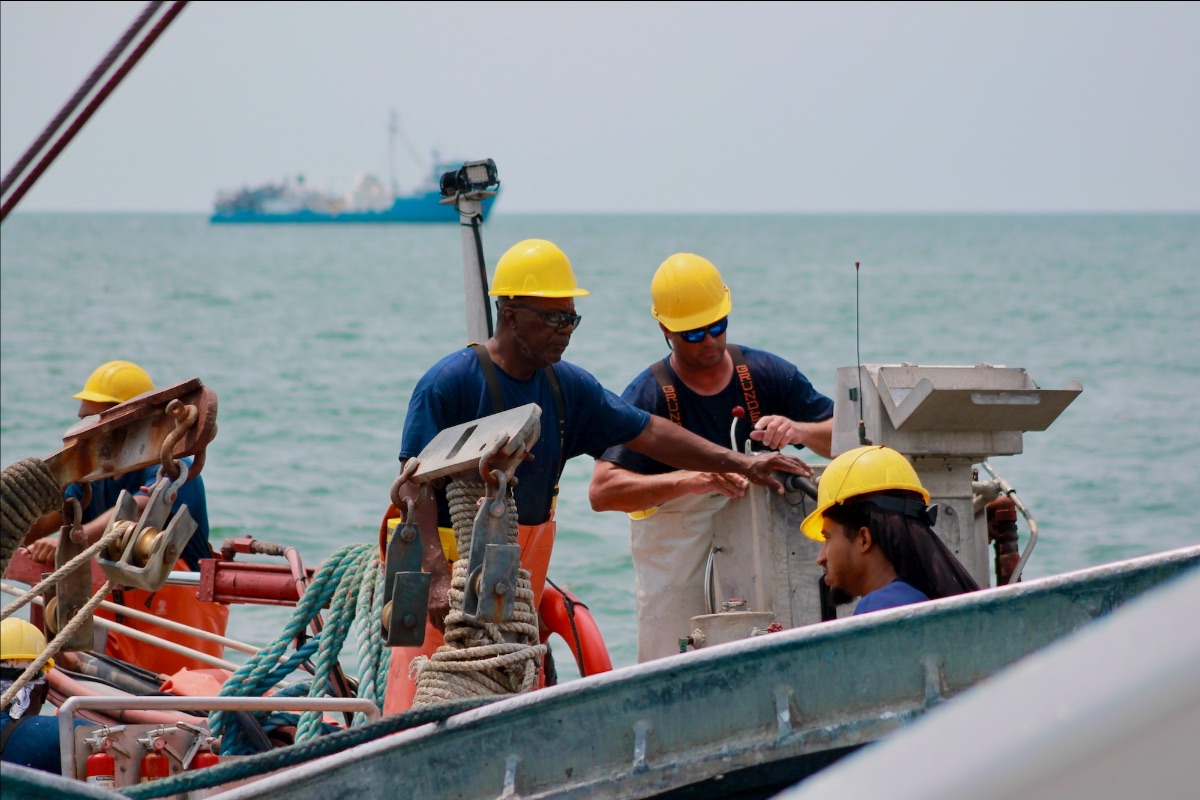
Ocean Harvesters owns and operates a fleet of more than 30 fishing vessels in the Atlantic Ocean and Gulf of America. The company's purse-seine fishing operation is exclusively engaged in the harvest of menhaden, a small, nutrient-dense fish used to produce fish meal, fish oil, and fish solubles. Both its Atlantic and Gulf Menhaden fisheries are certified sustainable by the Marine Stewardship Council. Committed to responsible fishing operations, Ocean Harvesters is proud to be heir to a fishing legacy that extends nearly 150 years.
Press Contact
Stove Boat Communications
(202) 595-1212
[email protected]
SOURCE: Ocean Harvesters
View the original press release on ACCESS Newswire
M.Thompson--AMWN